
Nuttall's woodpecker
Nuttall's woodpecker is a small to medium-sized bird found in the oak woodlands of California and northwestern Baja California, Mexico. It is characterized by its black and white striped plumage, a red crown in adult males, and a primarily white undercarriage. These woodpeckers primarily feed on insect larvae and are known for their specialized adaptations to absorb shock while hammering into trees.
Key Facts
- ›Found in oak woodlands of California and northwestern Baja California.
- ›Adult males have a distinctive red crown, absent in females but present in juveniles of both sexes.
- ›Primarily feeds on insect larvae, with beetles forming a significant portion of its diet.
- ›Possesses specialized skull and hyoid bone structures to withstand high-impact hammering.
- ›Nests are excavated annually in the cavities of dead trees.
- ›Non-migratory species with a restricted geographic range.

Nuttall's Woodpecker
California, Baja California, Mexico
Oak Woodlands, Riparian Sites, Chaparral
Striped black and white wings and tail, White undercarriage with some black spots, Black forehead with white streaks, Unbarred black region at the top of the back, Red crown
Insect Larvae, Beetles, Ants, Sap, Berry Seeds
- Tapping and probing into tree crevices
- Peeling back tree layers to expose ant colonies
- Drilling into tree trunks and branches
Cavities of Dead Trees
Call Note, Double Call, Rattle Call, Kweek Call, Drumming
About Nuttall's woodpecker
Nuttall's woodpecker, scientifically known as Dryobates nuttallii, is a distinctive avian species inhabiting the oak woodlands of California and extending into northwestern Baja California, Mexico. Named in honor of naturalist Thomas Nuttall, this bird is recognized by its striking black and white striped wings and tail, a predominantly white undercarriage, and unique plumage patterns on its head and back. Adult males are further distinguished by a vibrant red crown, a feature absent in females but present in juveniles of both sexes.
Habitat and Distribution
This species is non-migratory and prefers arid to mesic woodlands, with a strong affinity for oak woodlands. In areas where oaks are less abundant, they adapt to riparian sites and chaparral. Nuttall's woodpeckers can be found from sea level up to higher elevations, though their year-round presence is most reliably documented within Northern California, south of the Oregon border, down to Ensenada in Baja California, typically west of desert regions.
Diet and Foraging
The diet of Nuttall's woodpecker consists primarily of insect larvae, particularly those of wood borers, click beetles, and ants, which they extract by tapping and probing into tree crevices. Adult and larval insects, especially beetles, constitute about 80% of their food intake. They also supplement their diet with tree sap, notably from oaks, and consume various berry seeds. Their robust beaks are used to drill into trees, and they possess specialized skull and hyoid bone structures that absorb the significant shock of their hammering, enabling them to strike at speeds of 21 to 25 kilometers per hour.
Reproduction and Behavior
Pair bonding typically occurs from late January to March, with egg-laying predominantly in April and May. Nuttall's woodpeckers are socially monogamous and exhibit bi-parental care. Nests are excavated annually by males in the cavities of dead trees. Both sexes engage in drumming, producing relatively long rolls. Their vocalizations include a call note for mate communication, a double call serving as an alarm, a rattle call for territory establishment, and a kweek call used by females prior to copulation. Clutch sizes range from three to six eggs, with incubation shared by both parents and fledglings cared for by parents for approximately 29 days post-hatch.
Source: Wikipedia ↗
Frequently Asked Questions
What is the scientific name for Nuttall's woodpecker?
The scientific name for Nuttall's woodpecker is Dryobates nuttallii.
Where can Nuttall's woodpecker be found?
Nuttall's woodpecker is found in the oak woodlands of California, extending south into northwestern Baja California, Mexico. Their range is generally west of the deserts and the Sierra Nevada divide.
How can I distinguish Nuttall's woodpecker from similar species?
Nuttall's woodpecker can be distinguished from Down and Hairy Woodpeckers by the horizontal stripes on its back. It differs from the Ladder-backed woodpecker by having a solid black area on its upper back, whereas the Ladder-backed has barring that extends to the nape.
What do Nuttall's woodpeckers eat?
Nuttall's woodpeckers primarily feed on insect larvae, such as those of wood borers, click beetles, and ants. They also consume sap from trees and a variety of berry seeds.
Do Nuttall's woodpeckers migrate?
No, Nuttall's woodpeckers are a non-migratory species. They maintain a year-round presence within their defined geographic range.
What are the nesting habits of Nuttall's woodpecker?
Nuttall's woodpeckers excavate new nests annually in the cavities of dead trees, such as willow, oak, and alder. These nesting cavities can be located at various heights above the ground.
Related Woodpecker species
Buff-rumped woodpecker
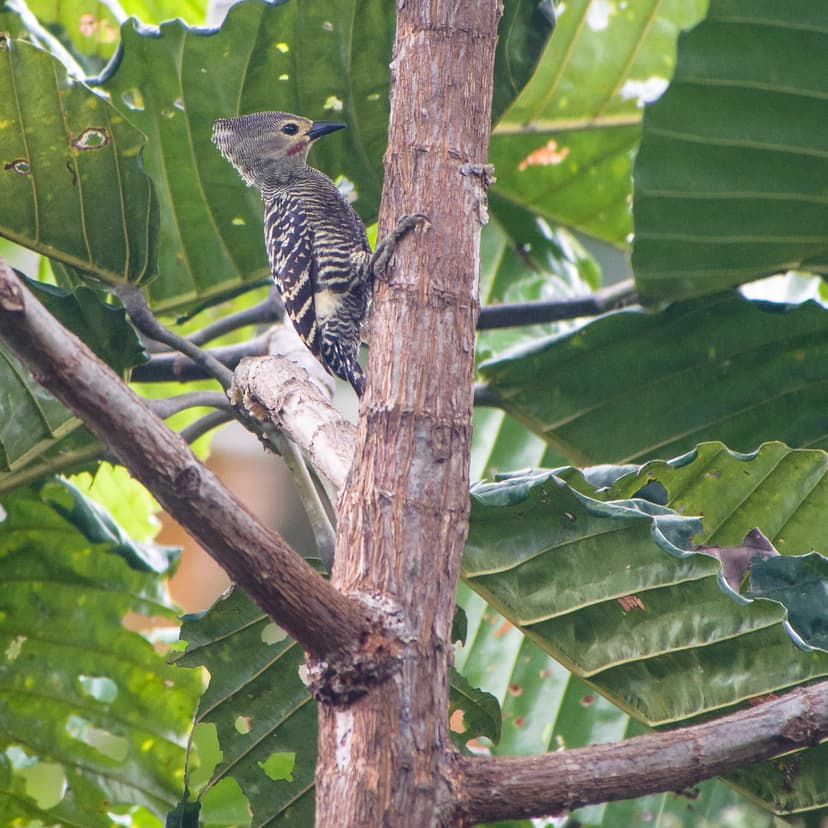
The buff-rumped woodpecker is a bird species found in Southeast Asia, native to areas including southern Myanmar, Thailand, Malaya, Sumatra, and Borneo. It is characterized by its small nuchal crest, black-and-white wings, fine barring on its belly, and a prominent whitish-buff rump patch. Males are distinguished by a red "mustache" stripe.

Downy woodpecker
The downy woodpecker is the smallest woodpecker species in North America, distinguished by its black and white plumage and a short bill. It is commonly found in forested areas across the United States and Canada, avoiding only the driest deserts and northern tundra. These birds nest in tree cavities and primarily feed on insects, supplementing their diet with seeds and berries.

Middle spotted woodpecker
The Middle spotted woodpecker is a European bird belonging to the genus Dendrocoptes, characterized by its red crown, pink vent, and lack of a moustachial stripe. It primarily inhabits deciduous forests across Europe and parts of West Asia, preferring areas with old trees and varied woodland structures. This species feeds mainly on insects and their larvae, foraging on branches and twigs, and is known for its distinctive song.