
Olive-backed woodpecker
The olive-backed woodpecker is a species of bird found across Southeast Asia, inhabiting tropical moist lowland, mangrove, and montane forests. It is characterized by its yellow-green upperparts, gray-olive underparts, and distinctive black and white stripes on the sides of its head. Males possess a prominent red crest, while females have a smaller black crest.
Key Facts
- ›Found in Southeast Asia, including Myanmar, Thailand, Malaysia, Singapore, Brunei, and Indonesia.
- ›Inhabits subtropical or tropical moist lowland, mangrove, and montane forests.
- ›Males have a large red crest, while females have a smaller black crest.
- ›Threatened by illegal deforestation, primarily for palm oil plantations.
- ›Classified as near Threatened by the IUCN.

Southeast Asia, Myanmar, Thailand, Malaysia, Singapore, Brunei, Indonesia
Yellow-Green, Gray-Olive, Black, White, Red
- Yellow-green upperparts
- Gray-olive underparts
- Two black and white stripes on the side of the head
- Large red crest
- Smaller black crest
About Olive-backed woodpecker
The olive-backed woodpecker, scientifically known as Gecinulus rafflesii, is a bird species residing in the diverse ecosystems of Southeast Asia. Its natural range spans across countries including Myanmar, Thailand, Malaysia, Singapore, Brunei, and the Indonesian islands of Borneo and Sumatra. This species is primarily found in subtropical and tropical moist lowland forests, as well as mangrove and montane forest environments, showing a preference for undisturbed areas and avoiding clearings and secondary growth.
Description and Identification
The olive-backed woodpecker is distinguished by its plumage, which features yellow-green upperparts and gray-olive underparts. A notable characteristic is the presence of two black and white stripes adorning the sides of its head. Sexual dimorphism is evident in the crest; males possess a prominent, large red crest, while females are identified by a smaller, black crest. These features aid in distinguishing individuals within their forest habitat.
Conservation Concerns
The olive-backed woodpecker faces significant threats, primarily due to widespread illegal deforestation. The expansion of palm oil plantations is a major driver of habitat loss, with primary forests being targeted for clearing, even within officially protected areas. While the precise total population of this species remains unknown, it is considered uncommon. Consequently, the International Union for Conservation of Nature (IUCN) has classified the olive-backed woodpecker as Near Threatened, highlighting the urgent need for conservation efforts to protect its remaining forest habitats.
Source: Wikipedia ↗
Frequently Asked Questions
What is the scientific name of the olive-backed woodpecker?
The scientific name of the olive-backed woodpecker is Gecinulus rafflesii. It was originally described by Nicholas Aylward Vigors in 1830 and named in honor of Stamford Raffles.
Where is the olive-backed woodpecker found?
This species has a wide distribution in Southeast Asia, occurring in countries like Myanmar, Thailand, Malaysia, Singapore, Brunei, and on the Indonesian islands of Borneo and Sumatra.
What kind of habitat does the olive-backed woodpecker prefer?
The olive-backed woodpecker prefers subtropical or tropical moist lowland, mangrove, and montane forests. It tends to avoid clearings and secondary forest areas.
What are the main threats to the olive-backed woodpecker?
The primary threat to the olive-backed woodpecker is illegal deforestation. This is largely driven by the development of palm oil plantations, which often target primary forests, even within protected areas.
What is the conservation status of the olive-backed woodpecker?
The olive-backed woodpecker is currently classified as Near Threatened by the International Union for Conservation of Nature (IUCN). Its total population size is not precisely known but is believed to be uncommon.
Related Woodpecker species

Stripe-breasted woodpecker
The stripe-breasted woodpecker is a bird species found in Southeast Asia, inhabiting subtropical and tropical moist forests. It is characterized by its black and white barred plumage, with males and females differing in crown coloration. This species primarily feeds on insects and nests in excavated cavities within rotten tree stumps or trees.
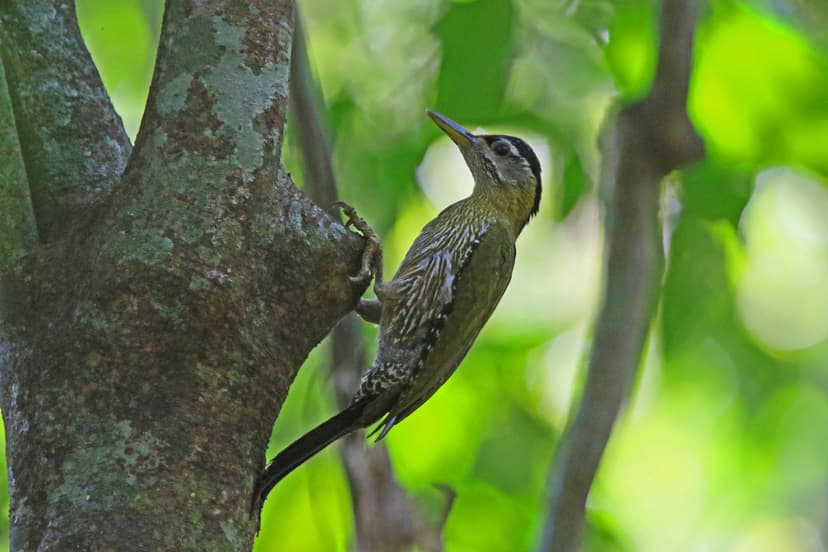
Streak-breasted woodpecker
The streak-breasted woodpecker (Picus viridanus) is a bird species found in southeastern Bangladesh and the central Malay Peninsula. It inhabits subtropical or tropical moist lowland forests and mangrove forests.
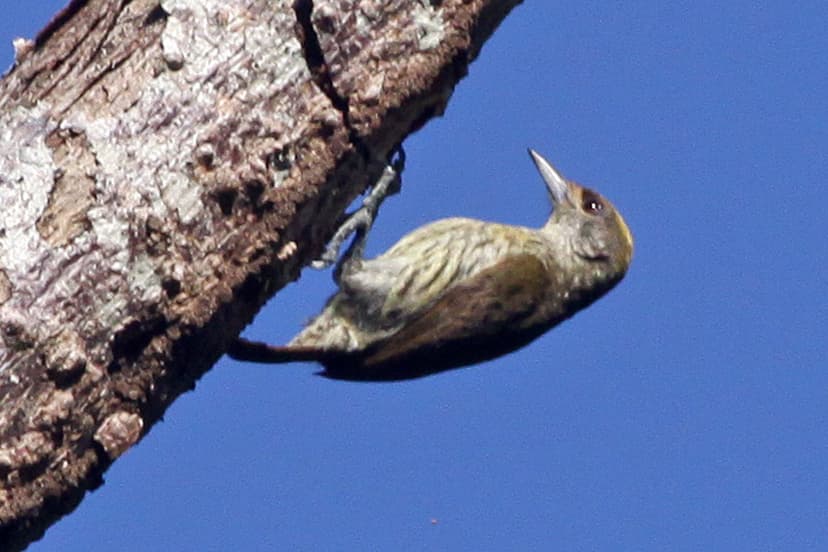
Antillean piculet
The Antillean piculet is a small woodpecker endemic to the Caribbean island of Hispaniola, shared by the Dominican Republic and Haiti. It is notable for being the sole member of its genus, Nesoctites, and is evolutionarily distinct from other piculets. This species inhabits a variety of forest types and scrublands, preferring dense undergrowth and foraging primarily for insects.