
Stripe-breasted woodpecker
The stripe-breasted woodpecker is a bird species found in Southeast Asia, inhabiting subtropical and tropical moist forests. It is characterized by its black and white barred plumage, with males and females differing in crown coloration. This species primarily feeds on insects and nests in excavated cavities within rotten tree stumps or trees.
Key Facts
- ›Adult length ranges from 21 to 22 cm.
- ›Plumage is black with heavy white barring on upper parts; males have red crowns, females have black.
- ›Found in Southeast Asia, from northeastern India to Vietnam and southwestern China.
- ›Inhabits montane evergreen forests, including pine and oak forests, and edges of deciduous forests.
- ›Feeds on insects, particularly ants and beetle larvae, often foraging in pairs or small family groups.
- ›Nests are excavated in rotten stumps or trees, typically with a clutch size of four or five eggs.

Stripe-Breasted Woodpecker
Southeast Asia, Northeastern India, Vietnam, Southwestern China
Subtropical Moist Lowland Forest, Tropical Moist Lowland Forest, Subtropical Moist Montane Forest, Montane Evergreen Forest, Pine Forest, Oak Forest, Deciduous Forest Edges, Open Areas With Scattered Trees
Black and White Barred Upper Parts, Red Crown, Black Crown, Whitish Face With Black Moustache, Black Stripe On Breast Edge, Red Under Tail Coverts
Insects, Ants, Beetle Larvae
Forages in mid to upper canopy, Often forages in pairs or small family groups
Excavated In Rotten Stumps, Excavated In Rotten Trees
About Stripe-breasted woodpecker
The stripe-breasted woodpecker (Dendrocopos atratus) is a species of bird belonging to the woodpecker family, Picidae. This species is distributed across Southeast Asia, inhabiting a variety of subtropical and tropical moist forest environments. It is known for its distinctive plumage, which features heavy black and white barring on its upper parts, with males displaying a red crown and females a black one.
Habitat and Distribution
This woodpecker is native to southeastern Asia, with its range extending from northeastern India through to Vietnam and the Yunnan province of southwestern China. It is typically found in montane evergreen forests, particularly pine and oak woodlands, but also occupies the edges of deciduous forests and more open areas containing scattered trees. Its altitudinal preference is generally above 2,000 meters (6,600 feet), though it can be found as low as 800 meters.
Description and Behavior
Adult stripe-breasted woodpeckers measure between 21 and 22 centimeters in length. Their facial features include a whitish face accented by a prominent black moustache that merges with a stripe along the breast's edge. The throat, breast, and belly are a greyish-yellow or greyish-buff, marked with bold black streaks, and the under tail coverts are a striking red. The iris is chestnut, and the beak is grey, sharp, and pointed, supported by bluish-grey legs and feet. Juveniles exhibit greyer underparts and pink or orange under tail coverts, with young males having a duller red crown.
The stripe-breasted woodpecker forages in the mid to upper canopy, primarily feeding on insects such as ants and beetle larvae. They are often observed foraging in pairs or small family groups. Breeding activities commence from February in many parts of their range, extending through May in regions like India and Myanmar. Nests are constructed by excavating cavities into rotten tree stumps or standing trees, usually positioned well above the ground. A typical clutch consists of four or five eggs.
Source: Wikipedia ↗
Frequently Asked Questions
What is the scientific name of the stripe-breasted woodpecker?
The scientific name of the stripe-breasted woodpecker is Dendrocopos atratus. It was initially described by Edward Blyth in 1849 as Dryobates atratus before being transferred to the genus Dendrocopos.
What does the stripe-breasted woodpecker eat?
The stripe-breasted woodpecker primarily feeds on insects. Its diet includes ants and beetle larvae, which it typically finds in the mid to upper parts of the forest canopy.
Where is the stripe-breasted woodpecker found?
This species is native to Southeast Asia, with its range extending from northeastern India eastward to Vietnam and the Yunnan province of southwestern China.
What kind of habitat does the stripe-breasted woodpecker prefer?
The stripe-breasted woodpecker mainly resides in montane evergreen forests, particularly those dominated by pine and oak. It can also be found in the edges of deciduous forests and more open areas with scattered trees.
How large is the stripe-breasted woodpecker?
Adult stripe-breasted woodpeckers typically measure between 21 and 22 centimeters (8.3 to 8.7 inches) in length.
What are the distinctive physical features of the stripe-breasted woodpecker?
Distinctive features include black and white barring on its upper parts, a red crown in males and black in females, and a whitish face with a black moustache that connects to a stripe on the breast. The under tail coverts are red.
When does the stripe-breasted woodpecker breed?
Breeding typically begins from February onwards in many areas of its range. In India, the breeding season is from March to May, and in Myanmar, it occurs from April to May.
Related Woodpecker species

Olive-backed woodpecker
The olive-backed woodpecker is a species of bird found across Southeast Asia, inhabiting tropical moist lowland, mangrove, and montane forests. It is characterized by its yellow-green upperparts, gray-olive underparts, and distinctive black and white stripes on the sides of its head. Males possess a prominent red crest, while females have a smaller black crest.

Guatemalan flicker
The Guatemalan flicker is a species of woodpecker found in Middle America, ranging from southern Mexico to Nicaragua. It is characterized by its distinct facial markings, barred back, and a white rump. This species primarily forages on the ground for insects and also consumes fruits and seeds, nesting in excavated cavities in dead trees.
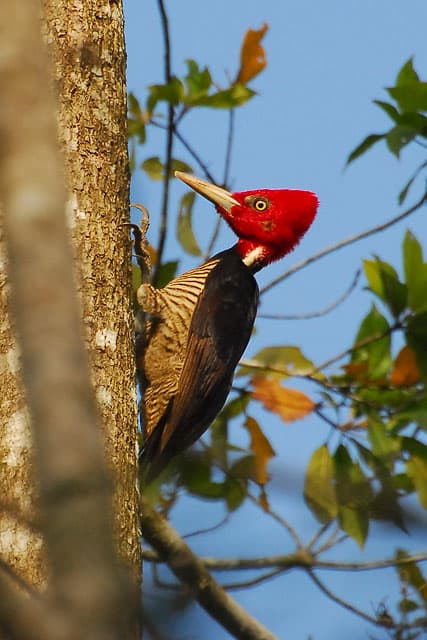
Pale-billed woodpecker
The pale-billed woodpecker is a large woodpecker species found from Mexico to Panama, inhabiting various forested landscapes including lowland tropical evergreen forests. It is characterized by its black upperparts with white or buffy white stripes, a long ivory-yellow bill, and a red head with a bushy crest in adult males. Primarily feeding on the larvae of wood-boring beetles, this species plays a role in forest ecosystems by excavating dead trees for nesting and foraging.