
Red-backed flameback
The Red-backed flameback is a species of woodpecker endemic to Sri Lanka, known for its predominantly crimson plumage and black markings. It inhabits various forest types and man-made environments, and its diet primarily consists of ants.
Key Facts
- ›Endemic to Sri Lanka and absent only from the far north of the island.
- ›Measures approximately 28 centimeters (11 inches) in length.
- ›Features crimson plumage with black trailing edges on the wings and white underparts with black markings.
- ›Primarily feeds on ants, including carpenter ants and weaver ants, and also consumes other invertebrates and some fruit.
- ›Breeds between December and September, laying two to three eggs per clutch.
- ›Listed as Least Concern on the IUCN Red List due to a stable population and common presence within its range.

Lesser Sri Lanka Flameback, Sri Lanka Red-Backed Woodpecker, Ceylon Red-Backed Woodpecker
Sri Lanka
- Crimson back and wings
- Black eyestripe stretching to the nape
- White streaks on breast and between eye and neck
- Red crown
Ants, Carpenter Ants, Meranoplus Ants, Asian Weaver Ants Pupae and Larvae, Spiders, Caterpillars, Weevils, Beetles, Fruit
- Uses tail for support when climbing trees
- Flies in a flap-and-glide bounding pattern
- Breaks into weaver ant nests in trees
- Descends to the ground to access ground ant nests
- Forages alone, in pairs, or in family groups
- Often joins multi-species foraging flocks
Drilled Nest Holes In Trees, Cavities Created By Woodpeckers
- Sharp, Unmusical, Screeching Whinny
- Rhythmic "Woik-Woik-Wik-Wi-Ti-Ti-T-T T-T-Trrrrrr!"
- Repeated "Woik-Tri-Tri-Tri-Tri-Tri-Tri-Tri- !"
- Dull Drumroll of 0.8 - 1.5 Seconds
About Red-backed flameback
The Red-backed flameback, scientifically known as Dinopium psarodes, is a distinctive woodpecker species that is endemic to the island of Sri Lanka. It is often referred to by other common names such as the Lesser Sri Lanka flameback, Sri Lanka red-backed woodpecker, or Ceylon red-backed woodpecker. This species is characterized by its predominantly crimson plumage, accented by black markings on its wings and underparts, and white streaks along its breast and neck. It is sometimes considered a subspecies of the Black-rumped flameback, but studies have supported its elevation to full species status.
Habitat and Distribution
This woodpecker is found across Sri Lanka, with the exception of the far northern regions. Its natural habitats include a variety of forest types, such as subtropical and tropical dry forests, moist lowland forests, and mangrove forests. The Red-backed flameback also readily adapts to man-made environments, frequently being observed in home gardens. It can be found at elevations up to 1,500 meters (4,900 feet) and shows a preference for the dry zone while also inhabiting humid environments.
Behavior and Diet
The Red-backed flameback exhibits typical woodpecker foraging behaviors, using its tail for support as it climbs trees and employing a flap-and-glide flight pattern. Its diet primarily consists of ants, with a particular preference for carpenter ants and weaver ants, from which it extracts pupae and larvae. It also consumes other invertebrates like spiders, caterpillars, weevils, and beetles, and occasionally supplements its diet with fruit. Foraging can occur solitarily, in pairs, as family groups, or as part of mixed-species flocks.
Breeding and Conservation
As a cavity nester, the Red-backed flameback excavates its own nest holes in trees. These artificial cavities are also utilized by other bird species that are unable to create their own. The breeding season spans from December to September, with peak activity from August to September and again from February to June. Females typically lay two to three eggs per clutch. The species is listed as Least Concern on the IUCN Red List, owing to its stable population and its status as one of the most common endemic woodpeckers in Sri Lanka. No significant declines or threats to the population have been identified.
Source: Wikipedia ↗
Frequently Asked Questions
What is the scientific name of the Red-backed flameback?
The scientific name of the Red-backed flameback is Dinopium psarodes. It was formerly classified as a subspecies of the Black-rumped flameback (Dinopium benghalense).
Where are Red-backed flamebacks found?
Red-backed flamebacks are found exclusively in Sri Lanka, inhabiting subtropical or tropical dry forests, moist lowland forests, mangrove forests, and even home gardens. They are generally absent only from the extreme northern parts of the island.
What does the Red-backed flameback eat?
The primary food source for the Red-backed flameback is ants, with a preference for carpenter ants and weaver ants. They also consume other invertebrates such as spiders, caterpillars, weevils, and beetles, and occasionally supplement their diet with fruit.
What are the nesting habits of the Red-backed flameback?
Red-backed flamebacks are cavity nesters and drill their own nest holes in trees at various heights. These cavities also serve as nesting sites for other cavity-nesting birds that cannot excavate their own.
What is the conservation status of the Red-backed flameback?
The Red-backed flameback is listed as Least Concern on the IUCN Red List. This status is due to its stable, albeit unknown, population size and its common to locally common presence across its range in Sri Lanka.
Related Woodpecker species

Banded woodpecker
The banded woodpecker, also known as the banded red woodpecker, is a bird species found in tropical southeastern Asia. It is characterized by its predominantly rufous-brown upper parts, yellowish nape, and heavily barred belly. This species primarily inhabits lowland forests and mangroves, feeding on ants and other invertebrates.
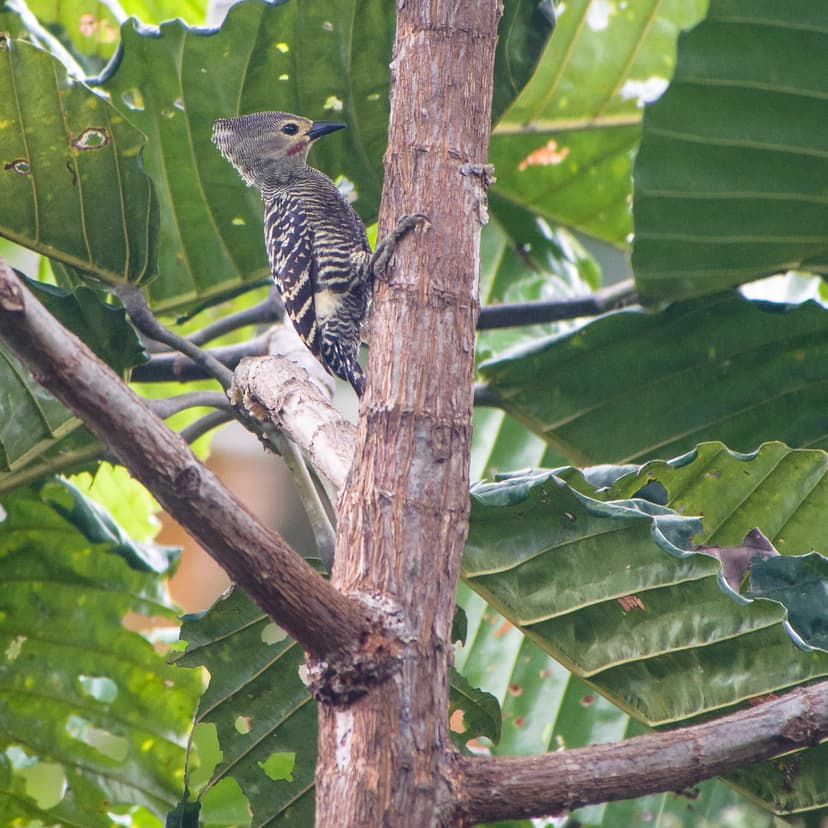
Buff-rumped woodpecker
The buff-rumped woodpecker is a bird species found in Southeast Asia, native to areas including southern Myanmar, Thailand, Malaya, Sumatra, and Borneo. It is characterized by its small nuchal crest, black-and-white wings, fine barring on its belly, and a prominent whitish-buff rump patch. Males are distinguished by a red "mustache" stripe.

Zebra woodpecker
The zebra woodpecker (Meiglyptes tristis) is a bird species found in Java, Indonesia. Its natural habitats include dry and moist lowland forests, as well as disturbed areas like plantations and villages. This species is currently considered endangered.