
Yellow-eared woodpecker
The yellow-eared woodpecker is a species of bird endemic to eastern Brazil, found between the states of Bahia and Rio de Janeiro. This species inhabits lowlands and hills of the Atlantic Forest, including primary and secondary forests, as well as parks. Adults are approximately 15 cm long and are characterized by olive-brown faces with whitish streaks and a pale golden-yellow nape, with males and females differing primarily in their head plumage.
Key Facts
- ›Endemic to eastern Brazil, found between Bahia and Rio de Janeiro.
- ›Inhabits Atlantic Forest lowlands and hills, including primary and secondary forests, and parks.
- ›Adults measure approximately 15 cm in length.
- ›Males and females have distinct head plumage, with males having a brown crown with white streaks and red tips, while females have an olive crown with pale spots.
- ›Its vocalization is described as a high, nasal, chattering rattle.
- ›Assessed by the IUCN as Least Concern, with a believed stable population.
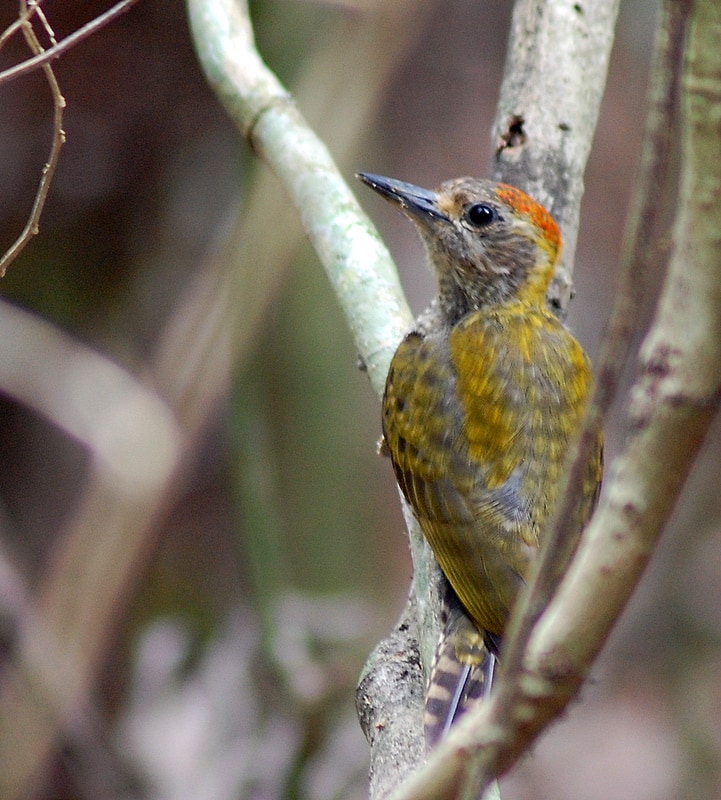
Yellow-Eared Woodpecker
Brazil
Olive-Brown, Whitish Streaks, Pale Golden-Yellow, Yellowish Green, Bronzy Tinge, Yellowish Spots and Bars, Darkish Brown, Pale Yellow, White Bars, Dark Brown, Paler Bars, Off-White, Olive Bars
- Males have a brown crown with white streaks and red tips, and a mostly red hindcrown.
- Females have an olive crown with pale spots, and golden tips on feathers in the rear.
- Adults have a mostly olive-brown face with whitish streaks and a pale golden-yellow nape.
Insect Larvae, Avocado
Pecking
Tree Cavities
- High, nasal, rising then slightly falling, chattering rattle lasting five to seven seconds
About Yellow-eared woodpecker
The yellow-eared woodpecker (Veniliornis maculifrons) is a species of bird belonging to the woodpecker family, Picidae. It is found exclusively in eastern Brazil, inhabiting the lowlands and hills of the Atlantic Forest. This includes both primary and secondary forests, as well as parks within its range.
Description
The yellow-eared woodpecker measures approximately 15 cm (5.9 inches) in length. Adults display olive-brown faces with whitish streaks and a pale golden-yellow nape. Their upperparts are generally yellowish green, sometimes with a bronzy hue, and marked with yellowish spots and bars, particularly on the rump. Flight feathers are darkish brown with pale yellow to white bars, and the tail is dark brown with paler barring. Underparts are off-white with narrow olive bars, which are more prominent on the breast and flanks. Iris color ranges from dark brown to reddish, the beak is blackish with a paler base, and the legs are olive or gray. Males and females have similar plumage except on their heads: males exhibit a brown crown with white streaks and some red tips, along with a mostly red hindcrown, while females possess an olive crown with pale spots and golden tips on the rear feathers. Juveniles are duller than adults and show heavier barring on their upperparts and coarser barring on their underparts.
Distribution and Habitat
This species is endemic to eastern Brazil, with its known distribution extending between the states of Bahia and Rio de Janeiro. It prefers lowland and hilly regions within the Atlantic Forest biome.
Behavior and Ecology
The yellow-eared woodpecker is believed to be a year-round resident throughout its range. Its diet has been documented to include insect larvae, and it has been observed pecking at avocados. However, further details regarding its comprehensive diet or foraging strategies are not widely known. The breeding season appears to span at least from March to July. One documented nest was located in a tree cavity approximately 18 meters (60 feet) above the ground. Beyond this, little else is recorded about the species' breeding biology.
Vocalization
The characteristic sound produced by the yellow-eared woodpecker is a high, nasal, chattering rattle that lasts for about five to seven seconds, described as rising and then slightly falling in pitch.
Conservation Status
The International Union for Conservation of Nature (IUCN) has assessed the yellow-eared woodpecker as Least Concern. Despite possessing a somewhat limited range and an unknown population size, the population is believed to be stable. No immediate threats have been identified for this species, which is not particularly well-known. Efforts to determine and monitor its population within its unique Brazilian habitat are considered desirable.
Source: Wikipedia ↗
Frequently Asked Questions
Where is the yellow-eared woodpecker found?
The yellow-eared woodpecker is found exclusively in eastern Brazil. Its range extends between the states of Bahia and Rio de Janeiro.
What kind of habitat does the yellow-eared woodpecker prefer?
This species inhabits the lowlands and hills of the Atlantic Forest. It can be found in both primary and secondary forests, as well as in parks within its geographic range.
What is the size of an adult yellow-eared woodpecker?
Adult yellow-eared woodpeckers are relatively small, measuring about 15 cm (5.9 inches) in length.
What does the yellow-eared woodpecker eat?
Documented feeding behavior includes consuming insect larvae and pecking at avocados. However, detailed information about its complete diet or foraging strategy is not widely known.
What is the conservation status of the yellow-eared woodpecker?
The yellow-eared woodpecker is currently assessed by the IUCN as Least Concern. Although its population size is unknown, it is believed to be stable and no immediate threats have been identified.
What is the call of the yellow-eared woodpecker like?
The vocalization of the yellow-eared woodpecker is characterized as a high, nasal, chattering rattle. This sound typically lasts for about five to seven seconds and rises slightly before falling.
Related Woodpecker species

Red-stained woodpecker
The red-stained woodpecker is a species found across several South American countries, primarily inhabiting the interior of tall rainforests. It is characterized by its yellowish-green upperparts with red feather tips and pale yellow streaks, and its underparts are cinnamon-buff with dark olive-brown bars. This woodpecker is known for its relatively quiet nature, with a primary vocalization consisting of high-pitched nasal notes.

Ringed woodpecker
The ringed woodpecker is a South American bird found in various forests across the continent, excluding some southern countries. It is characterized by its pale cinnamon head with a rufous tinge and a crest, with males displaying a distinctive red facial patch. The species' conservation status varies by subspecies, with one categorized as Near Threatened due to deforestation threats.
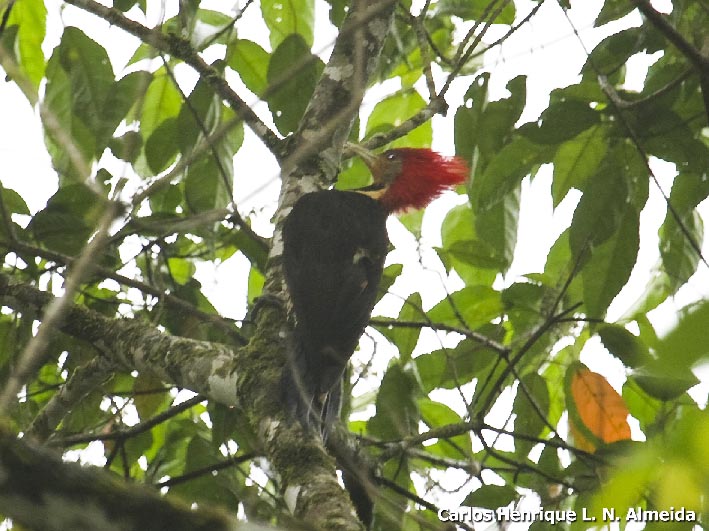
Helmeted woodpecker
The helmeted woodpecker (Celeus galeatus) is a Vulnerable species found in Argentina, Brazil, and Paraguay, primarily inhabiting the Atlantic Forest. This medium-sized woodpecker is distinguished by its cinnamon face, long red crest, and black and buff plumage, with males exhibiting a distinctive red malar patch. It primarily forages by probing soft decaying trees rather than hammering, and its limited vocalizations include a distinctive long call.