
Scaled piculet
The scaled piculet (Picumnus squamulatus) is a small bird found in Colombia and Venezuela, belonging to the woodpecker family. It is characterized by its small size, olive-brown upperparts with a scaly appearance, and distinctive markings on its crown, which differ between males and females and vary among subspecies. This species inhabits a range of semi-open to open landscapes and feeds primarily on small insects.
Key Facts
- ›The scaled piculet is 8 to 9.2 cm long and weighs 7 to 12 grams.
- ›Adult males have a black cap with red feather tips on the forehead, while females have white spots on their entire crown.
- ›Its upperparts are olive brown with a scaly pattern due to narrow black borders on the feathers.
- ›The species inhabits semi-open to open landscapes such as gallery forests, woodland edges, and farmland with scattered trees.
- ›It feeds on small insects and forages on thin branches and twigs, usually alone or in pairs.
- ›The IUCN conservation status is Least Concern, with a presumed stable population.

Colombia, Venezuela
Gallery Forest, Edges of Primary Forest, Secondary Forest, Deciduous Woodland, Farmland With Scattered Trees, Pastures
- Scaly appearance on upperparts due to narrow black borders on feathers
- Red feather tips on forehead of adult males
- White spots on crown of adult females
Small Insects
Forages on thin branches and twigs, Forages in dense vegetation or small trees, Usually forages singly or in pairs
High-pitched squeaky 'chi-chi-chi'e'e'chi', Trill-like vocalizations at the end of calls
About Scaled piculet
The scaled piculet, scientifically known as Picumnus squamulatus, is a small bird species within the woodpecker family (Picidae), specifically belonging to the subfamily Picumninae. It is native to and found in Colombia and Venezuela. This species is characterized by its diminutive size, typically measuring between 8 and 9.2 centimeters in length and weighing between 7 and 12 grams.
Physical Description
The plumage of the scaled piculet features olive-brown upperparts marked by a distinctive scaly appearance, created by narrow black borders on the feathers. The flight feathers are brown with yellowish edges. Adult males of the nominate subspecies possess a black cap with red feather tips on the forehead and white tips on the rest of the cap. Their facial region is largely brown, with a whitish line behind the eye. Adult females are similar but are distinguished by white spots covering their entire crown. Juveniles tend to be darker above than adults, with a less defined scaly pattern on their underparts. Subspecies exhibit variations, such as yellow or orange forehead spots instead of red, grayer upperparts, or different tinges and markings on the underparts.
Distribution and Habitat
The scaled piculet inhabits a variety of semi-open to open landscapes. Its preferred environments include gallery forests, the edges of primary and secondary forests, deciduous woodlands, farmland with scattered trees, and pastures. It can be found at elevations up to 1,900 meters (6,200 feet). The species is believed to be a year-round resident throughout its known range.
Behavior and Diet
This piculet species feeds on small insects. Its foraging behavior involves searching on thin branches and twigs, often within dense vegetation or small trees. They are typically observed foraging alone or in pairs. The scaled piculet is known to produce a high-pitched, squeaky call, which can become trill-like towards the end.
Breeding
The precise breeding season for the scaled piculet is not well-defined, but observations suggest it occurs from October to January in Colombia and from April to June, possibly extending to September, in Venezuela. Little else is currently known about its breeding biology.
Conservation Status
The International Union for Conservation of Nature (IUCN) has assessed the scaled piculet as Least Concern. While its exact population size is not determined, the population is presumed to be stable. No immediate threats to the species have been identified, and it is known to occur in at least two protected areas in Venezuela. It is noted that the scaled piculet may sometimes be overlooked due to its inconspicuous behavior.
Source: Wikipedia ↗
Frequently Asked Questions
What is the scientific name for the scaled piculet?
The scientific name for the scaled piculet is Picumnus squamulatus. This binomial name was given to the species by Frédéric de Lafresnaye in 1854, with the specific epithet 'squamulatus' derived from the Latin word for 'little scale'.
Where can the scaled piculet be found?
The scaled piculet is found in Colombia and Venezuela. It inhabits a variety of semi-open to open landscapes within these countries, including gallery forests, woodland edges, and farmland.
What does a scaled piculet look like?
The scaled piculet is a small bird, measuring 8 to 9.2 cm in length. Adult males have a black cap with red forehead tips, while females have white spots on their crown. Their upperparts are olive-brown with a distinctive scaly appearance, and their underparts are whitish with similar scaly markings.
What does the scaled piculet eat?
The scaled piculet feeds primarily on small insects. It is known to forage on thin branches and twigs, often in dense vegetation or small trees.
What is the conservation status of the scaled piculet?
The scaled piculet is listed as Least Concern by the IUCN. Its population size is not precisely known but is believed to be stable, and no immediate threats have been identified.
What are the different subspecies of the scaled piculet?
Five subspecies of the scaled piculet are recognized: P. s. squamulatus, P. s. roehli, P. s. obsoletus, P. s. lovejoyi, and P. s. apurensis. These subspecies differ subtly in plumage coloration and markings, particularly on the forehead and underparts.
Related Woodpecker species
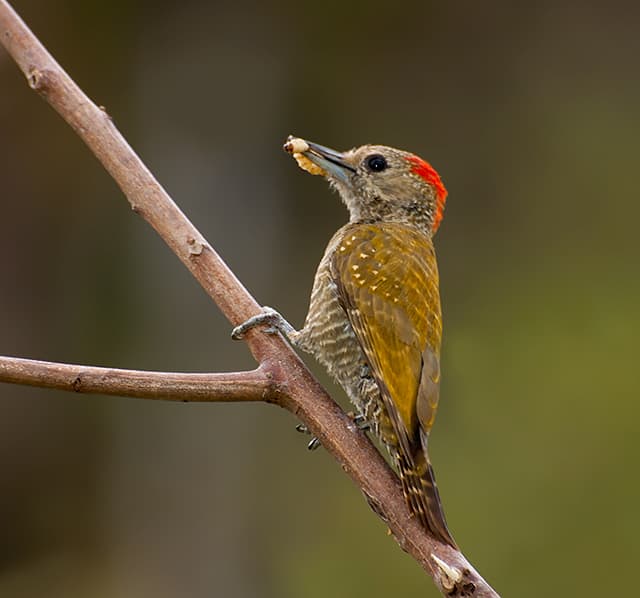
Little woodpecker
The little woodpecker (Veniliornis passerinus) is a small South American bird found in a wide variety of wooded habitats, generally avoiding dense forest interiors. Males and females share similar plumage, with males displaying red on their heads. This adaptable species is widespread across the continent and is currently listed as Least Concern.

Eurasian wryneck
The Eurasian wryneck is a migratory woodpecker species found predominantly in temperate regions of Europe and Asia, wintering in tropical Africa and southern Asia. It is characterized by its thrush-like body shape, unique snake-like head-twisting ability used as a defense mechanism, and a diet primarily consisting of ants and other insects.

Arrowhead piculet
The Arrowhead piculet is a small bird belonging to the woodpecker family, characterized by its distinctive plumage and a varied diet. It is found in the Guianas region of South America, inhabiting a range of environments from mangroves to montane forests.