
Stierling's woodpecker
Stierling's woodpecker is a species of bird found in the tropical dry forests of southeastern Africa, specifically in Malawi, Mozambique, and Tanzania. This medium-sized woodpecker is characterized by distinct sexual dimorphism in its crown and nape coloration, and its diet consists primarily of insects and invertebrates foraged from tree branches. It is currently assessed as 'near-threatened' due to ongoing habitat destruction.
Key Facts
- ›Native to Malawi, Mozambique, and Tanzania in southeastern Africa.
- ›Inhabits tropical dry forests, particularly the Eastern miombo woodlands.
- ›Males have a red MID-crown and nape, while females have a brown crown with pale streaks and a black nape.
- ›Forages for insects and invertebrates on branches, often in the middle to upper canopy.
- ›Breeding season is believed to occur between July and October.
- ›Classified as 'near-threatened' by the IUCN due to habitat loss.

Africa
Tropical Dry Forests, Miombo Woodlands
- Male has red mid-crown and nape
- Female has brown crown with pale streaks and black nape
- Brown band from eye across ear coverts
- Brown malar streak
Insects, Centipedes, Invertebrates
Forages on branches 4-12 cm in diameter, Searches in middle and upper canopy, Occasionally flies to catch winged termites
Hole In A Tree
About Stierling's woodpecker
Stierling's woodpecker, scientifically known as Dendropicos stierlingi, is a bird species belonging to the family Picidae. It is native to the tropical dry forests of southeastern Africa, specifically found in Malawi, Mozambique, and Tanzania within the Eastern miombo woodlands ecoregion. This species is currently facing threats due to habitat destruction, leading to its assessment as 'near-threatened'. The bird is named in honor of the German bird collector N. Stierling.
Description and Identification
This woodpecker typically reaches a length of about 17.5 cm. A notable characteristic is the sexual dimorphism in its appearance. Males possess a distinctive red coloration on their mid-crown and nape, while females have a brown crown marked with pale streaks and a black nape. The upper parts of both sexes are a uniform olive brown, contrasting with white or cream underparts that feature brown markings. The face, neck, chin, and throat are white. A brown band extends from the eye across the ear coverts, and a brown malar streak runs down to the breast. The wings are brown on top and white underneath, and the tail is brown with a buff tip and a pale underside. Its beak is grey with a paler base, its legs are grey or olive, and its iris is reddish.
Distribution and Habitat
Stierling's woodpecker is endemic to southeastern Africa, with its geographical range encompassing southern Tanzania, southwestern Malawi, and northern Mozambique. It is a resident species that inhabits open miombo woodland environments, generally avoiding dense forest interiors. The species can be found at elevations up to 1,500 meters (5,000 feet).
Ecology and Behavior
The diet of Stierling's woodpecker primarily consists of insects, centipedes, and other invertebrates. It forages for food in the middle and upper sections of the forest canopy, typically searching on branches that are between 4 and 12 cm in diameter. This foraging strategy may help reduce competition with the cardinal woodpecker (Dendropicos fuscescens), which tends to forage on smaller branches and twigs. While it occasionally attempts to catch winged termites in flight, it is less proficient at this than some other woodpecker species. The breeding season is believed to occur between July and October, with nests constructed in tree cavities.
Conservation Status
Stierling's woodpecker has a relatively limited and patchily distributed range, and it is generally considered an uncommon species. The miombo woodlands it inhabits are increasingly being cleared for firewood, particularly in areas dedicated to tobacco cultivation, where open fires are used for drying the crop. As its suitable habitat diminishes, the species relies on remaining woodland patches and forest reserves for survival. Consequently, the International Union for Conservation of Nature has classified its conservation status as 'near-threatened'.
Source: Wikipedia ↗
Frequently Asked Questions
What does Stierling's woodpecker look like?
Stierling's woodpecker is about 17.5 cm long. Males are distinguished by a red mid-crown and nape, while females have a brown crown with pale streaks and a black nape. Both sexes have plain olive-brown upper parts and white or cream underparts with brown markings.
Where can Stierling's woodpecker be found?
This species is endemic to southeastern Africa, with its range including southern Tanzania, southwestern Malawi, and northern Mozambique. Its natural habitat is tropical dry forests, specifically the Eastern miombo woodlands.
What does Stierling's woodpecker eat?
Stierling's woodpecker primarily forages for insects, centipedes, and other invertebrates. It searches for food on branches, typically between 4 and 12 cm in diameter, often in the middle and upper parts of the canopy.
What is the conservation status of Stierling's woodpecker?
The conservation status of Stierling's woodpecker is assessed as 'near-threatened' by the International Union for Conservation of Nature. This is due to its limited range and the ongoing clearing of its miombo woodland habitat.
When does Stierling's woodpecker breed?
Breeding is thought to take place between July and October. Nests are made in holes within trees.
Related Woodpecker species
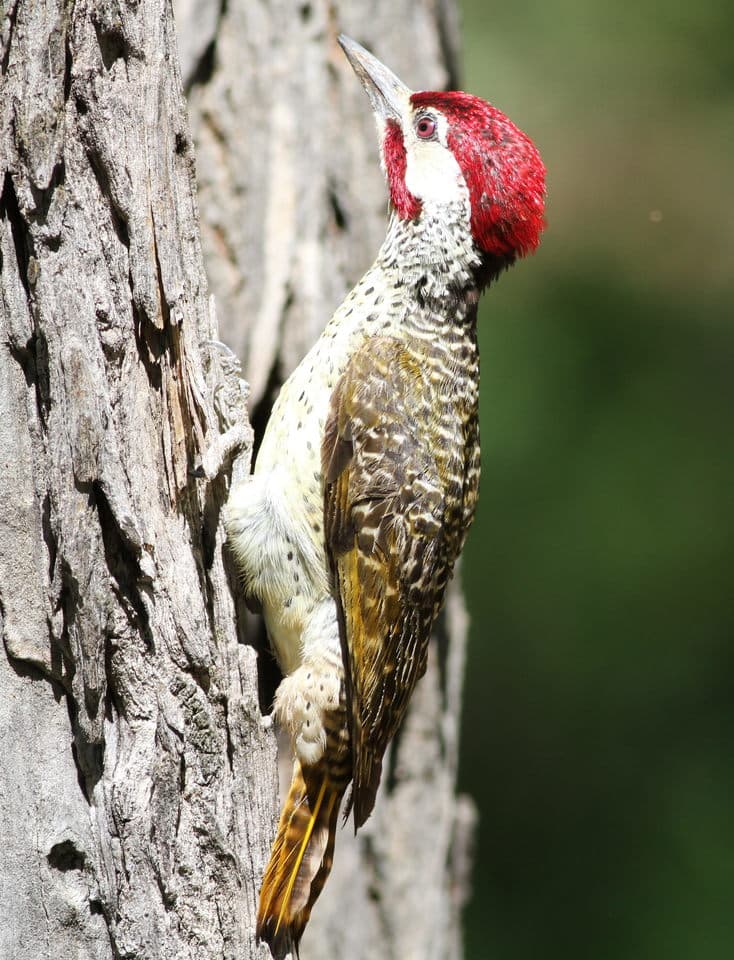
Bennett's woodpecker
Bennett's woodpecker is a bird species found in woodlands and bushes across various African countries. It is characterized by its distinctive spotted plumage and a diet primarily consisting of ants and termites. The species is currently assessed as least concern by the IUCN due to its stable population.
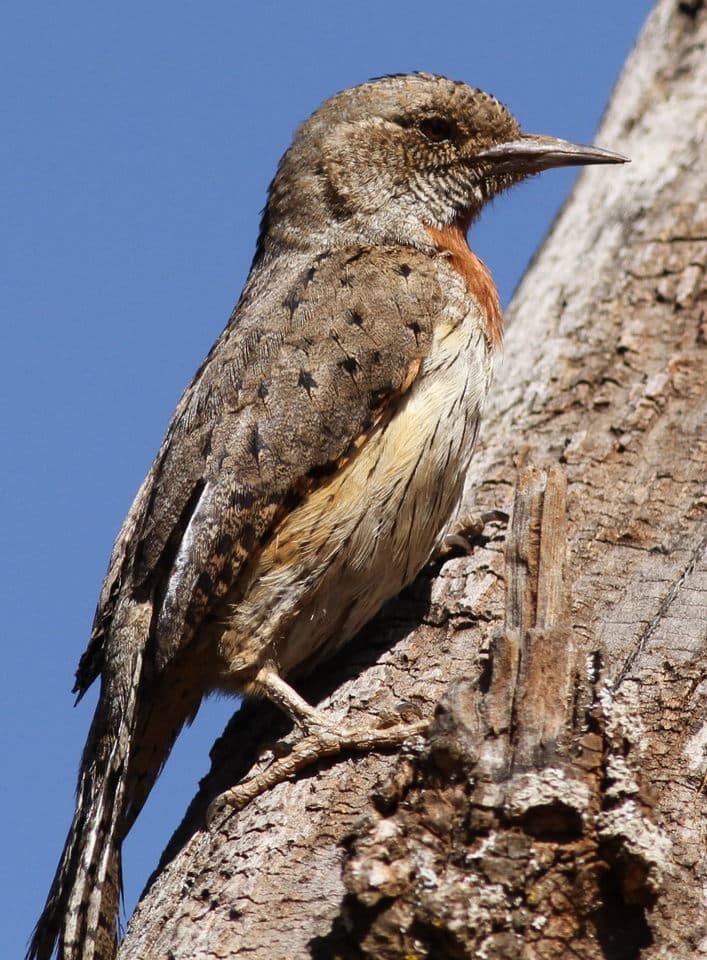
Red-throated wryneck
The red-throated wryneck is a slim, elongated bird found in sub-Saharan Africa, recognized by its cryptic plumage of greys and browns. It is a member of the woodpecker family, distinguished by its habit of twisting its neck when agitated. Primarily feeding on ants, it nests in pre-existing holes and is considered a species of least concern due to its large and increasing population.

Northern sooty woodpecker
The Northern sooty woodpecker is a bird species found in the Philippines, inhabiting tropical lowland and montane forests. Distinguishable by its darker gray plumage and the male's burgundy facial markings, this species is typically observed alone or in pairs. Its primary diet is believed to consist of invertebrates, and it nests in tree cavities.