
Bennett's woodpecker
Bennett's woodpecker is a bird species found in woodlands and bushes across various African countries. It is characterized by its distinctive spotted plumage and a diet primarily consisting of ants and termites. The species is currently assessed as least concern by the IUCN due to its stable population.
Key Facts
- ›Found in woodlands and bushes in Africa, with a patchy distribution.
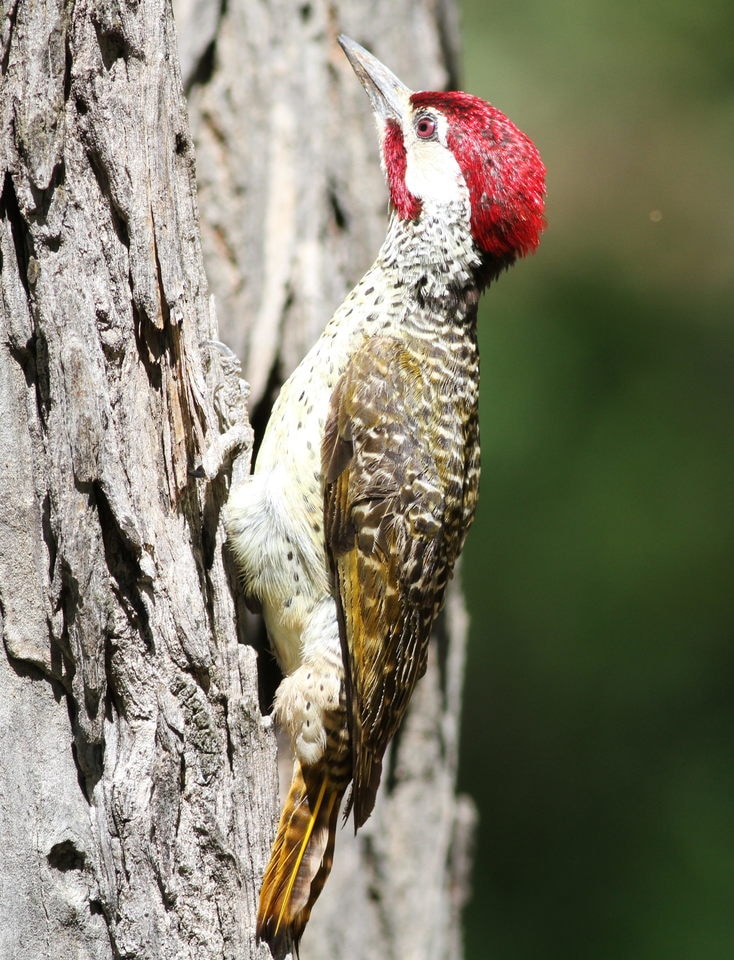
- ›Males have red foreheads and crowns, while females have black foreheads with white spots.
- ›Primarily forages on the ground for ants and termites, including their eggs.
- ›Breeding season typically runs from August to February.
- ›Nests are excavated or reused holes in trees, with clutches of three eggs.
- ›Assessed as a least-concern species by the IUCN due to a stable population.
Fine-Spotted Woodpecker, Nubian Woodpecker, Speckle-Throated Woodpecker
Africa
Woodlands, Bushes, Miombo Woodlands, Baikiaea Woodlands, Acacia Woodlands, Mopane Woodlands
Male's Red Forehead, Crown and Nape, Female's Black Forehead With White Spots, Dark Spots On Breast and Flanks
Ants, Termites, Ant Eggs, Termite Eggs
Forages On the Ground, Feeds In Trees
Holes In Trees
Chuur Notes, A Series of Wi-Wi-Wi-Wi, Kee-Kee-Kee, Ddrahh, Ddrahh, Ddray-Ay, Ddray-Ay, A Chattering Wirrit-Wirrit
About Bennett's woodpecker
Bennett's woodpecker, scientifically known as Campethera bennettii, is a species of bird belonging to the family Picidae. It inhabits woodlands and bushland environments across a wide swathe of Africa, with its range extending through countries such as Angola, Botswana, South Africa, and Zimbabwe, among others. Despite its broad distribution, its presence can be patchy within these regions.
Description and Identification
Adult Bennett's woodpeckers measure approximately 24 cm in length and typically weigh between 61 and 84 grams. Sexual dimorphism is evident in their plumage. Males are characterized by a striking red forehead, crown, and nape, contrasting with a white chin and throat. Their upperparts display a mix of brown, yellow, and white, while the underparts are pale yellow, marked with dark spots on the breast and flanks. Both sexes share red eyes, grey beaks, and bluish-green or grey-green legs. Females present a different facial pattern, featuring a black forehead with white spotting, and brown or blackish-brown ear coverts and throat. Juvenile birds exhibit a black forehead and crown, with darker upperparts.
Habitat and Behavior
The preferred habitats for Bennett's woodpecker include various types of woodlands and bushes, such as miombo, Baikiaea, Acacia, and mopane woodlands. They are observed singly, in pairs, or as family groups. A notable aspect of their behavior is their foraging strategy, which largely occurs on the ground, utilizing areas of bare earth or short grass, though they also feed within trees. Their diet predominantly consists of ants and termites, including their eggs.
Reproduction and Conservation
The breeding season for Bennett's woodpecker typically spans from August to February. They are cavity nesters, excavating new holes in trees or utilizing existing ones. Females lay a clutch of three eggs, which are incubated for a period of 15 to 18 days. The species has a stable population and faces no substantial threats, leading the International Union for Conservation of Nature (IUCN) to classify it as a species of least concern. The common name and binomial name commemorate the British naturalist Edward Turner Bennett. Bennett's woodpecker, the fine-spotted woodpecker, the Nubian woodpecker, and the speckle-throated woodpecker are considered to form a superspecies.
Source: Wikipedia ↗
Frequently Asked Questions
What is the scientific name for Bennett's woodpecker?
The scientific name for Bennett's woodpecker is Campethera bennettii. This binomial name is used to classify the species within the scientific community.
Where is Bennett's woodpecker found?
Bennett's woodpecker is distributed across several African countries, including Angola, Botswana, Burundi, the Democratic Republic of the Congo, Eswatini, Malawi, Mozambique, Namibia, Rwanda, South Africa, Tanzania, Zambia, and Zimbabwe. Its habitat includes various types of woodlands and bushes.
What does Bennett's woodpecker eat?
The primary diet of Bennett's woodpecker consists of ants and termites. They also consume the eggs of these insects, foraging for food both on the ground and in trees.
How are male and female Bennett's woodpeckers different?
Male Bennett's woodpeckers are distinguished by their red forehead, crown, and nape. In contrast, females have a black forehead adorned with white spots, and their ear coverts and throat are brown or blackish-brown.
What is the conservation status of Bennett's woodpecker?
Bennett's woodpecker is listed as a species of least concern by the International Union for Conservation of Nature (IUCN). This assessment is based on its stable population and the absence of significant threats.
Related Woodpecker species
Red-throated wryneck
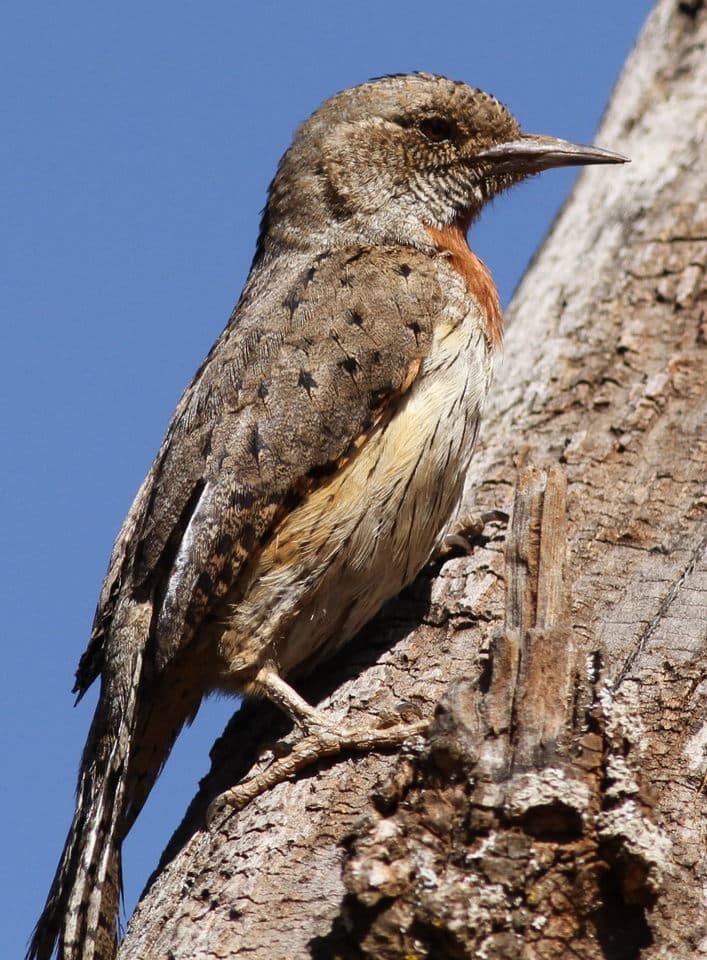
The red-throated wryneck is a slim, elongated bird found in sub-Saharan Africa, recognized by its cryptic plumage of greys and browns. It is a member of the woodpecker family, distinguished by its habit of twisting its neck when agitated. Primarily feeding on ants, it nests in pre-existing holes and is considered a species of least concern due to its large and increasing population.

Stierling's woodpecker
Stierling's woodpecker is a species of bird found in the tropical dry forests of southeastern Africa, specifically in Malawi, Mozambique, and Tanzania. This medium-sized woodpecker is characterized by distinct sexual dimorphism in its crown and nape coloration, and its diet consists primarily of insects and invertebrates foraged from tree branches. It is currently assessed as 'near-threatened' due to ongoing habitat destruction.

Beautiful woodpecker
The beautiful woodpecker is a species endemic to Colombia, found primarily in the Magdalena River valley. This bird is characterized by its striking plumage, with males and females differing in head patterns, and it feeds on a mixed diet of insects and fruits, foraging high in forest canopies. Its conservation status is assessed as Least Concern.