
Red-throated wryneck
The red-throated wryneck is a slim, elongated bird found in sub-Saharan Africa, recognized by its cryptic plumage of greys and browns. It is a member of the woodpecker family, distinguished by its habit of twisting its neck when agitated. Primarily feeding on ants, it nests in pre-existing holes and is considered a species of least concern due to its large and increasing population.
Key Facts
- ›Slim, elongated bird approximately 19 cm (7.5 in) long.
- ›Cryptic plumage of greys, browns, and black provides camouflage.
- ›Diet consists almost entirely of ants at all life stages.
- ›Nests in pre-existing holes, often in old barbet or woodpecker nests.
- ›When threatened, twists its neck in a snake-like manner and hisses.
- ›Population is large and increasing, leading to a Least Concern conservation status.
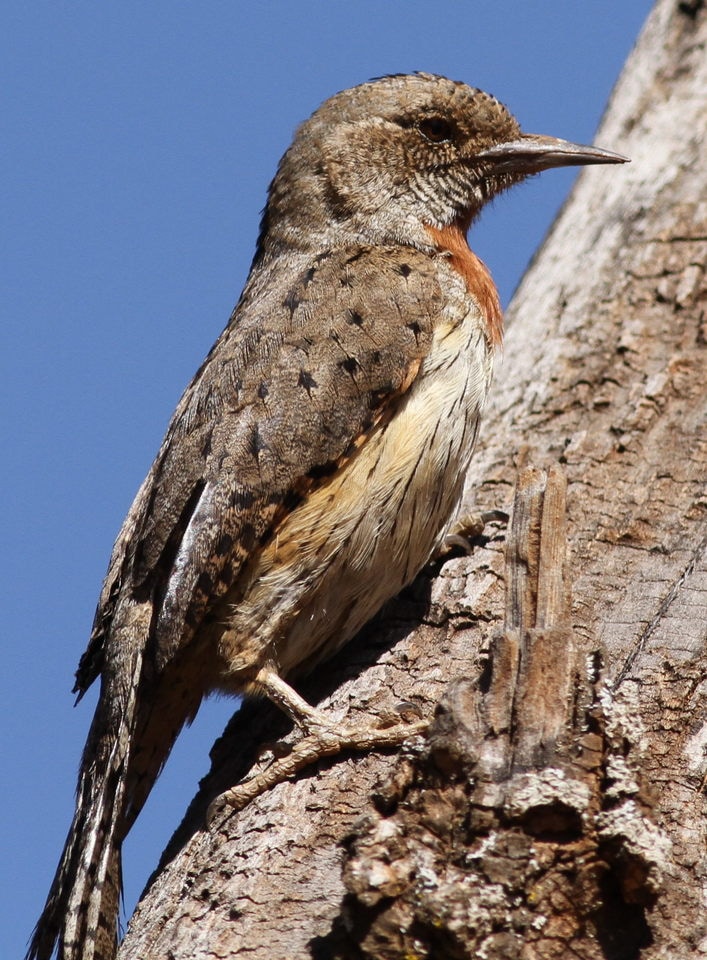
Rufous-Necked Wryneck, Red-Breasted Wryneck
Sub-Saharan Africa
Open Grassland With Trees, Acacia Woodlands, Miombo Woodlands, Semi-Open Woodland, Forest Edges, Clearings, Farmland, Parks, Gardens
- Twists neck and head in a snake-like manner when threatened
- Elongated body shape unlike typical woodpeckers
- Fine bill
- Long fan-shaped tail
- Obvious red throat
Ants, Ant Larvae, Ant Pupae, Ant Eggs
Gleans prey with long sticky tongue, Probes into ant hills, Picks prey off vegetation when in trees
Pre-Existing Holes In Trees, Old Barbet Nests, Old Woodpecker Nests, Holes In Fence Posts, Nest Boxes
Repeated Harsh, Shrill Notes, Peegh Alarm Call, Repeated Harsh Krok, Wheezing Squeaks, Repeated Buzzing Tsch, Quiet 'Click' Call
About Red-throated wryneck
The red-throated wryneck, scientifically known as Jynx ruficollis, is a distinctive species within the woodpecker family, closely related to the Eurasian wryneck. This bird is characterized by its slim, elongated body, small head, fine bill, and a long, fan-shaped tail, all contributing to a cryptic plumage intricately patterned in shades of grey and brown. It is found across much of sub-Saharan Africa, inhabiting open habitats that feature scattered trees, such as grasslands with acacias and miombo woodlands, as well as forest edges and clearings.
Diet and Foraging
The diet of the red-throated wryneck is remarkably specialized, consisting almost entirely of ants across all stages of their life cycle, supplemented occasionally by termites and other small invertebrates. They employ a long, sticky tongue to glean prey, with a significant portion of their foraging occurring on the ground, where they probe into ant hills. When foraging in trees, they pick insects off vegetation rather than excavating wood.
Nesting and Reproduction
Unlike many woodpeckers, the red-throated wryneck does not excavate its own nesting cavities. Instead, it relies on pre-existing holes, preferably in trees, often utilizing old barbet or woodpecker nests. These unfurnished cavities are typically located 3–4 meters above the ground. Both sexes share incubation duties, which last 12–15 days, and care for the blind, naked chicks after hatching. The young are fed by both adults for approximately 25–26 days before fledging. The species usually raises two broods per year, and breeding can occur in almost any month depending on the region.
Behavior and Defense
When agitated or threatened, the red-throated wryneck exhibits a unique behavior: it twists its neck and head in a snake-like fashion while producing a hissing sound, a tactic presumably aimed at deterring predators. Their flight pattern is characteristic of woodpeckers, involving alternating powered flaps with glides. Pairs maintain territories, which they advertise through calls from prominent perches.
Conservation Status
The red-throated wryneck boasts an extensive geographic range and a large, increasing population. Consequently, it is classified as a species of Least Concern by the International Union for Conservation of Nature (IUCN). In some areas, such as South Africa, its range has even expanded due to the introduction of non-native trees into formerly unwooded grasslands.
Source: Wikipedia ↗
Frequently Asked Questions
What is the scientific name of the red-throated wryneck?
The scientific name of the red-throated wryneck is Jynx ruficollis. It belongs to the genus Jynx, which was introduced by Carl Linnaeus.
Where is the red-throated wryneck found?
The red-throated wryneck has a distribution confined to sub-Saharan Africa, occurring in approximately 20 countries from Nigeria and Ethiopia in the north down to South Africa and Eswatini in the south.
What does the red-throated wryneck eat?
The diet of the red-throated wryneck consists almost entirely of ants, including their larvae, pupae, and eggs. They occasionally consume termites and other small invertebrates.
How does the red-throated wryneck defend itself?
When threatened, the red-throated wryneck exhibits a unique defense mechanism by twisting its neck and head in a snake-like manner while emitting a hissing sound, presumably to deter predators.
What is the conservation status of the red-throated wryneck?
The red-throated wryneck is evaluated as a species of least concern by the International Union for Conservation of Nature (IUCN). This is due to its extremely large range and a population that is large and increasing.
Related Woodpecker species
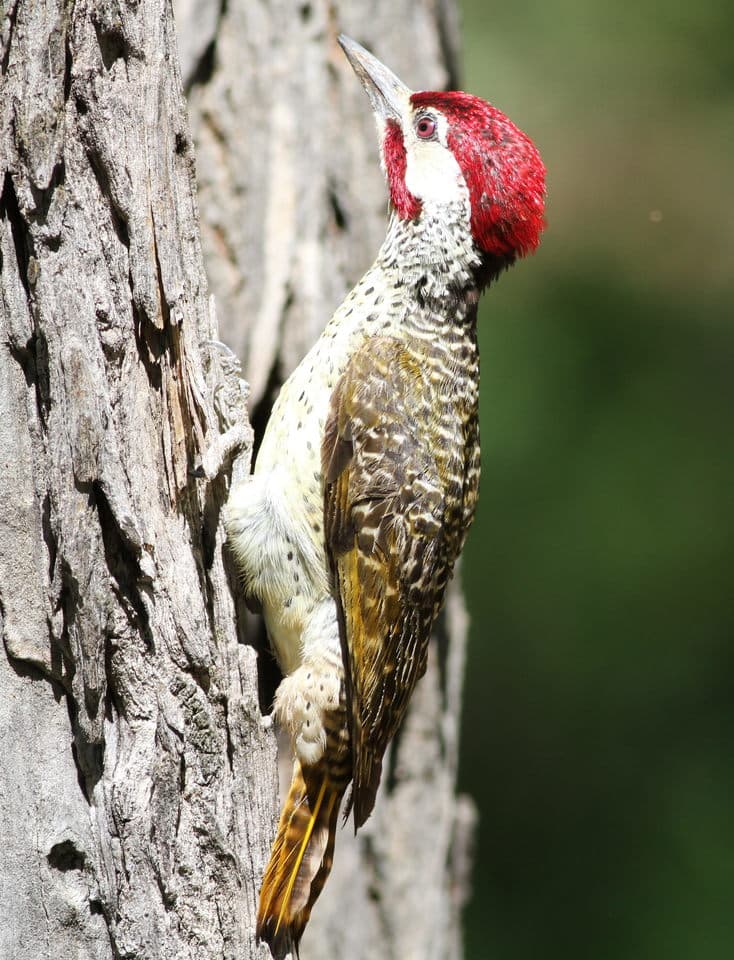
Bennett's woodpecker
Bennett's woodpecker is a bird species found in woodlands and bushes across various African countries. It is characterized by its distinctive spotted plumage and a diet primarily consisting of ants and termites. The species is currently assessed as least concern by the IUCN due to its stable population.

Campo flicker
The campo flicker is a medium-sized woodpecker found across South America, inhabiting a variety of open and semi-open landscapes. It is known for its terrestrial foraging habits, primarily feeding on ants and termites, and exhibits a complex breeding system.

Stierling's woodpecker
Stierling's woodpecker is a species of bird found in the tropical dry forests of southeastern Africa, specifically in Malawi, Mozambique, and Tanzania. This medium-sized woodpecker is characterized by distinct sexual dimorphism in its crown and nape coloration, and its diet consists primarily of insects and invertebrates foraged from tree branches. It is currently assessed as 'near-threatened' due to ongoing habitat destruction.