
Stripe-cheeked woodpecker
The stripe-cheeked woodpecker is a species endemic to Panama, characterized by its bronze-green upperparts and buffy white underparts with greenish olive barring. Males and females exhibit sexual dimorphism primarily in head plumage, with males displaying more extensive red coloration. This bird inhabits humid forests at mid-elevations.
Key Facts
- ›Endemic to Panama, found from Veraguas to Darién provinces.
- ›Measures approximately 17 cm (6.7 in) in length.
- ›Males have red on their forehead and cheeks, while females have red only on the rear crown and hindneck.
- ›Inhabits humid forests at elevations between 300 and 900 meters.
- ›Diet includes ants, and they forage in the lower to MID-levels of the forest.
- ›Classified as Least Concern by the IUCN, though its population is believed to be decreasing.

Chloronerpes Callopterus
Panama
- Red coloration on male's head and cheeks
- Buffy white stripe above malar region in males
- Bronze-green upperparts
- Cinnamon-rufous flight feathers with dark brown bars
- Sky-blue to pale gray irises
Ants
Forages alone or in pairs, Joins mixed-species feeding flocks, Forages at lower to mid-levels of the forest, Pecks into the substrate
Dead Trees
Nasal Bi-Syllabic Note 'Nyeeeh-Wheet', Scolding, Fast Chattering Series of Short Nasal Notes
About Stripe-cheeked woodpecker
The stripe-cheeked woodpecker (Piculus callopterus) is a bird species found exclusively in Panama. It belongs to the Picinae subfamily within the woodpecker family, Picidae. This species is recognized for its distinctive plumage and its habitat preference for humid forest environments.
Description and Identification
Adult stripe-cheeked woodpeckers typically measure around 17 cm (6.7 inches) in length. Their upperparts are a notable bronze-green, while their underparts are buffy white, marked with greenish olive barring. A key characteristic is the sexual dimorphism in their head plumage: males display red coloration from the forehead to the hindneck, extending widely onto the cheeks, with a buffy white stripe above this malar region. The rest of their face is olive. Females exhibit red coloration only from the back of the crown to the hindneck. Both sexes share bronze-green upperparts and flight feathers that are predominantly cinnamon-rufous with dark brown bars. Their tail is blackish with some cinnamon-rufous on the outer feathers. The throat and upper breast are greenish olive, with yellowish spots on the latter. Their beak is blackish with a paler mandible, their irises are sky-blue to pale gray, and their legs are olive-gray. Juveniles are duller, with mottled throats and breasts, and uneven barring on their underparts.
Distribution and Habitat
The stripe-cheeked woodpecker is endemic to Panama, with its range extending from Veraguas Province in west-central Panama to Darién Province, predominantly on the Caribbean side. While there are sightings near the Colombian border, official records do not confirm its presence in Colombia. The species inhabits the interior and edges of humid forests, typically at elevations between 300 and 900 meters (1,000 to 3,000 feet).
Behavior and Ecology
This woodpecker is believed to be a year-round resident throughout its range. It is commonly observed foraging alone or in pairs, and also joins mixed-species feeding flocks. Its foraging behavior involves moving through the lower to mid-levels of the forest and pecking into substrates to find food. While its diet is not fully detailed, ants are known to be a component. The breeding season is known to include April and May. Nest cavities have been discovered in dead trees, situated between approximately 3.4 and 6 meters above the ground. Information regarding clutch size, incubation period, fledging time, and parental care is not extensively documented.
Vocalizations
The primary call of the stripe-cheeked woodpecker is a nasal, bi-syllabic note described as 'nyeeeh-wheet,' uttered singly or in rapid series by both sexes. Other vocalizations include scolding sounds and a fast chattering series of short nasal notes, often when the bird is excited.
Conservation Status
The International Union for Conservation of Nature (IUCN) has assessed the stripe-cheeked woodpecker as Least Concern. Despite having a restricted geographic range and an estimated population of at least 20,000 mature individuals that is believed to be decreasing, these metrics have not yet reached the thresholds for a more threatened status. No immediate threats to the species have been identified. It is considered uncommon and local, and not extensively studied.
Source: Wikipedia ↗
Frequently Asked Questions
What is the scientific name of the stripe-cheeked woodpecker?
The scientific name of the stripe-cheeked woodpecker is Piculus callopterus. It was originally described under the genus Chloronerpes.
Where is the stripe-cheeked woodpecker found?
This species is endemic to Panama, primarily found in the interior and edges of humid forests. Its range extends from Veraguas Province to Darién Province, mainly on the Caribbean side.
What does the stripe-cheeked woodpecker eat?
While its diet is not known in great detail, it is known to include ants. They typically forage by pecking into tree substrates.
What are the nesting habits of the stripe-cheeked woodpecker?
Nesting sites discovered have been in dead trees, typically between 3.4 and 6 meters above the ground. Specific details about clutch size and incubation are not well-documented.
What is the conservation status of the stripe-cheeked woodpecker?
The stripe-cheeked woodpecker is listed as Least Concern by the IUCN. Despite a restricted range and a believed decreasing population, it does not currently meet the criteria for a more threatened status.
How can I identify a stripe-cheeked woodpecker?
Adults have bronze-green upperparts and buffy white underparts with greenish olive barring. Males are distinguished by red on their forehead and cheeks, while females have red only on the rear crown to hindneck. Both sexes have sky-blue to pale gray irises.
Related Woodpecker species
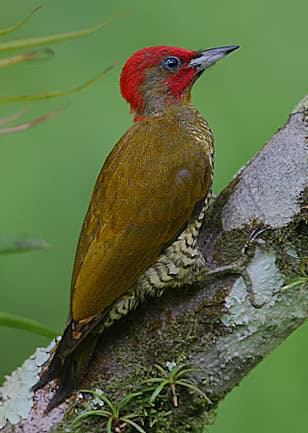
Rufous-winged woodpecker
The rufous-winged woodpecker is a bird species found in Central America, inhabiting humid forests and sometimes nearby open areas with large trees. This species is characterized by its bronze-green upperparts and cinnamon-rufous flight feathers, with males and females differing primarily in head plumage. It is known for its distinctive song and drumming, and primarily feeds on ants and beetles.

Andean flicker
The Andean flicker is a distinctive woodpecker species found in the open, high-altitude landscapes of South America, including the páramo and puna. It is characterized by its terrestrial foraging behavior, colonial nesting in earthen banks, and a varied vocal repertoire. This species is widespread across several Andean countries and is currently listed as Least Concern.
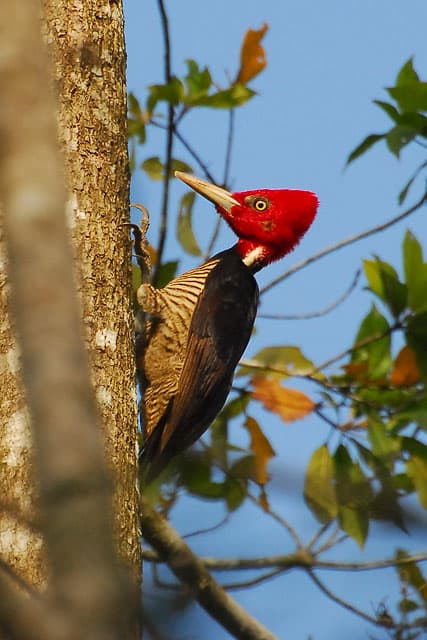
Pale-billed woodpecker
The pale-billed woodpecker is a large woodpecker species found from Mexico to Panama, inhabiting various forested landscapes including lowland tropical evergreen forests. It is characterized by its black upperparts with white or buffy white stripes, a long ivory-yellow bill, and a red head with a bushy crest in adult males. Primarily feeding on the larvae of wood-boring beetles, this species plays a role in forest ecosystems by excavating dead trees for nesting and foraging.