
White-backed woodpecker
The white-backed woodpecker (Dendrocopos leucotos) is a large Eurasian woodpecker characterized by white bars on its wings and a white lower back, distinguishing it from other spotted woodpeckers. Found across extensive deciduous forests from Europe to East Asia, it requires mature woodlands with ample dead wood for foraging and nesting.
Key Facts
- ›It is the largest spotted woodpecker in the western Palearctic, measuring 24–26 cm in length.
- ›Distinctive plumage includes white wing bars and a white lower back, with males having a red crown and females a black one.
- ›The species inhabits mature deciduous forests with a significant presence of standing and lying dead wood.
- ›Its diet primarily consists of wood-boring beetles and their larvae, supplemented by other insects, nuts, seeds, and berries.
- ›Nests are excavated in decaying tree trunks, typically measuring about 7 cm wide and 30 cm deep.
- ›Lifespan in the wild is typically three to four years, significantly longer in captivity.

Europe, Asia
White Bars Across Wings, White Lower Back, Red Crown, Black Crown
Wood-Boring Beetles, Larvae, Insects, Nuts, Seeds, Berries
- Forages on wood-boring beetles and their larvae within decaying wood.
Decaying Tree Trunks
Loud Drumming By Males, Soft 'Kiuk' Call, Longer 'Kweek' Call
About White-backed woodpecker
The white-backed woodpecker, scientifically known as Dendrocopos leucotos, is a notable member of the Dendrocopos genus, distinguished by its substantial size and specific plumage characteristics. It is recognized as the largest among the spotted woodpeckers found in the western Palearctic region, typically measuring between 24 and 26 centimeters in length with a wingspan of 38 to 40 centimeters.
Description and Identification
Its plumage bears a resemblance to the great spotted woodpecker but features distinctive white bars across the wings rather than spots, and a prominent white lower back. Males can be identified by their striking red crowns, while females have black crowns. The species' vocalizations include a loud drumming pattern produced by males and distinct calls described as a soft 'kiuk' and a longer 'kweek'.
Distribution and Habitat
The white-backed woodpecker has a wide geographical distribution, spanning across Eurasia. The nominate race, D. l. leucotos, is found from central and northern Europe eastward to northeast Asia, with various subspecies extending its range to Korea and Japan. This species is particularly dependent on large areas of mature deciduous forests that contain a significant amount of standing and lying dead wood, which are crucial for both its foraging and nesting requirements.
Ecology and Behavior
In terms of diet, the white-backed woodpecker primarily feeds on wood-boring beetles and their larvae, but it also supplements its diet with other insects, nuts, seeds, and berries. During the breeding season, it excavates nest holes, typically about 7 cm wide and 30 cm deep, within decaying tree trunks. It lays between three and five white eggs, with an incubation period of 10–11 days.
Lifespan and Conservation
The average lifespan of a white-backed woodpecker in the wild is between three and four years, though individuals in captivity can live considerably longer, up to approximately eleven years. The species faces conservation challenges, particularly in Nordic countries where its population has declined. This decline has led to protective measures, such as its inclusion in Sweden's national Biodiversity Action Plan, highlighting the importance of preserving its specific habitat needs.
Source: Wikipedia ↗
Frequently Asked Questions
What are the key physical characteristics of the white-backed woodpecker?
The white-backed woodpecker is the largest spotted woodpecker in the western Palearctic, measuring 24–26 cm long. It is distinguished by white bars across its wings and a white lower back. Males have a red crown, while females possess a black crown.
Where is the white-backed woodpecker found?
This species is distributed across Eurasia, with its range extending from northern, central, and eastern Europe to northeast Asia, including Korea and Japan. Its presence is dependent on large areas of mature deciduous forests.
What does the white-backed woodpecker eat?
The primary diet of the white-backed woodpecker consists of wood-boring beetles and their larvae. It also consumes other insects, along with nuts, seeds, and berries.
How does the white-backed woodpecker nest?
During the breeding season, the white-backed woodpecker excavates a nest hole in a decaying tree trunk. These holes are typically about 7 cm wide and 30 cm deep.
What is the typical lifespan of a white-backed woodpecker?
In its natural habitat, the white-backed woodpecker has a lifespan of approximately three to four years. In captivity, individuals have been known to survive for around eleven years.
What are the conservation concerns for the white-backed woodpecker?
Numbers of the white-backed woodpecker have decreased in Nordic countries, leading to protection measures in Sweden's national Biodiversity Action Plan. This decline is linked to its requirement for mature forests with ample dead wood.
Related Woodpecker species

Black woodpecker
The Black Woodpecker is the largest woodpecker species in Europe, easily recognizable by its entirely black plumage and striking red crown. Found in mature forests across the northern Palearctic, this non-migratory bird plays a crucial role in its ecosystem by excavating tree cavities that serve as homes for numerous other species. Its diet primarily consists of carpenter ants, and its powerful hammering ability allows it to access prey deep within trees.

Middle spotted woodpecker
The Middle spotted woodpecker is a European bird belonging to the genus Dendrocoptes, characterized by its red crown, pink vent, and lack of a moustachial stripe. It primarily inhabits deciduous forests across Europe and parts of West Asia, preferring areas with old trees and varied woodland structures. This species feeds mainly on insects and their larvae, foraging on branches and twigs, and is known for its distinctive song.
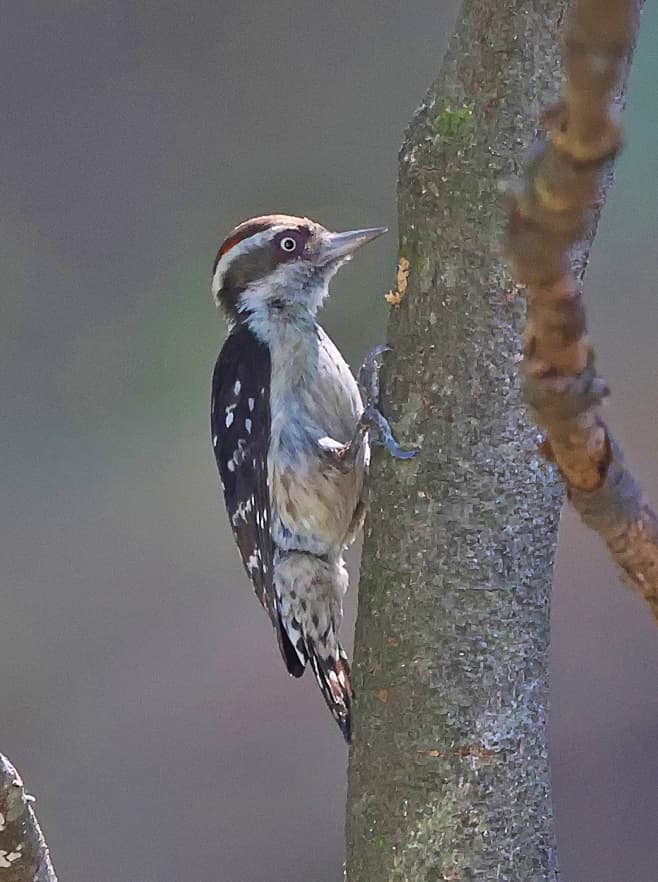
Brown-capped pygmy woodpecker
The brown-capped pygmy woodpecker is a very small species of woodpecker found in Nepal, India, and Sri Lanka. It is characterized by its brownish cap, pink-rimmed white irises, and barred brown and white plumage. These active birds are often observed foraging in pairs or small family groups in the tree canopy.