
White-naped woodpecker
The white-naped woodpecker is a large woodpecker species found across the Indian subcontinent, favoring open forests and scrubland with scattered trees. It is characterized by its distinctive white hind neck, golden-yellow upperparts, and V-shaped black markings on its back. Both males and females exhibit unique crown colors, with males having red and females yellow, while juveniles are duller versions of the female.
Key Facts
- ›It is a large woodpecker, measuring approximately 29 cm (11 in) in length.
- ›Distinguishing features include a white hind neck, golden-yellow upperparts, and a V-shaped black marking on the back.
- ›Adult males have a red crown, while females possess a yellow crown; young birds are duller.
- ›The species nests in tree holes, typically laying one or two white eggs.
- ›It inhabits open forest and scrub areas with some tree cover.
- ›Its diet primarily consists of insects, which it extracts using its long, darting tongue.
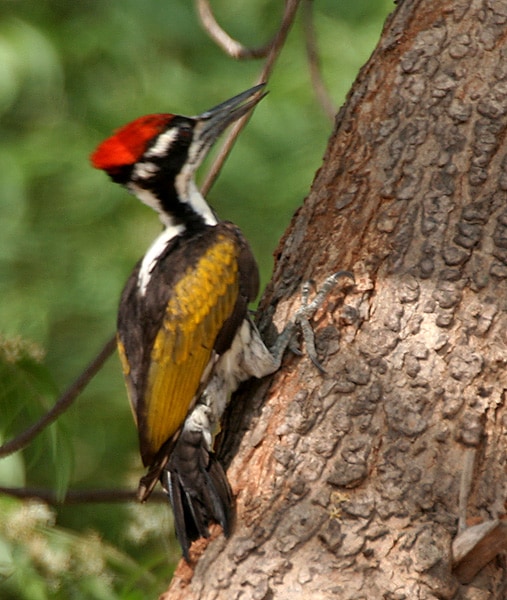
Festive Woodpecker
Indian Subcontinent, Sri Lanka
White, Golden Yellow, Black, Red, Yellow
White Hind Neck, V-Shaped Black Marking On Back, Dark Moustache Stripe, Red Crown, Yellow Crown
Insects
- Extracting insects from trees using a long, darting tongue
Tree Holes
About White-naped woodpecker
The White-naped woodpecker, scientifically known as Chrysocolaptes festivus, is a striking bird of the woodpecker family found across the Indian subcontinent and Sri Lanka. While widespread, it is considered a scarce breeder in many parts of its range. This species is most commonly observed in open forest settings and scrubland areas that feature scattered trees, indicating a preference for varied arboreal environments.
Description and Identification
Measuring approximately 29 cm (11 inches) in length, the White-naped woodpecker is a substantial species with a typical woodpecker morphology. Its most distinctive characteristic is the prominent white patch on its hind neck, which extends down the back. This is often bordered by black shoulder patches that form a V-shape on the upper back. The rest of the upperparts and wings are a vibrant golden yellow. The rump and tail are black, while the underparts are white, marked with dark chevron patterns. The head features a whitish base color, accented by a dark moustache stripe and a black eye patch that continues down the sides of the neck. A key sexual dimorphism is present in the crown coloration: adult males boast a red crown, whereas adult females display a yellow crown. Juvenile birds exhibit a duller coloration, generally resembling that of the female.
Like all woodpeckers, the White-naped woodpecker possesses a straight, pointed bill adapted for probing and excavating. Its tail feathers are stiff, providing essential support when clinging to tree trunks. Its feet are zygodactyl, meaning two toes point forward and two backward, an adaptation for arboreal life. The species has a long, extensible tongue capable of darting out to capture insects, its primary food source. The scientific name festivus is derived from Latin, meaning "festive" or "cheerful," perhaps reflecting its bright plumage.
Taxonomy and Subspecies
The White-naped woodpecker was first described by Georges-Louis Leclerc, Comte de Buffon, in 1780. It was later given the binomial name Picus festivus by Pieter Boddaert in 1783. The species is now classified within the genus Chrysocolaptes, a name derived from Ancient Greek words for "gold" and "chiseller." Two subspecies are recognized: C. f. festivus, found in central and southern India, and C. f. tantus, which inhabits Sri Lanka.
Behavior and Reproduction
The White-naped woodpecker nests in tree holes, a common behavior for cavity-nesting birds. A typical clutch consists of one or two white eggs. Specific details regarding their foraging behavior beyond insect extraction and their vocalizations are not elaborated upon in available records. Information on their lifespan, population trends, and precise breeding seasons is also not comprehensively documented.
Source: Wikipedia ↗
Frequently Asked Questions
What is the scientific name of the white-naped woodpecker?
The scientific name of the white-naped woodpecker is Chrysocolaptes festivus. It was first described by Pieter Boddaert in 1783 and is now placed in the genus Chrysocolaptes.
What does the white-naped woodpecker look like?
This woodpecker is large, about 29 cm long, with a prominent white hind neck. Its upperparts and wings are golden yellow, contrasted by black shoulder patches forming a V-shape on the back. The underparts are white with dark chevron markings, and it has a distinctive dark moustache stripe.
How can I tell male and female white-naped woodpeckers apart?
The primary difference is the crown color: adult males have a red crown, while females have a yellow crown. Young birds resemble the female but appear duller in coloration.
Where does the white-naped woodpecker build its nest?
The white-naped woodpecker excavates a nest hole in a tree. They typically lay one or two white eggs within these cavities.
What is the habitat of the white-naped woodpecker?
This species is found in open forest and scrubland environments that have a scattering of trees. It is widespread but generally scarce as a breeder in its range.
What do white-naped woodpeckers eat?
Like other woodpeckers, their diet consists mainly of insects. They are adept at extracting these from trees using their specialized long, darting tongues.
Related Woodpecker species
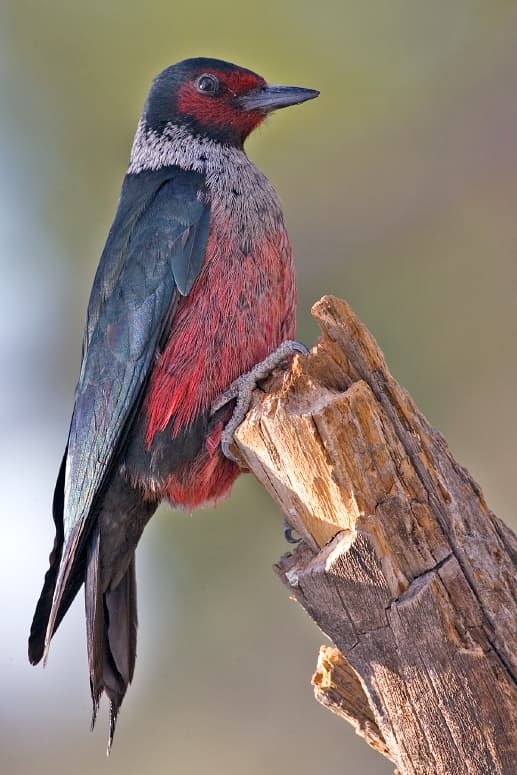
Lewis's woodpecker
Lewis's woodpecker is a large North American woodpecker known for its striking reddish-breasted and blackish-green plumage. It inhabits open pine woodlands and areas with scattered trees, often preferring to perch in the open. This species exhibits unique foraging behaviors, including catching insects in mid-air.

Black-rumped flameback
The black-rumped flameback is a distinctive woodpecker species found across the Indian subcontinent, notable for its presence in urban areas. It is characterized by its golden-yellow wing coverts, black throat, and black rump, setting it apart from other golden-backed woodpeckers. This species exhibits an undulating flight and a characteristic rattling-whinnying call.

Guatemalan flicker
The Guatemalan flicker is a species of woodpecker found in Middle America, ranging from southern Mexico to Nicaragua. It is characterized by its distinct facial markings, barred back, and a white rump. This species primarily forages on the ground for insects and also consumes fruits and seeds, nesting in excavated cavities in dead trees.