
Black-rumped flameback
Dinopium benghalense·Picidae·26–29 cm·February to July
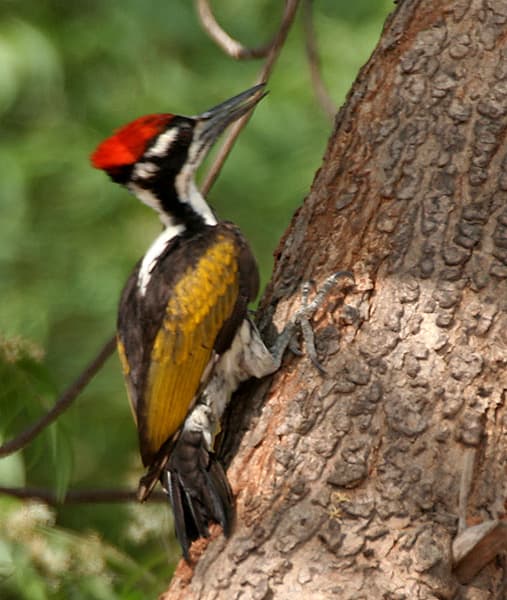
The black-rumped flameback is a distinctive woodpecker species found across the Indian subcontinent, notable for its presence in urban areas. It is characterized by its golden-yellow wing coverts, black throat, and black rump, setting it apart from other golden-backed woodpeckers. This species exhibits an undulating flight and a characteristic rattling-whinnying call.
Key Facts
- ›Found widely across the Indian subcontinent, including urban areas.
- ›Distinguished by golden-yellow wing coverts, a black throat, and a black rump.
- ›Adult males have a red crown and crest, while females have a black forecrown with white spots.
- ›Feeds primarily on insect larvae, especially from under tree bark, and visits termite mounds.
- ›Breeds between February and July, excavating nest holes with horizontal entrances.
- ›The nominate subspecies, Dinopium benghalense benghalense, is found in low elevations across India.

Lesser Golden-Backed Woodpecker, Lesser Goldenback
Indian Subcontinent, Pakistan, India, Bangladesh, Sri Lanka
Open Forest, Cultivation, Urban Areas With Wooded Avenues, Arid Regions
Golden Yellow, Black, White, Red, Grey
Black Throat, Black Rump, Golden Yellow Wing Coverts, Red Crown and Crest, Black Forecrown With White Spots
Beetle Larvae, Insects, Nectar
Forage From Ground To Canopy, Hop Movements Around Branches, Extract Larvae From Under Bark, Visit Termite Mounds, Adapt To Human-Modified Habitats
Excavated Nest Holes In Tree Trunks, Mud Embankments, Uurp Nest Holes of Other Birds
Characteristic Rattling-Whinnying Call, Drumming During Breeding Season
About Black-rumped flameback
The black-rumped flameback, scientifically known as Dinopium benghalense, is a striking woodpecker species recognized for its widespread presence across the Indian subcontinent. It is one of the few woodpecker species that readily adapts to and can be observed in urban environments, often frequenting wooded avenues. Its distinctive features, including golden-yellow wing coverts, a contrasting black throat, and a black rump, make it easily identifiable among other woodpecker species.
Description and Identification
Measuring between 26 to 29 cm in length, the black-rumped flameback possesses the typical robust build of a woodpecker. Its plumage is notable for the bright golden-yellow wing coverts and the unique combination of a black throat and a black rump, distinguishing it from the greater flameback which has a red rump. The underparts are white, marked with dark chevron patterns. The head is predominantly whitish with a greyish eye patch, and the male sports a red crown and crest. Females, in contrast, have a black forecrown speckled with white, with red coloration limited to the rear crest. Juveniles resemble females but appear duller.
Distribution and Habitat
This species is found primarily in the plains of Pakistan, India, Bangladesh, and Sri Lanka, extending to elevations of about 1200 meters. It thrives in open forests, agricultural areas, and is remarkably common in urban settings with sufficient tree cover. While it is widespread, it is noted to be somewhat rare in the desert regions of Rajasthan.
Behavior and Ecology
Black-rumped flamebacks are typically observed in pairs or small groups and may join mixed-species foraging flocks. Their diet consists mainly of insects, particularly beetle larvae, which they extract from beneath tree bark. They are also known to visit termite mounds and occasionally consume nectar. These woodpeckers are adept at foraging in various strata, from the ground to the canopy. They are highly adaptable, often taking advantage of human-modified habitats by feeding on fallen fruits or even food scraps.
Breeding
The breeding season for the black-rumped flameback generally occurs between February and July, with the exact timing influenced by local weather patterns. During this period, drumming is frequently heard. The birds excavate their own nest holes, which characteristically have a horizontal entrance that leads into a cavity. While they usually create their own nests, they are also known to usurp nest holes made by other bird species. Nests have also been recorded in mud embankments. A typical clutch consists of three elongate, glossy white eggs, which hatch after approximately 11 days of incubation. The young birds fledge and leave the nest about 20 days after hatching.
Source: Wikipedia ↗
Frequently Asked Questions
What are the identifying features of a black-rumped flameback?
The black-rumped flameback is easily identified by its golden-yellow wing coverts, a black throat, and a black rump, which are unique among golden-backed woodpeckers. It also has a whitish head with a greyish eye patch and no dark moustachial stripes, unlike the greater flameback.
Where can black-rumped flamebacks be found?
This species has a wide distribution across the Indian subcontinent, inhabiting plains up to about 1200 meters in Pakistan, India, Bangladesh, and Sri Lanka. They are often observed in open forests, cultivation, and even in urban environments with trees.
What do black-rumped flamebacks eat?
Their diet primarily consists of insects, particularly beetle larvae extracted from under tree bark. They also visit termite mounds and have been observed to feed on nectar. They are adaptable and may consume fallen fruits or food scraps in human-modified landscapes.
How do black-rumped flamebacks build their nests?
Black-rumped flamebacks excavate their own nest holes, typically with a horizontal entrance that descends into a cavity. These nests are usually found in tree trunks but can also be in mud embankments. They may sometimes take over nest holes made by other birds.
What is the difference between the black-rumped flameback and the greater flameback?
The primary differences lie in their rump color and throat markings. The black-rumped flameback has a black rump and a black throat finely marked with white, whereas the greater flameback has a red rump and lacks the distinct black throat. The black-rumped flameback also lacks the dark moustachial stripes found on the greater flameback.
Related Woodpecker species
White-naped woodpecker
The white-naped woodpecker is a large woodpecker species found across the Indian subcontinent, favoring open forests and scrubland with scattered trees. It is characterized by its distinctive white hind neck, golden-yellow upperparts, and V-shaped black markings on its back. Both males and females exhibit unique crown colors, with males having red and females yellow, while juveniles are duller versions of the female.

Beautiful woodpecker
The beautiful woodpecker is a species endemic to Colombia, found primarily in the Magdalena River valley. This bird is characterized by its striking plumage, with males and females differing in head patterns, and it feeds on a mixed diet of insects and fruits, foraging high in forest canopies. Its conservation status is assessed as Least Concern.

Black-cheeked woodpecker
The black-cheeked woodpecker is a medium-sized woodpecker found from Mexico south to Ecuador. It is characterized by its distinctive black "cheeks" extending from the eye down the neck, with males and females differing in head plumage. This species inhabits a variety of forest types and clearings, feeding on arthropods, fruits, and nectar.