
Lewis's woodpecker
Lewis's woodpecker is a large North American woodpecker known for its striking reddish-breasted and blackish-green plumage. It inhabits open pine woodlands and areas with scattered trees, often preferring to perch in the open. This species exhibits unique foraging behaviors, including catching insects in mid-air.
Key Facts
- ›One of the largest North American woodpecker species.
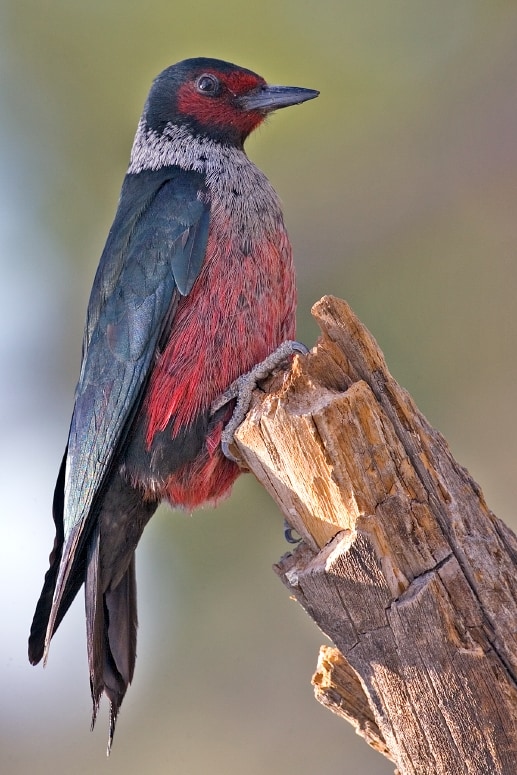
- ›Characterized by reddish breast, blackish-green back, and a gray collar.
- ›Forages by boring into trees, hawking insects in flight, and consuming berries and nuts.
- ›Nests in pre-existing cavities in dead trees.
- ›Ranges across the western and central United States, extending into Canada in summer.
- ›Known for its nomadic lifestyle and less clear migration patterns.
Lewis's Woodpecker
North America, Western United States, Central United States, Canada
Open Pine Woodlands, Areas With Scattered Trees, Areas With Snags
Reddish-Brown, Blackish-Green, Black, Gray, Pink, Red
Gray Collar and Upper Breast, Pinkish Belly, Red Face, Broad Wings
Insects, Berries, Nuts
Boring Into Trees, Hawking Insects In Flight, Storing Nuts
Pre-Existing Cavities In Dead Trees
Harsh Calls, Repertoire of Several Phrases
About Lewis's woodpecker
Lewis's woodpecker (Melanerpes lewis) is a notable species of woodpecker found in North America, distinguished by its size and unique behaviors. Ornithologist Alexander Wilson first described this bird in 1811, naming it in honor of Meriwether Lewis, a key figure in the exploration of the Louisiana Purchase territories.
Description and Identification
As one of the larger North American woodpeckers, Lewis's woodpecker typically measures between 25 to 28 cm in length. Its plumage is striking, featuring a reddish breast, blackish-green upperparts, a black rump, and a distinctive red face. A gray collar and upper breast, along with a pinkish belly, further enhance its unique appearance. Its wings are notably broader than those of many other woodpecker species, and it exhibits a slower, more deliberate flight pattern, often compared to that of a crow.
Range and Habitat
Lewis's woodpecker is locally common throughout the northwestern United States and can be found in the western and central parts of the country. Its preferred habitat includes open pine woodlands and areas with scattered trees and dead snags. Unlike many of its relatives, it tends to favor perching in open areas rather than deep tree cover. During the summer months, its range extends northward into Canada, and in winter, it can be found as far south as Southern California and the border region with Mexico. It has also been observed in several Midwestern states, including South Dakota, Michigan, Illinois, Minnesota, and Wisconsin.
Diet and Foraging Behavior
This species displays foraging habits that diverge from those of typical woodpeckers. While it does excavate wood to find insects, a significant portion of its diet is obtained through aerial insectivory, catching insects in flight—a behavior known as hawking, which is shared by only a few other woodpecker species. Lewis's woodpecker also supplements its diet with berries and nuts, and it has been observed shelling and storing nuts in tree crevices for later consumption.
Breeding and Nesting
Lewis's woodpecker nests in pre-existing cavities, typically within dead tree branches, usually positioned between 1 to 52 meters above the ground. The female lays between 5 and 9 plain white eggs. Incubation is shared by both parents, with the female incubating during the day and the male at night, for approximately 12 days. Both parents diligently care for the young, feeding them directly from the beak. The fledglings typically leave the nest four to five weeks after hatching. Successful mating pairs may return to the same nesting site in subsequent years.
Source: Wikipedia ↗
Frequently Asked Questions
What does Lewis's woodpecker look like?
Lewis's woodpecker is a large bird, measuring about 10-11 inches in length. It is predominantly blackish-green with a reddish breast, a gray collar, and a red face. Its wings are notably broad, contributing to a slower, more crow-like flight pattern.
Where can Lewis's woodpecker be found?
This species is commonly found in the northwestern United States, preferring open pine woodlands and areas with scattered trees. Its range extends across the western and central United States, and it can be seen as far north as Canada in the summer. In winter, it may be observed as far south as Southern California and the Mexican border.
What does Lewis's woodpecker eat?
Lewis's woodpecker has a diverse diet. While it does bore into trees for insects, it also famously catches insects in mid-air during flight. Additionally, it consumes berries and nuts, and even shells and stores nuts for later consumption.
How does Lewis's woodpecker nest?
Instead of excavating its own nest site, Lewis's woodpecker utilizes pre-existing cavities in dead tree branches. These nests are typically located between 1 to 52 meters above the ground. Both parents share incubation duties and care for the young after hatching.
What is unique about Lewis's woodpecker's behavior?
Lewis's woodpecker exhibits less typical woodpecker behavior in several ways. It enjoys perching in the open rather than in dense cover, and it is one of the few woodpecker species to catch insects in flight, a behavior known as hawking.
Related Woodpecker species
White-naped woodpecker
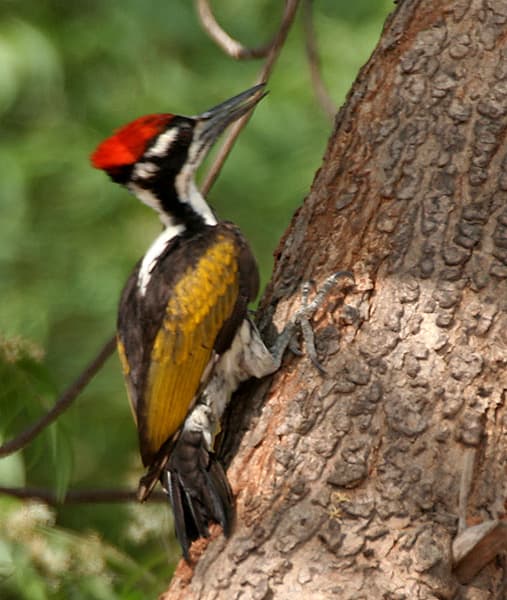
The white-naped woodpecker is a large woodpecker species found across the Indian subcontinent, favoring open forests and scrubland with scattered trees. It is characterized by its distinctive white hind neck, golden-yellow upperparts, and V-shaped black markings on its back. Both males and females exhibit unique crown colors, with males having red and females yellow, while juveniles are duller versions of the female.

Banded woodpecker
The banded woodpecker, also known as the banded red woodpecker, is a bird species found in tropical southeastern Asia. It is characterized by its predominantly rufous-brown upper parts, yellowish nape, and heavily barred belly. This species primarily inhabits lowland forests and mangroves, feeding on ants and other invertebrates.

Middle spotted woodpecker
The Middle spotted woodpecker is a European bird belonging to the genus Dendrocoptes, characterized by its red crown, pink vent, and lack of a moustachial stripe. It primarily inhabits deciduous forests across Europe and parts of West Asia, preferring areas with old trees and varied woodland structures. This species feeds mainly on insects and their larvae, foraging on branches and twigs, and is known for its distinctive song.