
White-spotted woodpecker
The white-spotted woodpecker is a species found in Argentina, Brazil, Paraguay, and Uruguay, inhabiting various wooded landscapes. It is characterized by its olive-green upperparts with yellowish bars and streaked olive underparts, with males and females differing primarily in head plumage. This species is known for its varied vocalizations and its habit of excavating nest cavities.
Key Facts
- ›Found in Argentina, Brazil, Paraguay, and Uruguay.
- ›Inhabits diverse wooded environments, including forests and open woodlands.
- ›Adults measure 16 to 19.5 cm in length and weigh 35 to 45 grams.
- ›Males and females exhibit similar plumage except for differences on their heads.
- ›Feeds on beetle larvae, other insects, fruit, and berries, foraging on various surfaces.
- ›Nests are excavated in cavities a few meters above the ground.
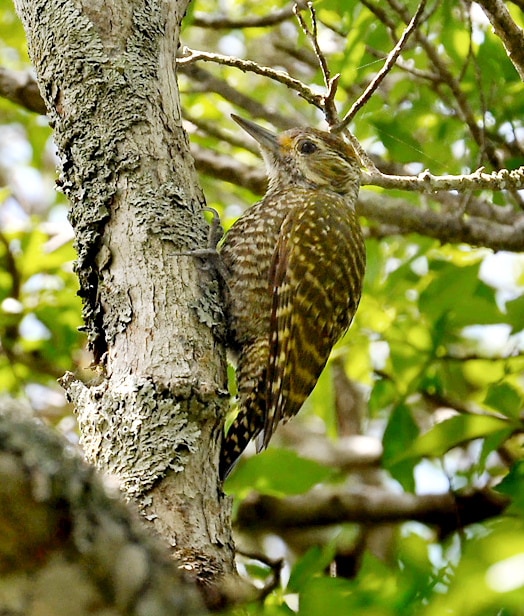
White-Spotted Woodpecker
South America
Humid Lowland Forest, Gallery Forest, Isolated Forest Patches, Open Woodland, Lightly Wooded Parks
- Males have a buffy to olive forehead and red streaks on the crown.
- Females have an olive-brown crown with fine white spots.
- Thin white supercilium.
- Thin white 'moustache'.
- White speckles throughout plumage.
- Yellowish to white feather edges on upperparts appearing as bars.
- Whitish bars on flight feathers and tail.
- Heavy yellowish white streaks on throat and bars on breast, belly, and undertail coverts.
Beetle Larvae, Insects, Fruit, Berries
- Forages on tree trunks, saplings, and fence posts.
- Pecks and hammers to extract prey.
- Plucks fruit and berries.
- Excavates Nest Cavities Within A Few Meters of the Ground.
- 'CheéKit Ch Che Che Che Che Che'
- 'CheéKit'
- 'Ti-Rra-Rra'
- 'Reh-Reh-Reh-Reh'
- Single 'Pic' notes
- Tapping signal in groups of 2–4 with pauses and single taps
About White-spotted woodpecker
The white-spotted woodpecker (Veniliornis spilogaster) is a species of bird belonging to the woodpecker family, Picidae. It is readily found across a wide range in South America, inhabiting countries such as Argentina, Brazil, Paraguay, and Uruguay. This adaptable species thrives in a variety of wooded environments, from dense humid lowland forests and gallery forests to more open woodlands and even lightly wooded parks.
Description and Identification
Adult white-spotted woodpeckers typically measure between 16 to 19.5 cm in length and weigh between 35 to 45 grams. Their plumage is predominantly olive-green on the upperparts, often appearing barred due to yellowish to white feather edges. The underparts are a darker olive, marked with heavy yellowish-white streaks and bars, particularly on the throat, breast, and belly. A key distinguishing feature is the thin white supercilium above the eye and a thin white 'moustache' mark. While both sexes share similar underparts and speckled faces, they differ in head coloration. Males display a buffy to olive forehead and a blackish-brown crown streaked with narrow red lines. Females, in contrast, have an olive-brown crown adorned with fine white spots. Juveniles resemble adults but exhibit fainter and less regular barring on their upper bodies.
Behavior and Ecology
The white-spotted woodpecker is a year-round resident within its established range, meaning it does not undertake seasonal migrations. Its feeding behavior is diverse; it forages on various surfaces like tree trunks, saplings, and fence posts, using its beak to peck and hammer for beetle larvae and other insects. It also supplements its diet by plucking fruit and berries. The breeding season for this species generally occurs between July and December. They are cavity nesters, excavating their nests within tree trunks or branches, typically a few meters above the ground. While much about their breeding cycle, such as clutch size and incubation period, remains undocumented, they are known for a variety of vocalizations, including distinct calls like 'cheékit' and 'ti-rra-rra', as well as alarm calls and a characteristic tapping signal.
Conservation Status
The International Union for Conservation of Nature (IUCN) has assessed the white-spotted woodpecker as Least Concern. This positive status is attributed to its extensive geographic range, a population that is believed to be stable, and its ability to adapt to various wooded habitats. No immediate threats are currently identified for the species, and it is considered common to locally abundant, often found within protected areas like national parks.
Source: Wikipedia ↗
Frequently Asked Questions
What is the scientific name for the white-spotted woodpecker?
The scientific name for the white-spotted woodpecker is *Veniliornis spilogaster*. However, some taxonomic systems have moved this species and others in the genus *Veniliornis* to the genus *Dryobates*.
Where can the white-spotted woodpecker be found?
The white-spotted woodpecker is distributed across South America, specifically in Brazil (Goiás and Minas Gerais), southeastern Paraguay, most of Uruguay, and northeastern Argentina as far as Entre Ríos Province.
What does the white-spotted woodpecker eat?
This woodpecker's diet consists of beetle larvae and other insects, which it extracts by pecking and hammering. It also consumes fruit and berries.
What kind of habitats does the white-spotted woodpecker prefer?
The white-spotted woodpecker is adaptable and can be found in a range of wooded environments. These include humid lowland forests, gallery forests, isolated forest patches, open to very open woodlands, and lightly wooded parks.
What are the typical nesting habits of the white-spotted woodpecker?
White-spotted woodpeckers excavate their nest cavities within a few meters of the ground. Details regarding clutch size, incubation periods, and fledging times are not extensively documented.
What is the conservation status of the white-spotted woodpecker?
The white-spotted woodpecker has been assessed by the IUCN as Least Concern. Its large range, believed stable population, and adaptability contribute to its favorable conservation status.
Related Woodpecker species
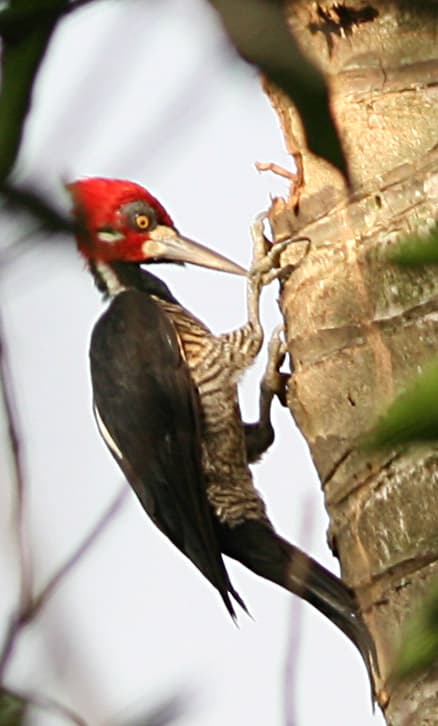
Crimson-crested woodpecker
The crimson-crested woodpecker is one of the largest woodpeckers in its range, distinguished by its striking plumage and a long, ivory chisel-like bill. It is found throughout much of mainland South America and Panama, inhabiting a variety of forested landscapes. This species is known for its foraging behavior, which involves pecking and probing bark for insects, and its distinct vocalizations and drumming patterns.

Chilean flicker
The Chilean flicker is a medium-sized woodpecker species found in central and southern Chile and southwestern Argentina. It primarily inhabits semi-open to open landscapes and feeds almost exclusively on ants found on the ground. This species is characterized by its dark slate gray head in males, buffish underparts with blackish brown barring, and a white rump.

Chestnut woodpecker
The chestnut woodpecker is a bird species found across much of mainland South America and Trinidad. It is characterized by its chestnut plumage, a bright red malar area in males, and a distinctive call. This species primarily inhabits forests and secondary growth areas, where it forages for ants and termites.