
Crimson-crested woodpecker
The crimson-crested woodpecker is one of the largest woodpeckers in its range, distinguished by its striking plumage and a long, ivory chisel-like bill. It is found throughout much of mainland South America and Panama, inhabiting a variety of forested landscapes. This species is known for its foraging behavior, which involves pecking and probing bark for insects, and its distinct vocalizations and drumming patterns.
Key Facts
- ›It is one of the largest woodpeckers in its geographic range, measuring 33 to 36 cm in length.
- ›Its diet primarily consists of insects, such as beetles, butterflies, moths, and ants, both adult and larval.
- ›The species is found in a wide variety of forested habitats, favoring humid lowland forests, riverine forests, and mature secondary forests.
- ›Both sexes excavate nest cavities, typically in large-diameter trees.
- ›The IUCN status is Least Concern, despite a belief that its population is decreasing due to deforestation.
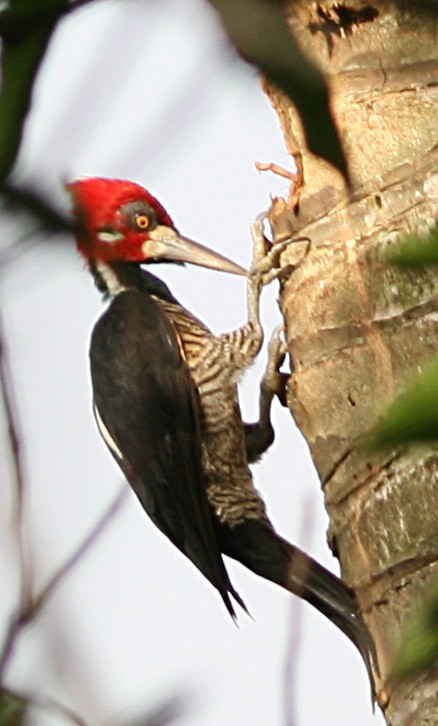
Buff-Crested Woodpecker
South America, Panama, Trinidad
Humid Lowland Forest, Forest Along Rivers, Mature Secondary Forest, Plantations With Tall Trees
Long ivory chisel bill, White to pale yellow patch at base of bill, Red head, Black around eye and front of crest, Wide white stripe with black edges on neck, Vertical white stripes on neck and back
Insects, Beetles, Butterflies, Moths, Ants, Termites, Berries, Seeds
Pecking, Probing, Digging, Scaling Bark
Excavated Cavity In Large-Diameter Tree
Hollow, Popping Series of Notes, Rapid Chatter: Tkep-Tkep-Tkep, Kwirr Kwirr-Al, Wuk Wuk, Wrr Wrr, Uh Uh, Alarm Calls: Repeated Ca-Wa-Rr-R, Shrill Put Put Puttas, Drumming: Da-Drrr
About Crimson-crested woodpecker
The crimson-crested woodpecker (Campephilus melanoleucos), also known historically as the buff-crested woodpecker, is a striking bird species belonging to the woodpecker family, Picidae. It is one of the largest woodpeckers to inhabit its extensive range, which spans Panama, Trinidad, and most mainland South American countries, excluding Chile and Uruguay.
Description and Identification
Measuring between 33 to 36 cm in length and weighing 225 to 281 grams, the crimson-crested woodpecker is notable for its size. Adult males display a predominantly red head, accented by a white patch at the base of their bill and a small black-and-white spot on their ear coverts. Females, in contrast, have black around their eyes and the front of their crest, distinguished by a broad white stripe edged in black that extends from the bill down the side of their neck. Both sexes share black upperparts, with white stripes running from the nape down the neck and onto the back, forming a "V" shape. Their wings and tail are brownish-black, and flight feathers often have pale white or yellowish edges. The lower breast and belly are a pale cinnamon buff to tawy, marked with wide black bars. Their bill is a significant feature, described as a long, ivory chisel. The iris is white to yellow, and their legs are various shades of gray.
Distribution and Habitat
The nominate subspecies, C. m. melanoleucos, is the most widespread, found across Trinidad, from eastern Colombia eastward through Venezuela and the Guianas, down the eastern side of the Andes in Ecuador, Peru, Bolivia, and Paraguay, across much of Amazonian Brazil, and into northeastern Argentina. Subspecies C. m. malherbii is found in Panama and northern/central Colombia, while C. m. cearae inhabits northeastern Brazil. These woodpeckers thrive in a diverse array of forested environments, showing a preference for large tracts of humid lowland forests, such as terra firme and riverine forests, as well as mature secondary forests. They can also be found in somewhat more open areas, including plantations, provided that tall trees are present.
Behavior and Ecology
The crimson-crested woodpecker forages at all levels of the forest, often favoring the mid-level. Its feeding techniques include pecking, probing, digging, and scaling bark to access its prey. The diet is primarily insectivorous, with a strong preference for beetles, butterflies, moths, and ants, including both adults and larvae. Termites, small berries, and seeds also supplement their diet. Pairs frequently forage together, though they may maintain some distance. The species breeds at different times across its range, with nesting periods noted from November through January in Panama and February to April in Suriname. Both male and female birds participate in excavating the nest cavity, typically in substantial trees. Drumming and vocalizations are common during this excavation phase. A known clutch size consists of two eggs, with both parents sharing incubation and the care of young.
Vocalizations
While not considered highly vocal, the crimson-crested woodpecker possesses a range of calls. During the breeding season, a common call is a "hollow, popping series of notes," sometimes delivered as a rapid chatter. Other calls between pairs include "kwirr kwirr-al," "wuk wuk, wrr wrr," and "uh uh." Alarm calls are described as a "repeated ca-wa-rr-r" or a "shrill put put puttas." The species' characteristic drumming is initiated with a strong blow, followed by a vibrating tremble of weaker notes, often rendered as "DA-drrr." Steady drumming has also been noted during nest excavation, and their wings produce a "heavy sound" in flight.
Conservation Status
The International Union for Conservation of Nature (IUCN) has assessed the crimson-crested woodpecker as Least Concern. The species boasts an extremely large range and an estimated population exceeding five million mature individuals. However, there is a belief that this population is currently decreasing. Deforestation poses the most significant human-induced impact, leading to a substantial loss of suitable habitat for the species over time.
Source: Wikipedia ↗
Frequently Asked Questions
What is the scientific name for the crimson-crested woodpecker?
The scientific name for the crimson-crested woodpecker is *Campephilus melanoleucos*. This binomial name was given by Johann Friedrich Gmelin in 1788, combining the Ancient Greek words for 'black' and 'white'.
Where does the crimson-crested woodpecker live?
This woodpecker is found in Panama, Trinidad, and most mainland South American countries, excluding Chile and Uruguay. Its habitat includes humid lowland forests, riverine forests, and mature secondary forests.
What does the crimson-crested woodpecker eat?
The primary diet of the crimson-crested woodpecker consists of insects, including beetles, butterflies, moths, and ants, in both adult and larval stages. They have also been observed eating termites, small berries, and seeds.
What are the distinguishing features of a crimson-crested woodpecker?
Adult males have a mostly red head with a white patch at the base of the bill. Females have black around their eye and the front of their crest, with a broad white stripe extending from the bill down the neck. Both sexes have black upperparts with white stripes on the neck and back, and pale cinnamon buff to tawy undersides with black bars.
What is the conservation status of the crimson-crested woodpecker?
The crimson-crested woodpecker is listed as Least Concern by the IUCN. While its population is believed to be decreasing, no immediate threats have been identified beyond the effects of deforestation.
Related Woodpecker species
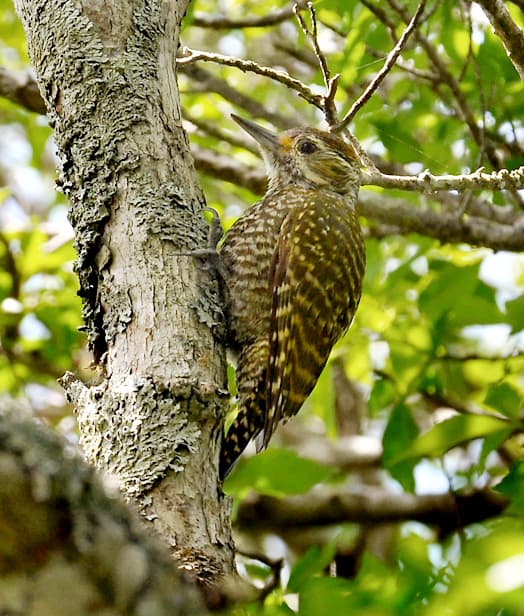
White-spotted woodpecker
The white-spotted woodpecker is a species found in Argentina, Brazil, Paraguay, and Uruguay, inhabiting various wooded landscapes. It is characterized by its olive-green upperparts with yellowish bars and streaked olive underparts, with males and females differing primarily in head plumage. This species is known for its varied vocalizations and its habit of excavating nest cavities.

Black-cheeked woodpecker
The black-cheeked woodpecker is a medium-sized woodpecker found from Mexico south to Ecuador. It is characterized by its distinctive black "cheeks" extending from the eye down the neck, with males and females differing in head plumage. This species inhabits a variety of forest types and clearings, feeding on arthropods, fruits, and nectar.
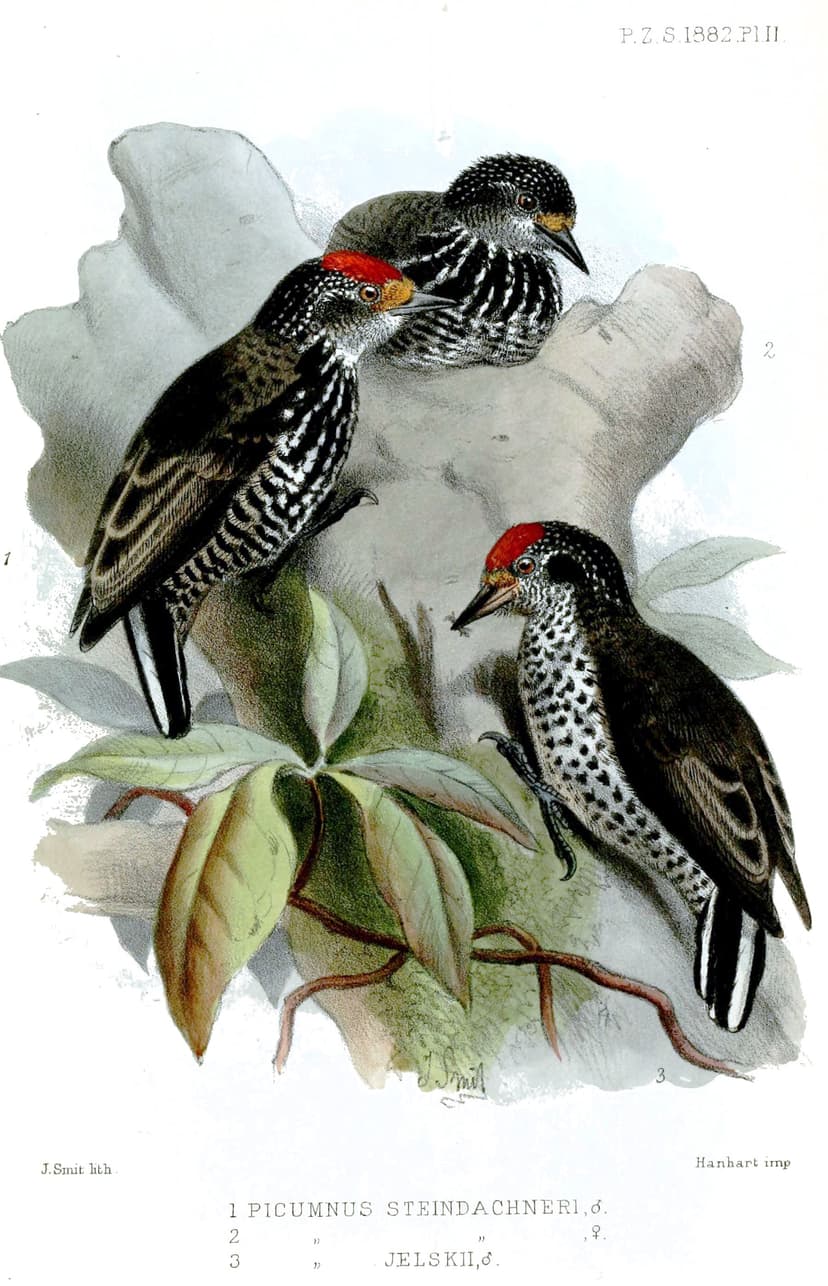
Ocellated piculet
The ocellated piculet is a small bird species found in the montane forests of Bolivia and Peru, with a possible extension into Argentina. Measuring between 9 to 10 cm, it is characterized by its predominantly brownish plumage, with males displaying red tips on their forehead feathers and males and females having spotted caps. They forage in pairs or singly, often as part of mixed-species flocks, and their diet is known to include insects.