
Dasypus
Mammal, Cingulata·Shady forests, brush areas, temperate regions, grassland, swamp areas, and near bodies of water.·Mainly insectivorous, consuming insects, small reptiles, amphibians, and plants. Also known to eat small mammals, bird eggs, and carrion.·Least Concern for the majority of species, though a few are at risk due to habitat loss.
Armadillos are a group of New World placental mammals, the only surviving family (Chlamyphoridae and Dasypodidae) of the order Cingulata. They are known for their distinctive leathery armor shell and their characteristic digging behaviors, primarily found in Central and South America. The genus Dasypus, known as long-nosed or naked-tailed armadillos, is the only extant genus in the family Dasypodidae. They are found in South, Central, and North America, as well as on the Caribbean islands of Grenada, Trinidad and Tobago.
Key Facts
- ›Armadillos are mammals belonging to the order Cingulata, characterized by a bony, leathery shell.
- ›They are primarily found in Central and South America, with some species extending into North America and Caribbean islands.
- ›Armadillos are known for their digging abilities, creating burrows for shelter and foraging.
- ›Their diet mainly consists of insects, small reptiles, amphibians, and some plant matter.
- ›They are generally solitary and nocturnal animals, avoiding extreme temperatures and predators.
- ›The nine-banded armadillo is commonly used in leprosy research due to its susceptibility to the disease.
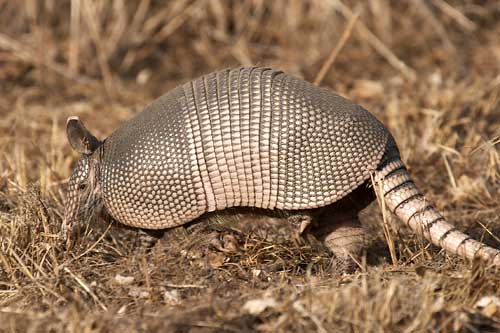
- Hard Armor-Like Shell Composed of Ossified Dermal Plates.
- Six To Eleven Movable Bands Covered By Leathery Keratinous Skin.
- Thin Epidermal Layer Between Armor Bands Allows For Flexibility.
- Gray Or Brown In Color.
- Long and Sharp Claws For Digging.
- Lack Bony Covering On Face, Neck, and Underside, Which Are Covered With Small Bunches of Hair.
- Small, Flattened Skull With A Long Lower Jaw and Narrow Snout.
- Small, Rudimentary Teeth Without Incisors Or Canines.
- Long and Sticky Tongue.
- Poor Eyesight, Reliant On Keen Sense of Smell and Hearing.
- Solitary Animals, Though May Pair During Mating Season.
- Primarily Nocturnal To Avoid Temperature Extremes and Predation.
- Dig Burrows For Shelter, Often Near Water Sources.
- Can Run To Burrows Or Crevices When Threatened.
- Curl Up To Protect Vulnerable Underside If No Shelter Is Available.
- Can Climb, Swim, and Jump.
- Hold Breath For Up To Six Minutes To Cross Water Bodies Underwater.
- Inflate Stomachs and Intestines With Air To Float and Swim Across Larger Water Bodies.
- Use Olfaction As Their Primary Sense For Foraging.
- Can Smell Food Up To 20 cm Below Ground.
- Stand On Hind Legs and Use Tail For Bracing To Sniff the Air.
- May Show Slight Aggressive Behavior During Mating Season Or When Nursing.
- Respond To Threats By Freezing, Jumping, Or Sprinting Away.
- Occasionally Share Burrows With Other Animals Like Rabbits Or Skunks, Or With Siblings During Their First Year.
- May Share Burrows With Other Armadillos During Extreme Cold For Thermoregulation.
Long-Nosed Armadillos, Naked-Tailed Armadillos
Coyotes, Dogs, Humans
Highway Accidents, Habitat Loss, Hunting, Predation By Dogs and Coyotes, Raiding Sea Turtle Nests In Some Areas
About Dasypus
What are Armadillos?
Armadillos are a distinctive group of New World placental mammals, belonging to the order Cingulata. They are characterized by their unique leathery armor shell, which is composed of ossified dermal plates. The genus Dasypus, known commonly as long-nosed or naked-tailed armadillos, represents the only extant genus within the family Dasypodidae.
Distribution and Habitat
These creatures are primarily found in South, Central, and North America, with some species extending their range to the Caribbean islands of Grenada, Trinidad, and Tobago. Armadillos thrive in a variety of habitats, including shady forests, brushy areas, grasslands, and swampy regions. They are often found near bodies of water, as adequate food and water availability are crucial for their survival. Their burrows, which can be extensive, are frequently dug into stream banks, tree stumps, or rock and brush piles.
Physical Characteristics and Behavior
Armadillos typically display a gray or brown coloration and possess long, sharp claws ideal for digging. Their armor shell, which consists of movable bands, allows for some flexibility. Unlike some other armadillo species, members of the genus Dasypus are unable to roll into a complete protective ball when threatened. Instead, they tend to flee to the nearest burrow or crevice, or wedge themselves in tightly. Due to their limited body fat and sensitivity to temperature, they are primarily nocturnal, active during cooler nights to avoid extreme heat and cold. They are also capable swimmers and can even hold their breath for extended periods to walk along the bottom of water bodies.
Diet and Reproduction
The diet of armadillos is largely insectivorous, consisting of insects, small reptiles, amphibians, and some plant matter. They utilize their keen sense of smell to locate food buried underground. Armadillos are generally solitary animals, but they often pair during the breeding season. A unique reproductive trait among Dasypus species is monozygotic polyembryony, where a single fertilized egg divides into four genetically identical offspring. Gestation is approximately five months, with a notable implantation delay, allowing for birth during a more opportune spring period.
Ecological Role and Conservation
Armadillos play a role in their ecosystems, though some populations face challenges. While the majority of Dasypus species are classified as Least Concern by the IUCN, certain species are at risk due to habitat loss. In some regions, they have been noted to raid sea turtle nests, leading to human intervention. Conversely, they also serve as an important food source for endangered predators like the Florida panther. The nine-banded armadillo, in particular, has become a significant model in scientific research, notably in the study of leprosy due to its susceptibility to the bacterium Mycobacterium leprae.
Source: Wikipedia ↗
Frequently Asked Questions
What are armadillos?
Armadillos are New World placental mammals recognized by their distinctive leathery armor shell. They are the sole surviving family of the order Cingulata and are predominantly found in Central and South America.
Where do armadillos live?
Armadillos inhabit a wide range across South, Central, and North America. They are also found on Caribbean islands such as Grenada, Trinidad, and Tobago.
What do armadillos eat?
The natural diet of armadillos is primarily insectivorous, including beetles, snails, ants, and worms. They also consume small reptiles, amphibians, fruits, seeds, and fungi.
Are armadillos nocturnal?
Yes, armadillos are primarily nocturnal. They are most active during the night to avoid temperature extremes and potential predators.
Can armadillos roll into a ball?
Most armadillos, particularly those in the genus Dasypus, cannot roll into a complete ball. This ability is characteristic of other armadillo species, like the Brazilian three-banded armadillo, due to their fewer dermal plates.
Why are armadillos used in leprosy research?
The nine-banded armadillo is a key model for leprosy research because it is one of the few animals, besides primates, that can naturally contract the disease. Its unique physiology allows for the propagation of the bacteria Mycobacterium leprae, advancing the study of the chronic effects and potential treatments for leprosy.
Related Armadillos

Chlamyphorus
The pink fairy armadillo (Chlamyphorus truncatus) is the smallest known species of armadillo, distinguished by its leathery yet flexible armor shell and silky fur. It is a solitary, nocturnal mammal endemic to the deserts and scrublands of central Argentina, known for its remarkable ability to rapidly burrow into sandy soils. This elusive creature faces conservation concerns due to habitat loss, predation, and its sensitivity to environmental changes.

Priodontes
The giant armadillo (Priodontes maximus) is the largest living species of armadillo, distinguished by its leathery armor and impressive digging abilities. Primarily found in South America, it is characterized by its dark brown body, yellowish side band, and a pale head. This species is currently classified as vulnerable due to various threats, including hunting and habitat loss.

Zaedyus
The pichi (Zaedyus pichiy), also known as the dwarf armadillo or pygmy armadillo, is a small armadillo species native to Argentina and Chile. It is the sole surviving member of the genus Zaedyus and is unique among armadillos for its ability to hibernate. Fossil evidence suggests the species has existed since the late Miocene epoch.