
Priodontes
Mammal, Cingulata·Primarily open habitats such as cerrado grasslands and lowland forests.·Mainly termites and ants, also consumes worms, spiders, other invertebrates, small vertebrates, carrion, and plants. Has been known to eat bees.·Vulnerable
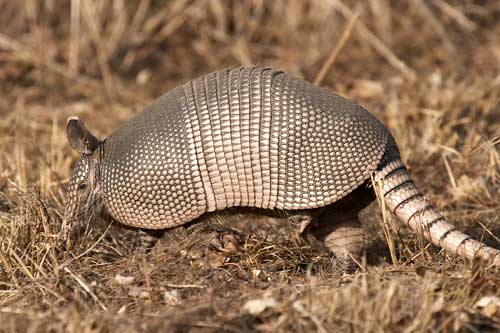
The giant armadillo (Priodontes maximus) is the largest living species of armadillo, distinguished by its leathery armor and impressive digging abilities. Primarily found in South America, it is characterized by its dark brown body, yellowish side band, and a pale head. This species is currently classified as vulnerable due to various threats, including hunting and habitat loss.
Key Facts
- ›It is the largest living species of armadillo.
- ›Possesses around 80 to 100 constantly growing teeth, more than any other terrestrial mammal.
- ›Features extremely long front claws, with the third claw reaching up to 22 cm.
- ›Primarily inhabits open habitats like cerrado grasslands and lowland forests.
- ›Considered a habitat engineer due to the extensive use of its burrows by other species.
- ›Classified as vulnerable to extinction by the IUCN.

- Largest Living Species of Armadillo.
- 11 To 13 Hinged Bands Protecting the Body, Plus 3-4 On the Neck.
- Dark Brown Body With A Lighter, Yellowish Band Along the Sides.
- Pale, Yellow-White Head.
- Around 80 To 100 Continuously Growing Teeth.
- Extremely Long Front Claws, With the Third Claw Up To 22 cm.
- Tail Covered In Small Rounded Scales.
- Almost Entirely Hairless, With Sparse Beige Hairs.
- Solitary and Nocturnal.
- Spends Days In Burrows.
- Digs Burrows For Prey and Predator Escape.
- Burrows Are Unusually Large With Wide Entrances.
- Uses Large Front Claws To Dig For Prey and Rip Open Termite Mounds.
- Considered A Habitat Engineer Due To the Extensive Use of Their Burrows By Other Species.
Tatu-Canastra, Tatou, Ocarro, Tatú Carreta
Hunting For Meat and Black Market Trade., Habitat Loss Due To Deforestation.
About Priodontes
The Giant Armadillo (Priodontes maximus)
The giant armadillo, scientifically known as Priodontes maximus, is the largest extant species of armadillo, distinguished by its robust armor plating and remarkable digging capabilities. Colloquially referred to by names such as tatu-canastra, tatou, ocarro, and tatú carreta, this species is native to South America.
Description and Physical Characteristics
This impressive mammal is characterized by its substantial size, weighing typically between 18.7 and 32.5 kg, with recorded specimens reaching up to 54 kg in the wild and 80 kg in captivity. Its body length ranges from 75 to 100 cm, with an additional 50 cm contributed by its tail. The giant armadillo's most striking feature is its leathery armor, composed of 11 to 13 hinged bands that protect its body, along with three to four bands on its neck. The coloration is predominantly dark brown, accented by a lighter, yellowish band running along its sides, and a pale, yellow-white head. Uniquely among terrestrial mammals, it possesses a high number of teeth, ranging from 80 to 100, which are continuously growing and lack enamel. Its front claws are exceptionally long and powerful, with the third claw being sickle-shaped and capable of reaching up to 22 cm, proportionate to its body size.
Distribution and Habitat
The distribution of the giant armadillo spans across much of northern South America, east of the Andes. Its range extends south to the northern provinces of Argentina, including Salta, Formosa, Chaco, and Santiago del Estero. While they are absent from eastern Brazil and Paraguay, they inhabit a variety of open environments, with cerrado grasslands constituting about 25% of their range, and they can also be found in lowland forests.
Biology and Behavior
Giant armadillos are solitary and nocturnal creatures, typically spending daylight hours concealed within burrows. These burrows are notably large, with entrances often averaging 43 cm in width, and are primarily dug to escape predators or to seek refuge. They are unable to roll into a complete protective ball, a common defense mechanism in some other armadillo species. Their formidable front claws are essential tools for their foraging habits, used to dig for prey and to excavate termite mounds. The diet primarily consists of termites, but they are opportunistic feeders, also consuming ants, worms, spiders, other invertebrates, small vertebrates, carrion, and even plants. Some individuals have been observed digging into beehives to consume bees. The species is recognized as a habitat engineer, as its large burrows are frequently utilized by dozens of other mammal, reptile, and bird species, highlighting its ecological importance.
Reproduction and Lifespan
Information regarding the reproductive biology of giant armadillos is limited. Female giant armadillos possess two teats and have a gestation period of approximately five months, with evidence suggesting they give birth only once every three years. While juveniles have not been discovered in the wild, it is estimated that young are weaned between seven to eight months of age. Mothers are believed to periodically seal the entrances of burrows containing young offspring, likely as a protective measure against predators. While captive breeding has not been achieved, a wild-born specimen at the San Antonio Zoo was estimated to be around sixteen years old at the time of its death, offering a limited insight into their potential lifespan.
Conservation Status and Threats
The giant armadillo is classified as vulnerable on the World Conservation Union's Red List, and its trade is regulated under Appendix I of CITES, indicating it is threatened with extinction. The species faces significant threats from hunting, as individual armadillos provide a substantial source of meat for some indigenous communities. Live capture for the black market also occurs, with many animals dying during transit or in captivity. Habitat loss driven by deforestation further exacerbates population declines. Current estimates suggest a worrying population decrease of 30 to 50 percent over the past three decades, a trend that is likely to persist without intervention. While protected by law in several South American countries and present in some protected reserves, targeted conservation efforts are crucial to prevent further decline.
Source: Wikipedia ↗
Frequently Asked Questions
What is the largest living armadillo species?
The largest living species of armadillo is the giant armadillo, scientifically known as Priodontes maximus. It is significantly larger than other armadillo species, though extinct relatives like glyptodonts were even more massive.
Where are giant armadillos found?
Giant armadillos are found throughout much of northern South America, east of the Andes mountains. They range south into the northernmost provinces of Argentina and inhabit areas with cerrado grasslands and lowland forests.
What does a giant armadillo eat?
The primary diet of the giant armadillo consists of termites, often consuming entire termite mound populations. They also prey on ants, worms, spiders, other invertebrates, small vertebrates, carrion, and have been known to eat bees.
Are giant armadillos endangered?
The giant armadillo is classified as vulnerable to extinction by the World Conservation Union's Red List. It faces threats from hunting for meat and the black market, as well as habitat loss due to deforestation.
What are the distinctive physical features of a giant armadillo?
Giant armadillos are characterized by their large size, dark brown body with a yellowish side band, and a pale head. They possess a unique shell with 11 to 13 hinged bands, and exceptionally long front claws, including a sickle-shaped third claw that can be up to 22 cm long.
How do giant armadillos behave?
Giant armadillos are solitary and nocturnal animals that spend their days in burrows. They are skilled diggers, using their powerful claws to excavate for prey and to create large burrows which are often utilized by other animal species.
Related Armadillos

Chlamyphorus
The pink fairy armadillo (Chlamyphorus truncatus) is the smallest known species of armadillo, distinguished by its leathery yet flexible armor shell and silky fur. It is a solitary, nocturnal mammal endemic to the deserts and scrublands of central Argentina, known for its remarkable ability to rapidly burrow into sandy soils. This elusive creature faces conservation concerns due to habitat loss, predation, and its sensitivity to environmental changes.
Dasypus
Armadillos are a group of New World placental mammals, the only surviving family (Chlamyphoridae and Dasypodidae) of the order Cingulata. They are known for their distinctive leathery armor shell and their characteristic digging behaviors, primarily found in Central and South America. The genus Dasypus, known as long-nosed or naked-tailed armadillos, is the only extant genus in the family Dasypodidae. They are found in South, Central, and North America, as well as on the Caribbean islands of Grenada, Trinidad and Tobago.

Zaedyus
The pichi (Zaedyus pichiy), also known as the dwarf armadillo or pygmy armadillo, is a small armadillo species native to Argentina and Chile. It is the sole surviving member of the genus Zaedyus and is unique among armadillos for its ability to hibernate. Fossil evidence suggests the species has existed since the late Miocene epoch.