
Tolypeutes
Mammal, Cingulata·Open and semi-open habitats·Endangered·Three-banded
Tolypeutes represents a genus of New World placental mammals, specifically the only surviving family (Chlamyphoridae and Dasypodidae) within the order Cingulata, commonly known as armadillos. The two species within this genus are distinguished by their unique three-banded leathery armor shell and their characteristic defensive behavior of rolling into a ball when threatened. They are primarily found in open and semi-open habitats across South America, particularly in Brazil. Unlike other armadillo species, Tolypeutes species do not typically dig their own burrows, relying instead on abandoned ones, which makes them vulnerable to habitat loss.
Key Facts
- ›The genus Tolypeutes contains the two species of three-banded armadillos.
- ›They are restricted to open and semi-open habitats in South America, especially Brazil.
- ›Tolypeutes species rely heavily on their armor for protection and can roll into a ball when threatened.
- ›They lack the ability to dig burrows and depend on abandoned ones.
- ›This genus is endangered due to hunting and deforestation.

Distinctive Leathery Armor Shell, Three Movable Bands In Their Shell
- Rely Heavily On Armor For Protection
- Frequently Roll Up Into A Ball When Threatened
- Lack the Ability To Dig Burrows, Relying On Abandoned Ones
Three-Banded Armadillo
Hunting, Deforestation
About Tolypeutes
The Genus Tolypeutes: Three-Banded Armadillos
The genus Tolypeutes encompasses the two species of three-banded armadillos, unique mammals found exclusively in South America. These armadillos are characterized by their distinctive leathery armor shell, which features three movable bands, allowing for a remarkable defensive maneuver. Unlike many of their relatives, Tolypeutes species possess the extraordinary ability to roll themselves into a tight, protective ball when faced with danger. This specialized adaptation is crucial for their survival in their native open and semi-open habitats.
Habitat and Behavior
Tolypeutes armadillos are primarily found in South America, with a significant presence in Brazil. They inhabit environments that are open or semi-open. A notable behavioral trait of this genus is their reliance on their armor for protection, a characteristic that sets them apart from other armadillo groups. Crucially, Tolypeutes species do not typically excavate their own burrows. Instead, they depend on abandoned burrows dug by other animals for shelter and safety.
Conservation Concerns
Regrettably, the two species within the Tolypeutes genus are currently classified as endangered. The primary drivers of this critical conservation status are hunting and the extensive deforestation occurring within their native Brazilian habitat. Deforestation poses a particularly severe threat, as it directly reduces the availability of the abandoned burrows that these armadillos depend upon. Without adequate shelter, they become more vulnerable to predators and human activities, further endangering their populations.
Source: Wikipedia ↗
Frequently Asked Questions
What is special about the Tolypeutes armadillo's defense mechanism?
Tolypeutes armadillos are unique among their relatives because they can roll up into a tight ball when threatened by a predator. This is a primary defense mechanism, offering significant protection due to their specialized armor.
Where are Tolypeutes armadillos found?
The species within the Tolypeutes genus are found in South America, specifically in open and semi-open habitats. Their native range includes Brazil, where they are particularly impacted by habitat loss.
Do Tolypeutes armadillos dig their own burrows?
No, Tolypeutes armadillos do not possess the ability to dig their own burrows. Instead, they rely on using abandoned burrows dug by other animals.
What are the main threats to Tolypeutes armadillos?
The primary threats to Tolypeutes armadillos are hunting and the deforestation of their native habitats. Deforestation is critical as it directly reduces the availability of suitable burrows.
How many species are in the Tolypeutes genus?
The genus Tolypeutes contains two recognized species. These are commonly known as three-banded armadillos due to the distinct bands on their protective shell.
Related Armadillos

Cabassous
Cabassous is a genus of South and Central American armadillos, known for their distinctive leathery armor shell and digging behaviors. The genus name is derived from the Kalini word for 'armadillo'.

Chlamyphorus
The pink fairy armadillo (Chlamyphorus truncatus) is the smallest known species of armadillo, distinguished by its leathery yet flexible armor shell and silky fur. It is a solitary, nocturnal mammal endemic to the deserts and scrublands of central Argentina, known for its remarkable ability to rapidly burrow into sandy soils. This elusive creature faces conservation concerns due to habitat loss, predation, and its sensitivity to environmental changes.
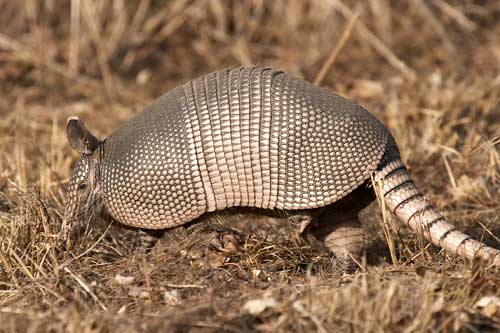
Dasypus
Armadillos are a group of New World placental mammals, the only surviving family (Chlamyphoridae and Dasypodidae) of the order Cingulata. They are known for their distinctive leathery armor shell and their characteristic digging behaviors, primarily found in Central and South America. The genus Dasypus, known as long-nosed or naked-tailed armadillos, is the only extant genus in the family Dasypodidae. They are found in South, Central, and North America, as well as on the Caribbean islands of Grenada, Trinidad and Tobago.