
Gegeneophis mhadeiensis
Asia·threatened·Western Ghats, southern India (specifically known from Chorla village, Belgaum district, Karnataka)
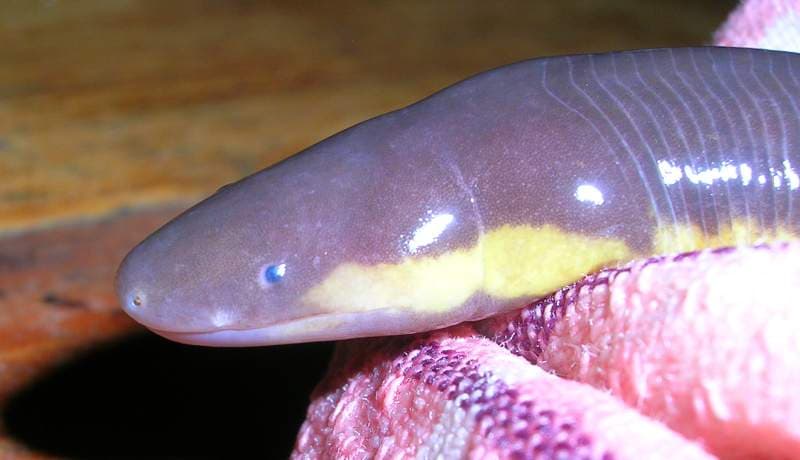
Gegeneophis mhadeiensis, also known as the Mahadeyi caecilian or Mhadei's blind caecilian, is a species of caecilian found in the Western Ghats of southern India. This burrowing amphibian is characterized by its dark brown, sub-cylindrical body and distinctive white annular grooves.
Key Facts
- ›Native to the Western Ghats of southern India.
- ›Belongs to the family Grandisoniidae.
- ›Has a total body length of 180–202 MM (7.1–8.0 in).
- ›Primarily dark brown with a pinkish-brown head.
- ›Found in forests, plantations, and along streams.
- ›Threatened by habitat loss, including fertilizers and pesticides.

Forests, Plantations, Along Streams
Mahadeyi Caecilian, Mhadei Caecilian, Mhadei's Blind Caecilian
Habitat Loss, Fertilizers, Pesticides
About Gegeneophis mhadeiensis
Gegeneophis mhadeiensis, commonly referred to as the Mahadeyi caecilian, Mhadei caecilian, or Mhadei's blind caecilian, is a species of caecilian native to the Western Ghats of southern India. Belonging to the family Grandisoniidae, this amphibian is characterized by its fossorial lifestyle and its distinctive physical features.
Description and Habitat
The Mahadeyi caecilian has a total body length ranging from 180 to 202 mm (7.1–8.0 inches). Its body is sub-cylindrical and slightly compressed from top to bottom, maintaining a uniform width. The head tapers to a narrow snout tip, and the species exhibits a mostly dark brown coloration, accented by a pinkish-brown head and striking white annular grooves. It is found in diverse environments including forests, plantations, and along streams, indicating an adaptability to various conditions, including disturbed habitats.
Distribution and Conservation
This species is endemic to the Western Ghats, with its known distribution currently limited to its type locality in Chorla village, Belgaum district, Karnataka. While its full geographical range remains undetermined, Gegeneophis mhadeiensis is recognized as a threatened species. Its survival is significantly impacted by habitat loss, with the presence of fertilizers and pesticides in its environment posing further risks.
Source: Wikipedia ↗
Frequently Asked Questions
What is Gegeneophis mhadeiensis commonly called?
Gegeneophis mhadeiensis is commonly known as the Mahadeyi caecilian, Mhadei caecilian, or Mhadei's blind caecilian.
Where is the Mahadeyi caecilian found?
This species is endemic to the Western Ghats in southern India. It is currently known from its type locality in Chorla village, Belgaum district, Karnataka.
What does Gegeneophis mhadeiensis look like?
It has a sub-cylindrical body that is slightly compressed from top to bottom, with a uniform width. Its coloration is mostly dark brown with a pinkish-brown head and white annular grooves.
What is the habitat of the Mhadei caecilian?
Gegeneophis mhadeiensis inhabits forests, plantations, and areas along streams. It is a fossorial animal, meaning it lives underground.
What are the threats facing Gegeneophis mhadeiensis?
The primary threat to this species is habitat loss. Additionally, the use of fertilizers and pesticides in its environment poses a risk to its survival.
Related Caecilian species
Ichthyophiidae
The Ichthyophiidae, also known as Asiatic tailed caecilians or fish caecilians, are a primitive family of caecilians found across South and Southeast Asia and in southernmost China. They are distinguished by their tails, numerous body scales, and mouths that are not recessed, setting them apart from more derived caecilian families. Ichthyophiidae reproduce by laying eggs in moist soil, with larvae that develop in water before metamorphosing into terrestrial adults, and females may exhibit parental care.

Ichthyophis beddomei
Ichthyophis beddomei, also known as the yellow-striped caecilian, is a species of caecilian found in the Western Ghats of southern India. This fossorial amphibian is characterized by its dark violet-brown body contrasted with a distinctive yellow lateral stripe that runs from its head to the tail tip.

Ichthyophis dulitensis
Ichthyophis dulitensis is a caecilian species endemic to Borneo, specifically known from the vicinity of Mount Dulit in Sarawak, Malaysia. Described in 1960, it is a poorly understood species with an uncertain taxonomic status. Its common name, the Mount Dulit caecilian, reflects its limited known geographic range.