
Ichthyophis beddomei
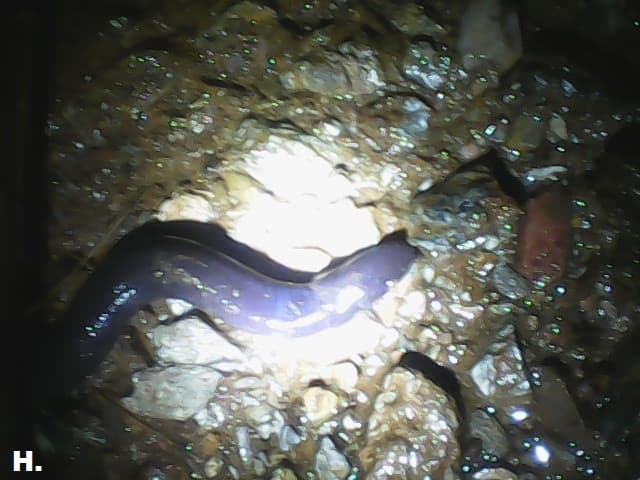
Ichthyophis beddomei, also known as the yellow-striped caecilian, is a species of caecilian found in the Western Ghats of southern India. This fossorial amphibian is characterized by its dark violet-brown body contrasted with a distinctive yellow lateral stripe that runs from its head to the tail tip.
Key Facts
- ›Found in the Western Ghats of southern India.
- ›Possesses a dark violet-brown body with a prominent yellow lateral stripe.
- ›Primarily a subterranean species, living in leaf-litter, humus, and soil.
- ›Inhabits wet evergreen tropical forests and can tolerate agricultural areas and plantations.
- ›Occurs at elevations up to 1,000 meters above sea level.

Wet Evergreen Tropical Forest, Leaf-Litter, Humus, Soil, Low-Intensity Agricultural Areas, Plantations
Yellow-Striped Caecilian, Beddome's Caecilian, Nilgherries Caecilian
Habitat Destruction
About Ichthyophis beddomei
Ichthyophis beddomei, commonly known as the yellow-striped caecilian, is a species of amphibian native to the Western Ghats region of southern India. This caecilian belongs to the family Ichthyophiidae and is characterized by its subterranean lifestyle and distinctive coloration.
Description and Habitat
Adult individuals typically range from 210 to 270 millimeters in length. Their bodies are a dark violet-brown, which becomes lighter on the underside. A striking yellow lateral stripe runs along the entire length of the body, from the head to the tail tip, and is slightly wider at the neck. The upper lip and lower jaw also feature yellow coloration. The species possesses distinct eyes and tentacles positioned close to the lip, nearly equidistant from the eyes and nostrils. The nostrils are visible from above on the snout. The upper jaw is notably longer than the lower jaw.
Ichthyophis beddomei is a fossorial species, meaning it lives primarily underground. Its natural habitat includes wet evergreen tropical forests, where it is found in substrates such as leaf-litter, humus, and soil. This adaptable species can also be found in areas with low-intensity agricultural practices and plantations. It inhabits elevations up to 1,000 meters above sea level.
Distribution and Conservation
The distribution of Ichthyophis beddomei is primarily confined to the Western Ghats in southern India. While the species can be locally abundant, severe habitat destruction poses a significant threat to its populations. It is believed to occur within several protected areas within its range, suggesting potential conservation efforts are in place.
Source: Wikipedia ↗
Frequently Asked Questions
What is the yellow-striped caecilian?
The yellow-striped caecilian, scientifically known as Ichthyophis beddomei, is a species of amphibian belonging to the caecilian family. It is native to the Western Ghats region of southern India.
What does Ichthyophis beddomei look like?
Adults of this species typically measure between 210 and 270 mm in length. Their body is dark violet-brown, becoming lighter brown on the underside, and is distinguished by a vibrant yellow stripe running along its sides from head to tail.
Where does Ichthyophis beddomei live?
Ichthyophis beddomei is a subterranean species found in the Western Ghats of southern India. Its habitat includes wet evergreen tropical forests, as well as leaf-litter, humus, and soil substrates. It can also be found in areas with low-intensity agriculture and plantations.
What is the conservation status of Ichthyophis beddomei?
While the article does not explicitly state the IUCN conservation status, it mentions that severe habitat destruction remains a potential threat to the species. It is considered adaptable and can be locally abundant, possibly occurring in several protected areas.
Related Caecilian species

Ichthyophis sumatranus
Ichthyophis sumatranus, commonly known as the Sumatra caecilian, is a species of amphibian endemic to Sumatra, Indonesia. This species is characterized by its dark brown coloration, distinct eyes with a white spot, and a subterranean lifestyle as an adult. Its primary threat is habitat loss due to the expansion of palm oil plantations.

Ichthyophis tricolor
Ichthyophis tricolor, also known as the three-colored caecilian or Maddatorai caecilian, is an amphibian species native to the Western Ghats of India. This burrowing caecilian is characterized by its distinctive violet-brown body marked with a yellow lateral stripe and a broad, white ventral stripe. Its exact taxonomic status remains a subject of ongoing research.
Sikkimese caecilian
The Sikkimese caecilian (Ichthyophis sikkimensis) is a species of amphibian found in the Himalayan foothills of India, Nepal, and potentially Bhutan. Described by Edward Harrison Taylor in 1960, this burrowing amphibian is characterized by its elongated, limbless body and smooth, moist skin.