
Siphonops annulatus
South America·Oviparous with maternal dermatophagy and lactation·Widely distributed east of the Andes in Brazil, Argentina, Bolivia, Colombia, Ecuador, French Guiana, Guyana, Paraguay, Peru, Suriname, and Venezuela.
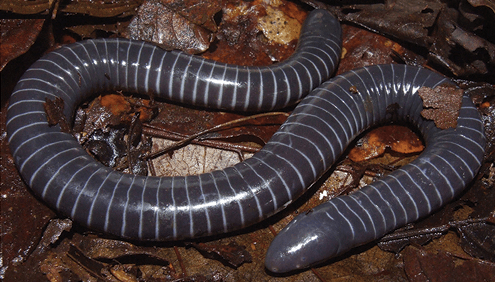
Siphonops annulatus, commonly known as the ringed caecilian, is a South American species of caecilian found east of the Andes. It is distinctive for its bluish-black to slate coloration, ringed by white or cream, and its specialized skin glands that secrete lubricating mucus and noxious chemicals. This highly fossorial species exhibits a unique reproductive strategy involving maternal dermatophagy and the production of a milk-like substance.
Key Facts
- ›Possesses annular grooves edged in white or cream that completely encircle its body.
- ›Skin glands on the head secrete lubricating mucus, while those on the tail contain noxious chemicals.
- ›Highly fossorial, utilizing a specialized, ossified skull for burrowing.
- ›Nestlings feed on their mother's skin through a process called maternal dermatophagy.
- ›Mothers produce a milk-like substance from oviduct glands to nourish their young.
- ›Exhibit unique vocalizations (clicking sounds) by hatchlings when seeking nourishment.
- Subtropical Or Tropical Moist Lowland Forest
- Dry Savanna
- Moist Savanna
- Subtropical Or Tropical Moist Shrubland
- Subtropical Or Tropical Seasonally Wet Or Flooded Lowland Grassland
- Pastureland
- Plantations
- Rural Gardens
- Heavily Degraded Former Forest
Outer Layer of Mother's Skin, Milk-Like Substance Produced By Mother
Ringed Caecilian
About Siphonops annulatus
The ringed caecilian, scientifically known as Siphonops annulatus, is a species of caecilian native to South America, notable for its extensive distribution across the continent east of the Andes. This amphibian is characterized by its distinctive bluish-black to slate coloration, marked by prominent annular grooves that encircle its cylindrical body, except for a few segments at the tail's end; these grooves are edged with white or cream.
Description and Adaptations
Adult ringed caecilians typically measure between 286 and 450 mm (11.3–17.7 inches) in length. Their bodies are adapted for a subterranean existence, with a highly ossified skull aiding in their burrowing capabilities. Specialized skin glands play a crucial role in their survival: those on the head excrete a lubricating mucus that likely assists in burrowing, while glands on the tail region are filled with noxious chemicals, serving as a defense mechanism against predators.
Behavior and Habitat
As one of the lesser-studied amphibian groups, much about caecilian behavior remains enigmatic. Siphonops annulatus is primarily fossorial, meaning it spends the majority of its life underground. Research has shown that the tunnels created by this species typically do not exceed 20 cm in depth. Their natural habitats are diverse, ranging from subtropical and tropical moist lowland forests and savannas to shrublands, seasonally wet grasslands, pastures, plantations, and even rural gardens and heavily degraded former forest areas.
Reproduction and Parental Care
The reproductive cycle of the ringed caecilian involves mating between late August and early October, with egg-laying occurring between November and December. A remarkable aspect of their reproduction is the specialized feeding behavior of the nestlings, who are equipped with spoon-shaped teeth to consume the outer layer of their mother's skin in a process known as maternal dermatophagy. Furthermore, recent studies have revealed that mothers produce a milk-like substance from glands in their oviduct epithelium, which is secreted in response to tactile and acoustic stimulation from the hatchlings. This nutrient-rich fluid, similar to mammalian milk, supports the rapid growth of the young and may play a role in developing their microbiome and immune system. Hatchlings also produce unique high-pitched clicking sounds when seeking this nourishment, a behavior not observed in other amphibians.
Source: Wikipedia ↗
Frequently Asked Questions
What makes the Siphonops annulatus distinctive?
The ringed caecilian is distinguished by its bluish-black to slate coloration with white or cream-edged annular grooves. It also possesses specialized skin glands that produce both lubricating mucus and noxious chemicals, and exhibits a unique milk-feeding reproductive strategy.
Where is the Siphonops annulatus found?
This species has a broad distribution east of the Andes in South America. It has been reported in countries including Brazil, Argentina, Bolivia, Colombia, Ecuador, French Guiana, Guyana, Paraguay, Peru, Suriname, and Venezuela.
What is the habitat of the ringed caecilian?
Siphonops annulatus inhabits subtropical or tropical moist lowland forests, dry and moist savannas, shrublands, seasonally wet or flooded grasslands, as well as pastures, plantations, rural gardens, and degraded former forest areas.
How does the Siphonops annulatus reproduce?
Reproduction involves oviposition and a unique form of parental care. Nestlings feed on their mother's skin (maternal dermatophagy), and mothers produce a milk-like substance from specialized glands to nourish their young.
What do young ringed caecilians eat?
Young ringed caecilians are equipped with specialized teeth to feed on the outer layer of their mother's skin. They also consume a milk-like substance produced by the mother, rich in fats and carbohydrates.
Are ringed caecilians venomous?
While not typically described as venomous in the same way as snakes, Siphonops annulatus possesses skin glands in its tail region that are packed with noxious chemicals. These chemicals are similar to poisons found in other amphibians and likely serve as a defense mechanism.
Related Caecilian species
Common yellow-banded caecilian
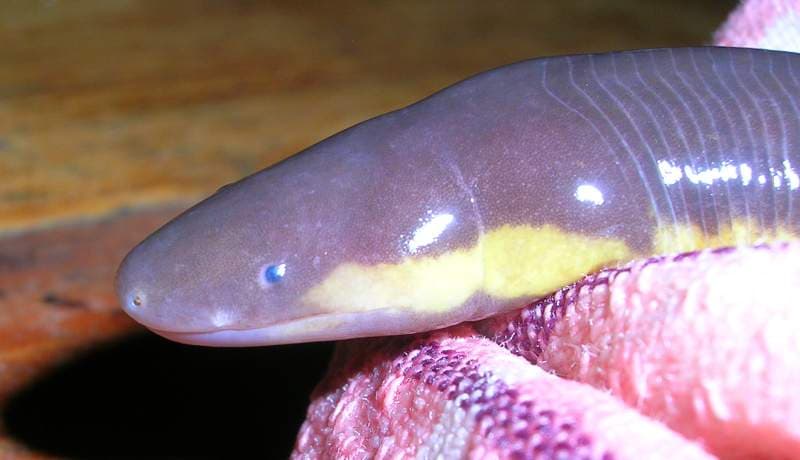
The Common yellow-banded caecilian, also known as the Ceylon caecilian, is a species of caecilian endemic to Sri Lanka. It is characterized by its earthworm-like appearance, with steely blue and pale yellow coloration and a distinctive yellow band along its sides. This adaptable species inhabits moist tropical and subtropical forests and pastures, where it burrows in damp earth or leaf litter.

Herpele squalostoma
Herpele squalostoma, also known as the Congo caecilian, is a species of caecilian found in Central and extreme eastern West Africa. This species is characterized by its cylindrical body, prominent snout, and eyes covered by bone, and it exhibits parental care through maternal dermatophagy.
Ichthyophiidae
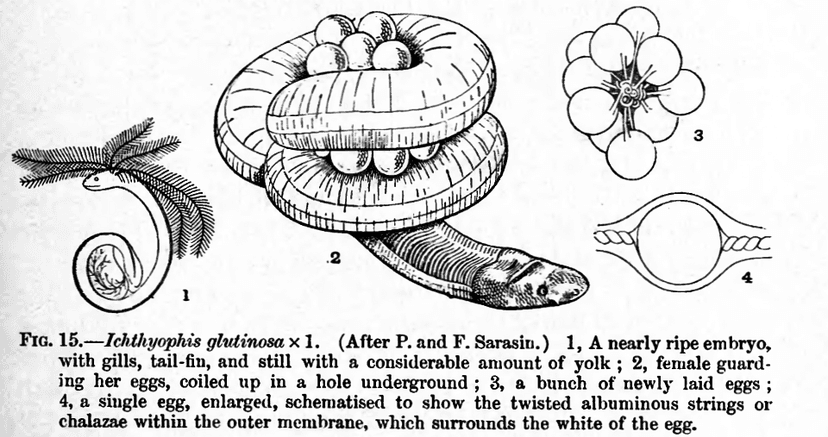
The Ichthyophiidae, also known as Asiatic tailed caecilians or fish caecilians, are a primitive family of caecilians found across South and Southeast Asia and in southernmost China. They are distinguished by their tails, numerous body scales, and mouths that are not recessed, setting them apart from more derived caecilian families. Ichthyophiidae reproduce by laying eggs in moist soil, with larvae that develop in water before metamorphosing into terrestrial adults, and females may exhibit parental care.