
Common yellow-banded caecilian
Asia·Oviparous·Vulnerable·Sri Lanka, southwestern and central regions
The Common yellow-banded caecilian, also known as the Ceylon caecilian, is a species of caecilian endemic to Sri Lanka. It is characterized by its earthworm-like appearance, with steely blue and pale yellow coloration and a distinctive yellow band along its sides. This adaptable species inhabits moist tropical and subtropical forests and pastures, where it burrows in damp earth or leaf litter.
Key Facts
- ›Endemic to Sri Lanka, with possible sightings in northeastern India attributed to other species.
- ›Resembles a large earthworm with over 300 transverse skin folds.
- ›Possesses a steely blue dorsal side and a pale yellow underside, with a prominent yellow lateral band.
- ›Feeds on earthworms and other small invertebrates, subduing prey by reversing into its burrow.
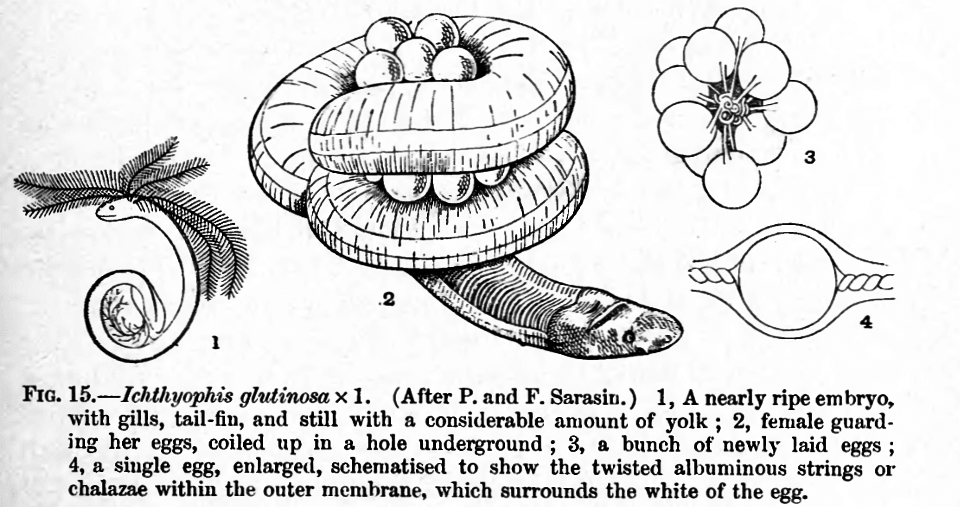
- ›Females lay strings of about 30 eggs, which they brood until hatching into aquatic larvae.
- ›Listed as 'Vulnerable' by the IUCN due to its limited range, though it is locally common and adaptable.
Moist Tropical and Subtropical Forests, Pastures, Subtropical Or Tropical Swamps, Cleared Forested Areas, Lowland Forests, Montane Forests
Earthworms, Small Invertebrates
Ceylon Caecilian
About Common yellow-banded caecilian
The Common yellow-banded caecilian, scientifically known as Ichthyophis glutinosus and also referred to as the Ceylon caecilian, is a species of amphibian endemic to the island of Sri Lanka. This unique creature belongs to the family Ichthyophiidae and inhabits moist tropical and subtropical forests, as well as pastures.
Description and Habitat
Resembling a large earthworm, the Common yellow-banded caecilian can grow to lengths of approximately 23 to 40 cm. Its body is distinctly segmented due to over 300 transverse folds in its skin. The coloration is a notable feature: the upper side is a steely blue, while the underside is pale yellow, accentuated by a vibrant yellow band that runs along each flank. These caecilians are fossorial, meaning they live primarily underground, burrowing into damp earth or leaf litter. Their preferred habitats include lowland and montane forests, as well as subtropical swamps and cleared areas, often found at elevations up to 1,355 meters.
Biology and Reproduction
The diet of the Common yellow-banded caecilian consists mainly of earthworms and other small invertebrates. When hunting, it exhibits a specialized method of subduing prey by reversing into its burrow. Reproduction takes place in concealed locations, such as underground chambers. The female lays strings of around 30 white, jelly-coated eggs and then coils her body around them, providing brooding and protection until the eggs hatch. The resulting larvae are aquatic, measuring about 7 to 11 cm long, and possess external gills and a tail fin for swimming. They undergo a relatively slow metamorphosis over approximately nine months, losing their external gills and lateral lines as they mature.
Conservation Status
The IUCN Red List classifies the Common yellow-banded caecilian as 'Vulnerable'. This designation stems from its range, which is likely less than 20,000 square kilometers. However, the species is locally common within its habitat and is considered highly adaptable, capable of coping with environmental changes. Significant portions of its range are protected within national parks and reserves in Sri Lanka, including the Sinharaja World Heritage Site and the Knuckles Range Forest Reserve.
Source: Wikipedia ↗
Frequently Asked Questions
What does the Common yellow-banded caecilian look like?
The Common yellow-banded caecilian resembles a large earthworm, measuring between 23 to 40 cm in length. Its skin features over 300 transverse folds, giving it a segmented appearance. It is steely blue on its upper side and pale yellow underneath, with a distinct yellow band running along each side of its body.
Where is the Common yellow-banded caecilian found?
This caecilian species is native to southwestern and central Sri Lanka. Its natural habitats include moist tropical and subtropical forests, pastures, and swamps, typically found in burrows within damp earth or leaf litter.
What does the Common yellow-banded caecilian eat?
The diet of the Common yellow-banded caecilian primarily consists of earthworms and other small invertebrates. When hunting, it often reverses into its burrow and uses its body to subdue its prey.
How does the Common yellow-banded caecilian reproduce?
Reproduction occurs in hidden locations, such as underground chambers, where the female lays strings of approximately 30 white, jelly-coated eggs. She then coils around the eggs to brood them until they hatch into larvae.
What is the conservation status of the Common yellow-banded caecilian?
The Common yellow-banded caecilian is classified as 'Vulnerable' by the IUCN Red List. This status is due to its restricted range, although it is locally abundant and demonstrates adaptability to habitat changes.
Related Caecilian species
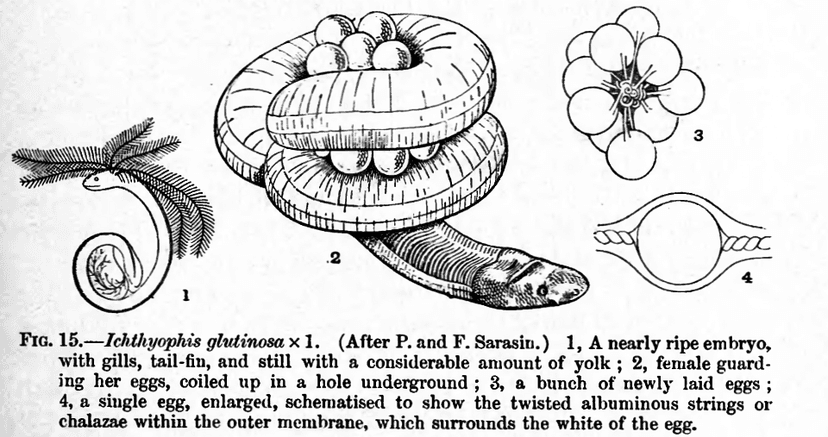
Ichthyophis glutinosus
The Ichthyophis glutinosus, commonly known as the Ceylon caecilian or common yellow-banded caecilian, is a species of caecilian native to Sri Lanka. It is characterized by its long, segmented appearance, steely blue and yellow coloration, and its habitat in moist tropical and subtropical forests and pastures.
Darjeeling caecilians
The Darjeeling caecilian, scientifically known as Ichthyophis sikkimensis, is a species of amphibian native to the Himalayan foothills of India, Nepal, and potentially Bhutan. This burrowing amphibian is characterized by its elongated, worm-like body and smooth, moist skin, typically found in damp soil and leaf litter.

Ichthyophis hypocyaneus
The Javan caecilian, Ichthyophis hypocyaneus, is a species of amphibian endemic to Java, Indonesia. Once thought to be extinct, it was rediscovered in 2000 and is known from a few specific sites on the island. This caecilian inhabits a variety of terrestrial microhabitats, from forests to plantations.