
Vulpini
Vulpini represents the fox-like tribe within the subfamily Caninae, distinguished by specific cranial and dental features that set it apart from the dog-like tribe Canini. This group encompasses 15 living and 21 extinct species distributed across all continents.
Key Facts
- ›Vulpini is the fox-like tribe of the subfamily Caninae.
- ›It is sister to the dog-like tribe Canini.
- ›The tribe includes 15 extant and 21 extinct species.
- ›Vulpini species are found on all continents.
- ›They are distinguished by a wide paroccipital process and specific features on the M2 tooth.
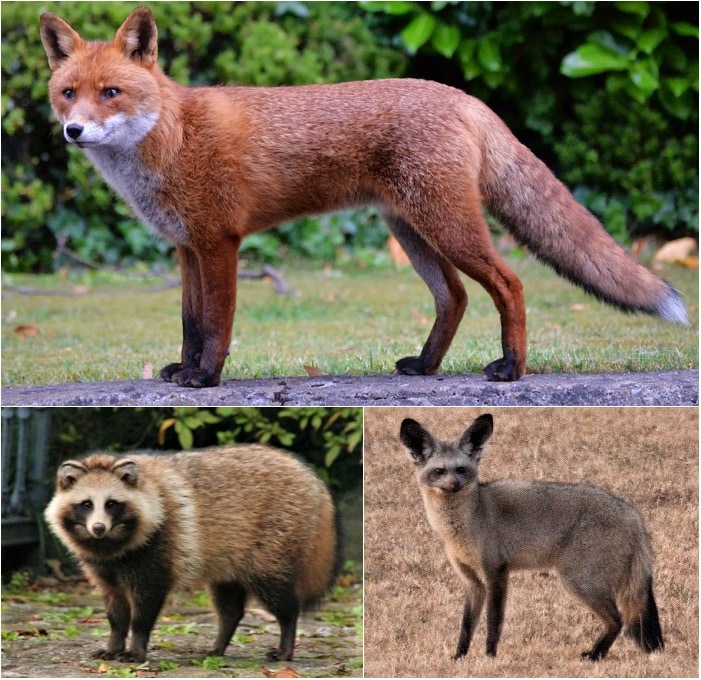
Fox-Like Canids
All Continents
Wide Paroccipital Process, Metaconule On M2, Postprotocrista On M2
About Vulpini
Vulpini is the taxonomic tribe that encompasses the fox-like canids, representing a distinct lineage within the subfamily Caninae. This group is recognized as being evolutionarily sister to the dog-like tribe, Canini, meaning they share a common ancestor but diverged into separate evolutionary paths.
Taxonomy and Distinguishing Features
The classification of Vulpini is based on detailed analysis of cranial and dental characteristics. Tedford has noted that these small canids are identifiable by a wide paroccipital process that is broadly fused to the posterior surface of the bulla. This process has a short, laterally directed free tip that extends only slightly below the body of the process. Furthermore, the presence of a metaconule and postprotocrista on the second upper molar (M2) in vulpines signifies a significant evolutionary development, representing a reversal to a form found in primitive canid M2s, a trait that began to emerge in later species of Leptocyon.
Diversity and Distribution
The Vulpini tribe is a diverse group, comprising 15 extant (currently living) species and 21 extinct species. These species have a global distribution, being found on all continents. This wide geographical spread indicates the adaptability of vulpine canids to a variety of ecological niches throughout their evolutionary history.
Source: Wikipedia ↗
Frequently Asked Questions
What is Vulpini?
Vulpini is a taxonomic tribe within the subfamily Caninae, specifically representing the fox-like canids. It is closely related to, and considered the sister group of, the dog-like tribe Canini.
How many species are in the Vulpini tribe?
The Vulpini tribe comprises 15 currently living (extant) species and an additional 21 species that are now extinct. This makes for a total of 36 known species that have belonged to this group.
Where are Vulpini species found?
Species belonging to the Vulpini tribe have a widespread distribution. They are found on all continents around the world, indicating a significant adaptability and historical presence across diverse environments.
What distinguishes Vulpini from other canids?
Vulpini species are distinguished from other canids by specific anatomical features, particularly in their dentition and basicranium. Notably, they possess a wide paroccipital process and a distinctive form on the M2 tooth, which represents a reversal of a primitive canine M2 structure.
Related Canid species

Canina
Canina is a taxonomic subtribe within the tribe Canini, encompassing wolf-like canids. Fossils indicate their existence as far back as 9 million years ago, making them an ancient lineage within the dog family. A distinctive characteristic of Canina members is their shared karyotype of 78 chromosomes, which allows for the production of hybrids.

Cuon
The dhole (Cuon alpinus) is a canid native to South, East, and Southeast Asia, distinguished by its unique skull morphology, lack of a third lower molar, and single-cusped upper molars. These highly social animals live in large clans and are diurnal pack hunters, primarily targeting large and medium-sized ungulates. Historically widespread, their range has significantly contracted due to habitat loss, prey depletion, and competition, leading to their current Endangered status.
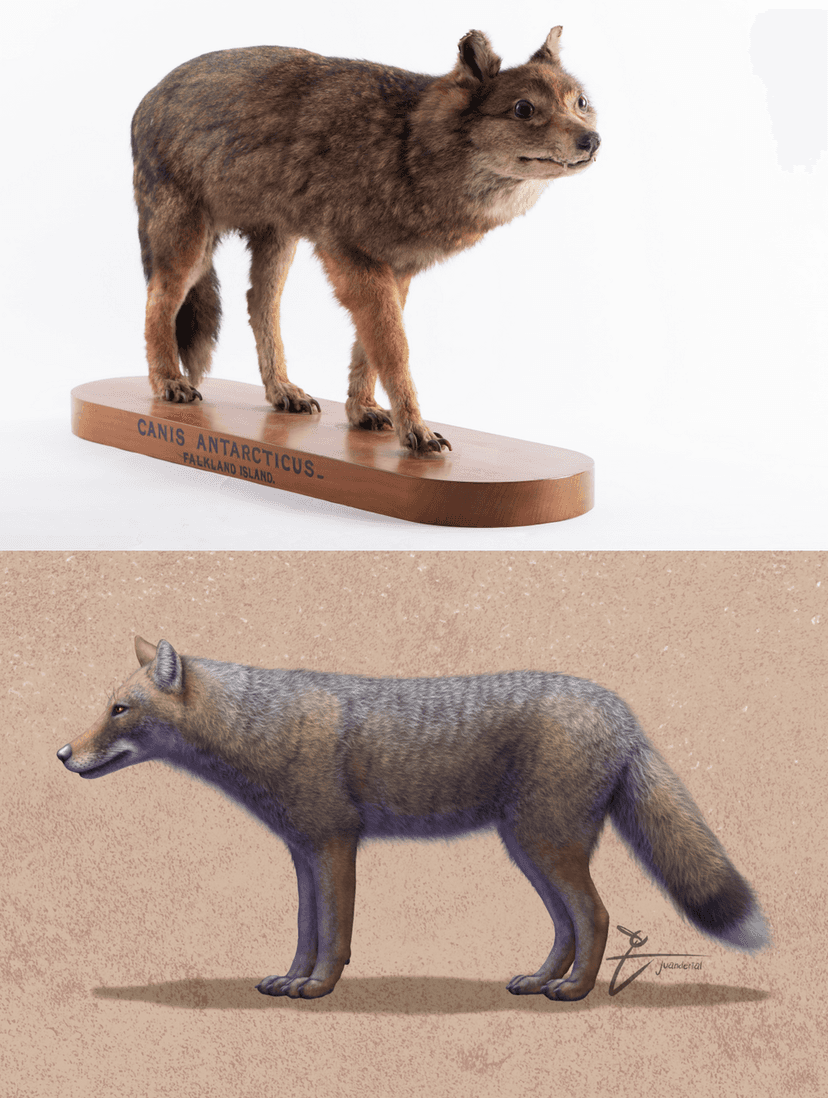
Dusicyon
Dusicyon is an extinct genus of South American canids. The genus, established in 1914, originally included several South American foxes, but these have since been reclassified. The most well-known species, Dusicyon australis, was the Falkland Islands wolf.