
Ruby Canyon
Ruby Canyon is a prominent canyon carved by the Colorado River, stretching approximately 40 kilometers (25 miles) along the border of Colorado and Utah in the western United States. Its name derives from the striking ruby-red sandstone cliffs that define its dramatic landscape. The canyon is a favored location for river expeditions, including rafting and overnight camping, and is accessible by train via the Union Pacific Railroad.
Key Facts
- ›Located on the Colorado River, straddling the Colorado-Utah border.
- ›Approximately 40 km (25 miles) in length.
- ›Named for its distinctive ruby-red sandstone cliffs.
- ›Popular for rafting and requires permits for overnight camping.
- ›Accessible by the Union Pacific Railroad, with Amtrak's California Zephyr passing through.

River Erosion
Ruby-Red Sandstone Cliffs, Utah | Colorado Painted Border Marker
About Ruby Canyon
Ruby Canyon is a notable river canyon located along the Colorado River, forming a boundary between the states of Colorado and Utah in the western United States. This canyon extends for approximately 40 kilometers (25 miles) and is distinguished by its striking ruby-red sandstone cliffs that give the area its name. It is recognized as a popular destination for recreational activities, particularly rafting and overnight camping, although permits are a requirement for overnight stays.
Access and Transportation
Access to Ruby Canyon is primarily achieved through water-based travel on the Colorado River. For those not engaged in rafting, the canyon is also accessible via the Union Pacific Railroad, which follows a route through the canyon that was formerly operated by the Denver and Rio Grande Western Railroad. Amtrak's California Zephyr passenger train utilizes this same corridor, traveling between Grand Junction, Colorado, and Thompson Springs, Utah, offering passengers views of the canyon. A specific point of interest along this route is the "Utah | Colorado" inscription painted on a canyon wall at the state border, adjacent to the Utaline Siding.
Source: Wikipedia ↗
Frequently Asked Questions
What is Ruby Canyon known for?
Ruby Canyon is renowned for its striking ruby-red sandstone cliffs that line the Colorado River. It is a popular destination for rafting trips and offers opportunities for overnight camping, though permits are required.
How can I access Ruby Canyon?
The primary access to Ruby Canyon for recreational purposes is via rafting on the Colorado River. For those not rafting, the Union Pacific Railroad line runs through the canyon, and Amtrak's California Zephyr stops at nearby points, offering views of the canyon.
Where is Ruby Canyon located?
Ruby Canyon is situated on the Colorado River, forming a natural border between the states of Colorado and Utah in the western United States.
Is camping allowed in Ruby Canyon?
Yes, overnight camping is permitted in Ruby Canyon for those on river trips. However, it is important to note that permits are required for any overnight stays.
Related Canyons
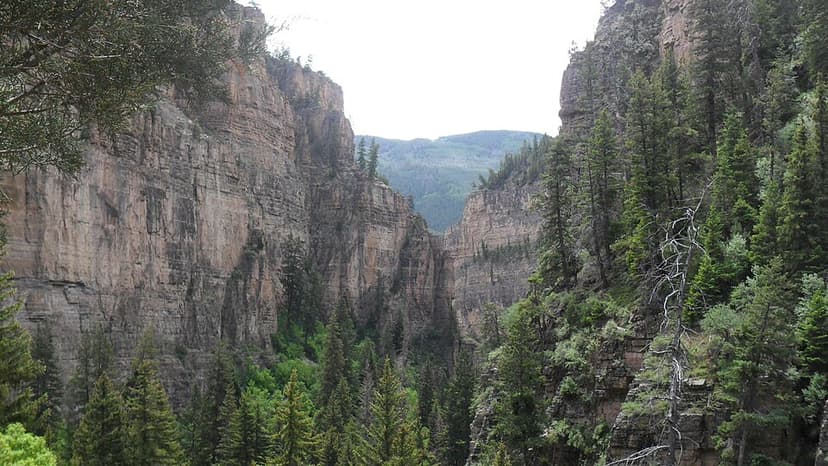
Glenwood Canyon
Glenwood Canyon is a rugged and scenic 20 km canyon in western Colorado, carved by the Colorado River. Its formation during the Pleistocene epoch involved the rapid erosion of sedimentary rock layers, including sandstone and Cambrian rock. Historically significant as a transportation corridor, it currently hosts Interstate 70 and a major railroad line, making it a notable natural feature on the U.S. Interstate Highway System.

Glen Canyon
Glen Canyon is a natural canyon carved by the Colorado River, primarily located in southeastern Utah and extending into northern Arizona. Its formation is a result of the river's erosive power over millennia, with significant prehistoric human occupation. In 1963, the construction of Glen Canyon Dam created the artificial reservoir Lake Powell, which inundated much of the canyon, making it a focal point for modern environmentalist movements concerned with dam removal and river restoration.

Cataract Canyon
Cataract Canyon is a significant 74 km stretch of the Colorado River in southern Utah, known for its powerful whitewater rapids. Carved into the Colorado Plateau, its lower half is submerged under Lake Powell, impacting its historical geology and accessibility. The canyon holds historical importance for indigenous peoples and early European explorers, and remains a popular destination for whitewater rafting.