
Andrews' beaked whale
Not listed on IUCN Red List
Andrews' beaked whale (Mesoplodon bowdoini) is a poorly understood species known only from stranded specimens, never having been observed alive in the wild. This medium-sized cetacean inhabits the Southern Hemisphere and is distinguished by the erupted tusks of adult males and distinctive scarring. Its diet likely consists of deep-sea squid and fish, and it is presumed to be a deep-diving, echolocating suction feeder.
Key Facts
- ›Known only from beached specimens; never observed in the wild.
- ›Adult males possess large, flattened tusks that erupt from the lower jaw.
- ›Females and subadult males have unerupted teeth.
- ›Likely preys on deep-sea squid and fish using suction feeding.
- ›May form small pods of 1-5 individuals.
- ›Suffers scarring from cookiecutter sharks and presumed male-male combat.

Deep-Crest Beaked Whale, Splay-Toothed Whale
- Adult Males: Dark Brown Or Black With A Contrasting Pale Lower Jaw and Rostrum Tip.
- Females: Bluish-Gray To Slate Grey Dorsally, Fading To Pale Sides and Underside, With A Pale To Whitish Lower Jaw and Rostrum Tip.
- Both Sexes: May Have A Small, Light Or Pale Patch In Front of the Eye.
- Calves: Dark Dorsally and Light Ventrally With A Dark Eye Patch.
Deep-Sea Squid, Fish
Deep-Sea
- Deep-Diving
- Echolocating
- Suction Feeders
- Presumed Male-Male Combat Indicated By Scarring
Southern Hemisphere, Australia, New Zealand, Macquarie Island, Falkland Islands, Tristan Da Cunha
Killer Whales, Large Sharks, Cookiecutter Sharks
- Large, Flattened Tusks Erupting From the Lower Jaw In Adult Males.
- Pair of V-Shaped Throat Grooves.
- Small, Triangular Dorsal Fin Positioned Far Back On the Body.
- Small, Narrow Flippers With Flipper Pockets.
- Broad Flukes Typically Lacking A Prominent Median Notch.
- Extensive, Linear Pale To White Scarring On Adult Males.
About Andrews' beaked whale
Andrews' beaked whale, scientifically known as Mesoplodon bowdoini, is one of the least understood species within a genus already noted for its elusive nature. This cetacean is known to science solely through specimens that have washed ashore on beaches; there are no confirmed sightings of live individuals in their natural habitat. This scarcity of direct observation makes it one of the most enigmatic of the beaked whales.
Taxonomy and Discovery
The species was formally described in 1908 by American scientist Roy Chapman Andrews, based on a specimen discovered at New Brighton Beach in Canterbury Province, New Zealand, in 1904. The whale was named in honor of George S. Bowdoin, a significant supporter and trustee of the American Museum of Natural History.
Physical Characteristics
Andrews' beaked whale is a medium-sized member of its family, with adult males typically measuring between 3.4 and 4.4 meters (11.2 to 14.4 ft) in length, and females slightly larger, ranging from 3.7 to 4.9 meters (12.1 to 16.1 ft). Calves are estimated to be around 2.2 meters (7.2 ft) at birth. While precise weight data is unconfirmed, mesoplodonts of similar size are generally recorded between 1 and 1.5 tons. The whale possesses a robust, spindle-shaped body, a low melon, and a short, thick beak. A distinctive feature is the pair of large, flattened tusks that erupt from the arched lower jaw only in adult males; in females, these teeth remain unerupted within their less-arched jawline. Adult males are characterized by their dark brown or black coloration, contrasted by a pale lower jaw and rostrum tip. Females display a bluish-gray to slate gray dorsal surface, transitioning to paler sides and underside, and also share the pale to whitish lower jaw and rostrum tip. Both sexes may exhibit a small, light patch in front of the eye. Subadult males can closely resemble females before their tusks develop. Calves are dark on their dorsal side and light ventrally, with a noticeable dark eye patch.
The flippers are small and narrow, set relatively low on the body. Behind the flippers are slight depressions known as 'flipper pockets,' which are thought to enhance streamlining during dives. The dorsal fin is small, triangular, and positioned far back on the body. The flukes are broad relative to the body and typically lack a prominent median notch.
Behavior and Diet
Andrews' beaked whales are presumed to be deep-diving, echolocating suction feeders. Similar to other beaked whales, they possess a pair of V-shaped throat grooves. These are believed to aid in suction feeding by creating negative pressure within the mouth as the tongue retracts and the throat grooves expand, effectively drawing prey inward like a biological vacuum. Although the specific diet of this species is unknown, it likely includes deep-sea squid and fish.
Social behavior is not well documented, but like other Mesoplodon species, they may form small pods consisting of 1 to 5 individuals. Adult males are notable for extensive, linear pale to white scarring across their bodies, which contrasts sharply with their dark skin. These scars are hypothesized to be the result of tusk use in male-male combat, possibly related to competition for access to females. The calving season is suggested to occur during summer and autumn off New Zealand, but other behavioral aspects remain largely unrecorded.
Predators and Distribution
The primary natural predators of Andrews' beaked whale are believed to be killer whales and large sharks. Both sexes commonly show evidence of cookiecutter shark activity, with numerous small, pale circular or oval healed wounds, sometimes concentrated around the genitals and sides.
Andrews' beaked whales inhabit the Southern Hemisphere, although their precise geographic range is uncertain. Approximately 48 stranded specimens have been recorded across Australia, New Zealand, Macquarie Island, the Falkland Islands, and Tristan da Cunha. This distribution pattern suggests a potential circumpolar presence, but this remains unconfirmed by direct sightings.
Conservation
Andrews' beaked whale has never been documented as a target of hunting, nor are there any records of it becoming entangled in fishing gear. The species is also protected under the Memorandum of Understanding for the Conservation of Cetaceans and Their Habitats in the Pacific Islands Region (Pacific Cetaceans MOU).
Source: Wikipedia ↗
Frequently Asked Questions
What is Andrews' beaked whale?
Andrews' beaked whale is a species of beaked whale that is one of the least known members of its genus. It is distinguished by its medium size and, in adult males, a pair of large, flattened tusks.
Where does Andrews' beaked whale live?
This species is found in the Southern Hemisphere, with recorded strandings in Australia, New Zealand, Macquarie Island, the Falkland Islands, and Tristan da Cunha. Its precise range is uncertain, but this distribution may suggest a circumpolar presence.
What does Andrews' beaked whale eat?
While its exact diet is not confirmed, Andrews' beaked whale is believed to prey on deep-sea squid and fish. It is thought to be a suction feeder, drawing prey into its mouth using throat grooves.
How large is an Andrews' beaked whale?
Males typically reach lengths between 3.4 and 4.4 meters (11.2 to 14.4 ft), while females are slightly larger, ranging from 3.7 to 4.9 meters (12.1 to 16.1 ft). Newborn calves are approximately 2.2 meters (7.2 ft) long.
Are there any known predators of Andrews' beaked whale?
The primary natural predators are thought to be killer whales and large sharks. Additionally, both sexes often exhibit healed wounds from cookiecutter sharks.
Related Cetacean species

Australian humpback dolphin
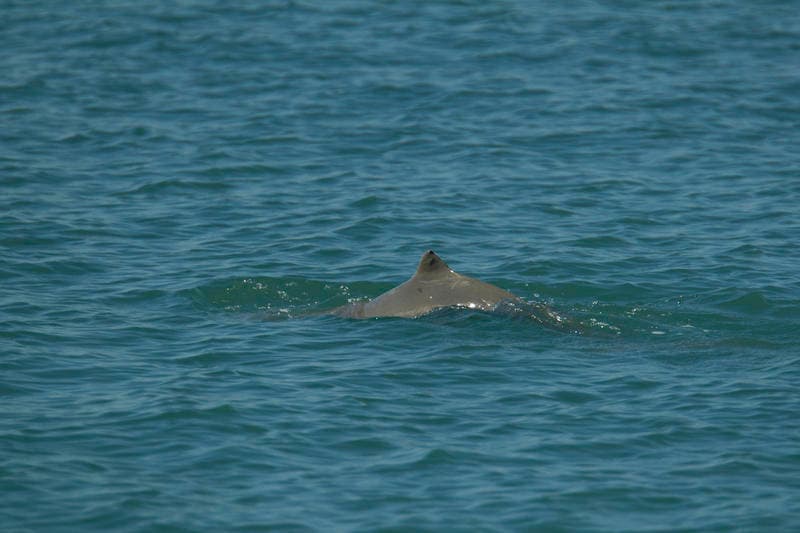
The Australian humpback dolphin (Sousa sahulensis) is a species of humpback dolphin found in the waters of northern Australia and southern New Guinea, specifically around the Sahul Shelf. It is distinguished from other humpback dolphin species by its lower, wider dorsal fin, its dark gray coloration with a distinctive cape-like marking, and its dentition and vertebral count. Despite being scientifically described in 2014, this vulnerable species faces significant threats from habitat destruction and human activities.
Australian snubfin dolphin
The Australian snubfin dolphin (Orcaella heinsohni) is a distinct dolphin species found along the northern coasts of Australia, scientifically described in 2005. It is distinguished from its close relative, the Irrawaddy dolphin, by its three-toned coloration, a rounded forehead, and a very small dorsal fin. This species is endemic to Australia and faces significant threats from human activities.

Atlantic spotted dolphin
The Atlantic spotted dolphin is a medium-sized dolphin inhabiting warm temperate and tropical waters of the Atlantic Ocean. It is distinguished by its unique spotted coloration, which develops and changes significantly as the dolphin matures through different age-dependent phases. These highly social animals are known for their cooperative hunting strategies and complex vocalizations.