
Arnoux's beaked whale
Not believed to be endangered
Arnoux's beaked whale, also known as the southern four-toothed whale, is a large species of beaked whale found in the Southern Ocean. It is distinguished by its prominent beak, the visibility of its front teeth even when its mouth is closed, and its ability to undertake very deep and long dives. This species is highly social and is believed to inhabit cooler waters, preferring the coasts of icy landmasses.
Key Facts
- ›Arnoux's beaked whale is one of the species in the genus Berardius.
- ›It shares many physical similarities with Baird's beaked whale, leading to initial debate about whether they were the same species.
- ›Both sexes of Arnoux's beaked whale have erupted teeth, which are presumed to be used by males for fighting.
- ›These whales are deep-diving suction feeders, with recorded dives exceeding 500 meters and lasting up to an hour.
- ›They are very social animals, forming pods that can number in the dozens.
- ›Killer whales are considered their primary potential predator.
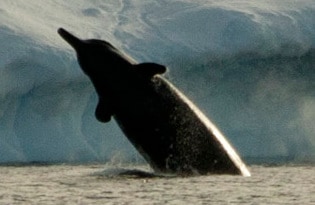
Southern Four-Toothed Whale, Southern Beaked Whale, New Zealand Beaked Whale, Southern Giant Bottlenose Whale, Southern Porpoise Whale
Squid, Fish
Southern Ocean, Coasts of Icy Landmasses, Polar Waters, Cool and Temperate Waters, Fjords
Deep-Diving, Echolocating, Suction-Feeding, Social, Breaching, Spyhopping, Lobtailing, Flipper Slapping, Inquisitive, Approaching Boats and Humans
Southern Ocean, Antarctica, New Zealand, Argentina, South Georgia, South Africa
Killer Whales, Cookiecutter Sharks
Prominent Beak, Longer Lower Jaw Than Upper Jaw, Front Teeth Visible When Mouth Is Closed, Small Flippers With Rounded Tips, Small Dorsal Fin Far Back On the Body, Thick, Lipid-Rich Blubber Layer, White Linear Scars From Social Interactions
About Arnoux's beaked whale
Arnoux's beaked whale (Berardius arnuxii), also referred to as the southern four-toothed whale, is a species of beaked whale inhabiting the vast expanses of the Southern Ocean. Its classification as a distinct species from Baird's beaked whale was confirmed through genetic evidence, despite their striking physical similarities. Little is known about their behavior due to infrequent encounters with live individuals, but when observed, they exhibit deep-diving capabilities and unique feeding strategies.
Description and Physical Characteristics
Arnoux's beaked whales are characterized by their substantial size, bulbous melons, and long, prominent beaks. A distinctive feature is that their lower jaw is longer than the upper, and once they reach sexual maturity, their front teeth become visible even when the mouth is fully closed. Both males and females possess erupted teeth, a trait within the Ziphiidae family thought to be used by males for competition. They have small flippers with rounded tips and small dorsal fins positioned far back on their bodies. A thick, lipid-rich blubber layer provides essential thermal insulation in their frigid environment. Females are generally slightly larger than males.
Behavior and Ecology
These whales are highly adapted deep-divers, utilizing echolocation for foraging. They are suction feeders, employing a pair of V-shaped throat grooves to create negative pressure within their mouths, drawing prey inward. Their diet consists of various squid species and some fish. Dives are typically long, lasting from 15 to 25 minutes up to an hour, with periods of 5 to 15 minutes spent at the surface between dives. They are known to routinely dive to depths exceeding 500 meters, with potential maximum depths reaching 3000 meters. Arnoux's beaked whales are also very social, forming pods that can number up to 47 individuals, and even larger aggregations of 80 have been observed before splitting into smaller groups. They engage in various aerial behaviors such as breaching, spyhopping, lobtailing, and flipper slapping. These whales are often noted for their inquisitive nature, frequently approaching boats and humans.
Distribution and Conservation
Arnoux's beaked whales are found throughout the Southern Ocean, with beachings in New Zealand and Argentina suggesting their presence between these regions and Antarctica. Sporadic sightings occur in polar waters, and they have been spotted near South Georgia and South Africa, indicating a circumpolar distribution. Their range extends to temperate waters as far north as 34 degrees south. While they prefer the coasts of icy landmasses, they can also be found near continents and in fjords in temperate regions above 60 degrees South. The species has rarely been exploited, and its population is not believed to be endangered, although abundance estimates are unavailable. Arnoux's beaked whale is included in the Memorandum of Understanding for the Conservation of Cetaceans and Their Habitats in the Pacific Islands Region.
Source: Wikipedia ↗
Frequently Asked Questions
What are the other common names for Arnoux's beaked whale?
Arnoux's beaked whale is also referred to as the southern four-toothed whale, southern beaked whale, New Zealand beaked whale, southern giant bottlenose whale, and southern porpoise whale.
How large do Arnoux's beaked whales get?
Arnoux's beaked whales reach similar sizes to Baird's beaked whales. Females of the species are slightly larger than males.
What do Arnoux's beaked whales eat?
They are suction feeders and their diet includes various species of squid, such as Batoteuthis skolops, Moroteuthopsis longimana, Galiteuthis glacialis, and Taonius sp., as well as some fish.
How deep can Arnoux's beaked whales dive?
Arnoux's beaked whales routinely dive to depths greater than 500 meters and have been recorded diving as deep as 3000 meters. Their dives can last from 15-25 minutes up to an hour.
Are Arnoux's beaked whales social?
Yes, Arnoux's beaked whales are described as very social animals. They form pods that can consist of adult males, females, and calves, with observed group sizes up to 47 individuals, and even larger congregations of 80 have been recorded.
Where are Arnoux's beaked whales found?
These whales inhabit large areas of the Southern Ocean, preferring the coasts of icy landmasses. They have been sighted in polar waters, near South Georgia and South Africa, and as far north as 34 degrees south, indicating a circumpolar distribution in cool and temperate waters.
Related Cetacean species

Australian humpback dolphin
The Australian humpback dolphin (Sousa sahulensis) is a species of humpback dolphin found in the waters of northern Australia and southern New Guinea, specifically around the Sahul Shelf. It is distinguished from other humpback dolphin species by its lower, wider dorsal fin, its dark gray coloration with a distinctive cape-like marking, and its dentition and vertebral count. Despite being scientifically described in 2014, this vulnerable species faces significant threats from habitat destruction and human activities.
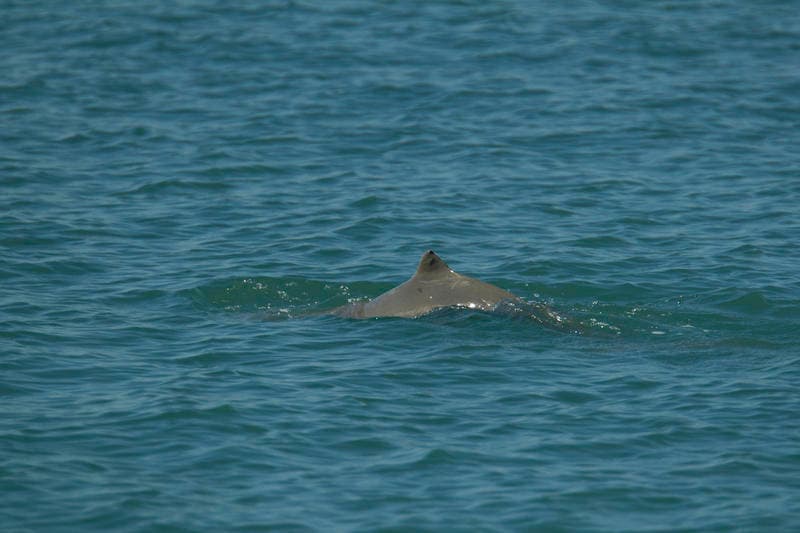
Australian snubfin dolphin
The Australian snubfin dolphin (Orcaella heinsohni) is a distinct dolphin species found along the northern coasts of Australia, scientifically described in 2005. It is distinguished from its close relative, the Irrawaddy dolphin, by its three-toned coloration, a rounded forehead, and a very small dorsal fin. This species is endemic to Australia and faces significant threats from human activities.

Atlantic spotted dolphin
The Atlantic spotted dolphin is a medium-sized dolphin inhabiting warm temperate and tropical waters of the Atlantic Ocean. It is distinguished by its unique spotted coloration, which develops and changes significantly as the dolphin matures through different age-dependent phases. These highly social animals are known for their cooperative hunting strategies and complex vocalizations.