
Atlantic humpback dolphin
Critically Endangered
The Atlantic humpback dolphin (Sousa teuszii) is a species of humpback dolphin found along the tropical to subtropical west coast of Africa. Distinctive for its gray or white coloration and a prominent dorsal hump, it is critically endangered due to severe human-induced threats. This shy species prefers shallow coastal and estuarine waters, where it forages for schooling fish and crustaceans.
Key Facts
- ›Found in coastal areas of West Africa, from western Sahara to Angola.
- ›Typically slate gray on the back and sides, fading to light gray ventrally.
- ›Males may have distinct humps under their dorsal fins.
- ›Has a lower average number of teeth (around 30 per row) compared to related species.
- ›Found in shallow coastal and estuarine waters, usually less than 20 meters deep.
- ›Critically endangered according to the IUCN.

- Slate Gray On the Back and Sides
- Light Gray Ventrally
- Males May Have Distinct Humps Under Their Dorsal Fins
- Gray Or White Color
Inshore Schooling Fish, Coastal Fish Species, Crustaceans
Shallow Coastal Waters, Estuarine Waters, Marine Neritic Zone, Waters Less Than 20 Meters Deep, Surf Zone
- Shy
- Does Not Bow-Ride
- Rarely Seen In Aerial Displays
- Occasionally Leap, Spy-Hop, and Tail-Slap
- Prefer To Keep Distance From Boat Engines
- Travel and Forage
- Forage Independently and Cooperatively
- Exhibit High Site Fidelity and Strong Association Patterns In Some Areas
- Communicate Via Echolocation
Tropical To Subtropical West Coast of Africa, Southeastern Atlantic Ocean, Western Sahara, Angola
- Distinct Skin Coloration
- Males Can Have Distinct Humps Under Their Dorsal Fins
- Robust Body With A Well-Defined Rostrum
- Small, Slightly Falcate, and Triangular Dorsal Fin
- Distinctive and Well-Developed Dorsal Hump
- Significantly Lower Amount of Teeth
- Shorter and Wider Skull Than Other Species
About Atlantic humpback dolphin
The Atlantic Humpback Dolphin
The Atlantic humpback dolphin (Sousa teuszii) is a marine mammal inhabiting the coastal waters of West Africa. This species is distinguished by its predominantly gray or white coloration, often featuring a prominent dorsal hump, and a robust body with a well-defined rostrum. Unlike its Indo-Pacific relatives, it lacks the characteristic pink mottling.
Range and Habitat
This dolphin's range is restricted to the tropical to subtropical west coast of Africa, from western Sahara to Angola, primarily in the southeastern Atlantic Ocean. They are typically found in shallow coastal and estuarine environments, usually within 20 meters of the shore, and are often observed in the marine Neritic zone and the surf zone.
Behavior and Diet
Atlantic humpback dolphins are known for their shy nature, rarely engaging in aerial displays or bow-riding. They are often observed traveling and foraging, either independently or cooperatively, in small groups that typically range from 1 to 8 individuals, though larger aggregations have been noted. Their diet consists mainly of inshore schooling fish like mullet, supplemented by other coastal fish and crustaceans, with feeding occurring in areas such as small bays and off dry river mouths.
Conservation Status and Threats
Regarded as critically endangered by the IUCN, the Atlantic humpback dolphin faces severe threats from human activities. These include incidental capture in fishing gear, directed hunting, habitat loss and degradation due to coastal development and pollution, overfishing of prey species, and the impacts of anthropogenic sound and climate change. These pressures have led to significant population declines and endanger the species' long-term survival.
Source: Wikipedia ↗
Frequently Asked Questions
What is the scientific name of the Atlantic humpback dolphin?
The scientific name of the Atlantic humpback dolphin is Sousa teuszii. This binomial name is used to classify it within the scientific community.
Where do Atlantic humpback dolphins live?
Atlantic humpback dolphins are native to the tropical to subtropical west coast of Africa, specifically in the southeastern Atlantic Ocean, ranging from western Sahara down to Angola. They primarily inhabit shallow coastal and estuarine waters.
How does the Atlantic humpback dolphin differ from the Indo-Pacific humpback dolphin?
The Atlantic humpback dolphin can be distinguished from the Indo-Pacific humpback by its distinct gray or white skin coloration, lacking the pink mottling seen in the latter. Morphological differences, such as a robust body and a well-defined rostrum, also set them apart.
What do Atlantic humpback dolphins eat?
Their diet mainly consists of inshore schooling fish, such as mullet, though they also consume a variety of other coastal fish and crustacean species. The specific prey depends on their geographic location and local availability.
What are the biggest threats to the Atlantic humpback dolphin?
The greatest threats to the Atlantic humpback dolphin are incidental capture in gill nets, followed by directed takes, habitat loss and degradation, overfishing, marine pollution, anthropogenic sound, and climate change. These factors have contributed to their critically endangered status.
Are Atlantic humpback dolphins social animals?
Yes, Atlantic humpback dolphins are social, typically found in groups ranging from 1 to 8 animals, though larger gatherings of up to 20-40 individuals have been observed. They forage both independently and cooperatively.
Related Cetacean species

Australian humpback dolphin
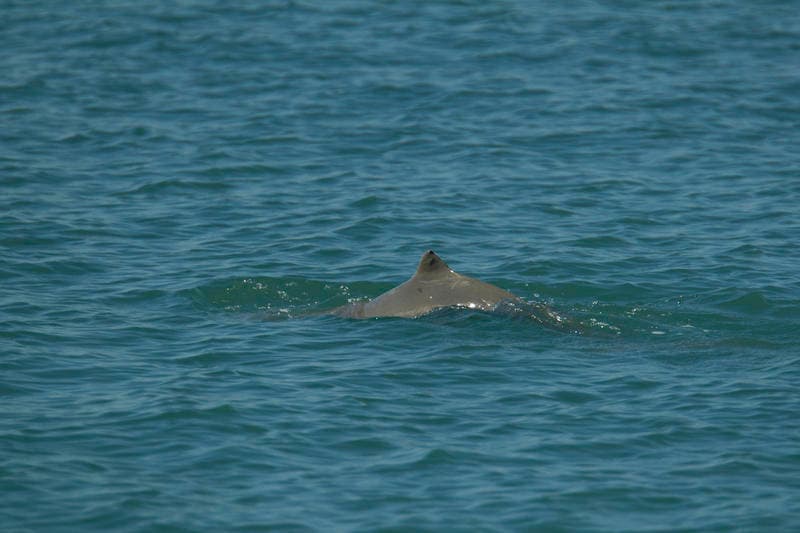
The Australian humpback dolphin (Sousa sahulensis) is a species of humpback dolphin found in the waters of northern Australia and southern New Guinea, specifically around the Sahul Shelf. It is distinguished from other humpback dolphin species by its lower, wider dorsal fin, its dark gray coloration with a distinctive cape-like marking, and its dentition and vertebral count. Despite being scientifically described in 2014, this vulnerable species faces significant threats from habitat destruction and human activities.
Australian snubfin dolphin
The Australian snubfin dolphin (Orcaella heinsohni) is a distinct dolphin species found along the northern coasts of Australia, scientifically described in 2005. It is distinguished from its close relative, the Irrawaddy dolphin, by its three-toned coloration, a rounded forehead, and a very small dorsal fin. This species is endemic to Australia and faces significant threats from human activities.

Atlantic spotted dolphin
The Atlantic spotted dolphin is a medium-sized dolphin inhabiting warm temperate and tropical waters of the Atlantic Ocean. It is distinguished by its unique spotted coloration, which develops and changes significantly as the dolphin matures through different age-dependent phases. These highly social animals are known for their cooperative hunting strategies and complex vocalizations.