
Cycas rumphii
Tropical closed forest or woodland on calcareous soils in coastal habitats, often on stabilised dunes formed of coralline sand and limestone.·Small tree·Near Threatened
Cycas rumphii, also known as the queen sago, is a dioecious gymnosperm native to Indonesia, New Guinea, and Christmas Island. This palm-like cycad can grow up to 10 meters tall, featuring glossy green fronds and distinctive fissured bark. Its reproductive structures are notable for the male strobilus's orange color and foetid odor, and the female's fleshy, hairy megasporophylls.
Key Facts
- ›Native to Indonesia, New Guinea, and Christmas Island.
- ›Can grow to a height of 10 meters with a trunk diameter of up to 40 cm.
- ›Leaves are palm-like fronds, 1.5–2.5 meters long, with 150–200 leaflets.
- ›Male cones are oblong-ellipsoidal, 30–60 cm long, and orange.
- ›Female megasporophylls are about 30 cm long, fleshy, and densely hairy.
- ›Assessed as near Threatened due to habitat loss and decreasing population.

Queen Sago, Queen Sago Palm
Indonesia, New Guinea, Christmas Island, Maluku Islands, Sulawesi, Java, Borneo, Australia
- Grows to about 10 m in height.
- Trunk diameter up to 40 cm.
- Bark is grey and distinctively fissured into rectangular, or diamond-shaped, segments.
- Can produce a dozen major adventitious limbs.
Bright green, glossy, palm-like fronds., 1.5–2.5 m long., 150–200 leaflets on each frond., Spiny petiole 35–60 cm long.
- Male strobilus is oblong-ellipsoidal, 30–60 cm long, orange in colour and foetid in odour.
- Female megasporophylls are about 30 cm long, fleshy, brown and densely hairy, with the fertile area about 35 mm wide.
- 45 mm long and 30 mm wide.
- Ripening from green to an orange- or reddish-brown colour.
- Source of edible starch from the trunk pith.
- Seeds can be processed to become edible.
- Bark, seeds, and sap used in poultices to treat sores.
- Sacred plant, symbol of peace and status in Vanuatu.
Habitat Loss, Decreasing Population Trend
About Cycas rumphii
Cycas rumphii: The Queen Sago
Cycas rumphii, commonly known as the queen sago, is a striking species of cycad recognized for its palm-like appearance, though it is not a true palm. This dioecious gymnosperm is native to the tropical regions of Indonesia, New Guinea, and Christmas Island.
Botanical Characteristics
The queen sago is a small tree that can reach heights of up to 10 meters, with a trunk diameter of up to 40 cm. Its bark is a notable grey, deeply fissured into distinct rectangular or diamond-shaped segments. The plant's crown is adorned with bright green, glossy fronds that are characteristic of cycads, typically measuring between 1.5 to 2.5 meters in length. Each frond is composed of 150 to 200 leaflets, attached to a spiny petiole that can be 35 to 60 cm long.
Reproductively, male plants produce oblong-ellipsoidal strobili (cones) that are orange and emit a foetid odor, measuring 30 to 60 cm in length. Female plants bear megasporophylls, which are about 30 cm long, fleshy, brown, and densely hairy. The seeds are relatively large, measuring 45 mm by 30 mm, and change color from green to orange or reddish-brown as they mature.
Distribution and Habitat
The natural range of Cycas rumphii is primarily centered around the Maluku Islands, extending north to Sulawesi, east to New Guinea, and west to Java and southern Borneo. It is also found on Christmas Island in the Indian Ocean and in parts of Australia, including the Top End and Western Australia. This species thrives in tropical closed forests or woodlands, typically growing on calcareous soils in coastal areas and often found on stabilized dunes composed of coralline sand and limestone.
Uses and Conservation
Historically, the trunk of Cycas rumphii contains a starchy pith that can be processed into sago, a valuable food source. While the seeds contain a toxic compound, they can be rendered edible through a process of pounding, repeated washing, and cooking. Traditional medicinal uses include applying the bark, seeds, and sap in poultices to treat sores. In some cultures, such as in Vanuatu, the plant holds sacred significance, symbolizing peace and status.
Despite its local abundance, Cycas rumphii is classified as Near Threatened. This designation reflects concerns over habitat loss across its native range and an observed decrease in its population trend, highlighting the need for conservation efforts.
Source: Wikipedia ↗
Frequently Asked Questions
What is the scientific name for the queen sago?
The scientific name for the queen sago is Cycas rumphii. It is a species of cycad belonging to the genus Cycas.
Where is Cycas rumphii found naturally?
Cycas rumphii is native to Indonesia, New Guinea, and Christmas Island. Its range extends across the Maluku Islands, Sulawesi, New Guinea, Java, Borneo, and also occurs on Christmas Island and in parts of Australia.
What are the characteristics of Cycas rumphii leaves?
The leaves of Cycas rumphii are bright green, glossy, and palm-like fronds. They typically measure between 1.5 to 2.5 meters in length and possess 150 to 200 leaflets each.
How tall can Cycas rumphii grow?
Cycas rumphii is a small tree that can grow to approximately 10 meters (33 feet) in height. Its trunk can reach a diameter of up to 40 cm (16 inches).
Are the seeds of Cycas rumphii edible?
The seeds of Cycas rumphii contain a toxic glucoside called pakoein. However, they can be made edible through processing, which includes pounding, repeated washing, and cooking.
What is the conservation status of Cycas rumphii?
Cycas rumphii is currently assessed as Near Threatened. This status is due to habitat loss throughout its range and a decreasing population trend.
Related Cycad species

Encephalartos lanatus
Encephalartos lanatus, commonly known as the Olifants River cycad, is a slow-growing cycad species native to Mpumalanga and Gauteng in South Africa. Characterized by its bluish-green, woolly leaves and the unique arrangement of leaflets, this species thrives in rocky, prairie-covered slopes and exhibits remarkable resilience to fire and frost.

Encephalartos natalensis
Encephalartos natalensis, also known as the Natal cycad or giant cycad, is a species of cycad native to the Eastern Cape and Kwazulu-Natal provinces of South Africa. It is characterized by its large, pinnate leaves and can grow to impressive heights, often leaning or branching from the base. This dioecious species produces distinct male and female cones, with the female cones yielding bright red seeds.
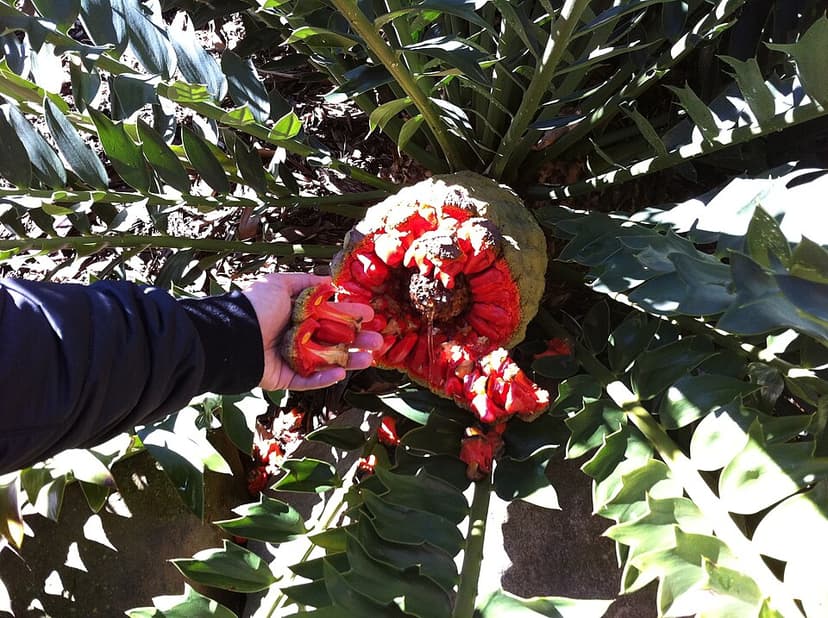
Encephalartos ituriensis
Encephalartos ituriensis, commonly known as the Ituri Forest cycad, is a palm-like cycad species native to the Democratic Republic of the Congo. It is characterized by its tall, robust growth, glossy dark green leaves with spiny, toothed leaflets, and distinctive reproductive cones. Found on granite monadnocks within the Ituri forest, this species is considered Near Threatened.