
Encephalartos natalensis
Rocky outcrops, south-facing cliffs, and steep scarp slopes in forests, found at altitudes up to 1,200 m, but seldom close to the coast.·Arborescent, often leaning or branched from the base.·Near threatened
Encephalartos natalensis, also known as the Natal cycad or giant cycad, is a species of cycad native to the Eastern Cape and Kwazulu-Natal provinces of South Africa. It is characterized by its large, pinnate leaves and can grow to impressive heights, often leaning or branching from the base. This dioecious species produces distinct male and female cones, with the female cones yielding bright red seeds.
Key Facts
- ›Endemic to the Eastern Cape and Kwazulu-Natal provinces of South Africa.
- ›Can grow up to 6 meters (20 ft) or more in length, often leaning.
- ›Possesses large, evergreen, pinnate leaves that can reach 3 meters (10 ft) long.
- ›Dioecious, with separate male and female plants bearing cones.
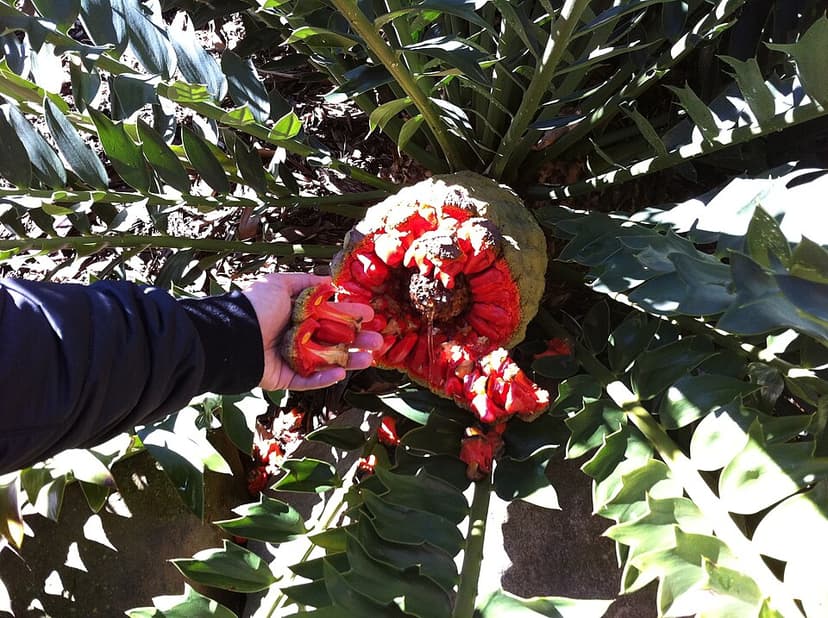
- ›Female cones are large, yellowish-green, and produce bright red seeds.
- ›Conservation status is assessed as 'near threatened' by the IUCN.

Natal Cycad, Giant Cycad
South Africa
- Grows to a length of 6 m or more.
- May have a single trunk or be branched from the base.
- Trunk is topped by a rosette of leaves.
- Large, evergreen, pinnate leaves.
- Leaves are somewhat twisted near the tip.
- Leaves can be up to 3 m long.
- Leaflets are dark green and about 6 cm wide.
- Leaflets may be untoothed or have one or more small prickles on either edge.
- Longest leaflets are in the center of the leaf.
- Leaflets nearest the leaf base may be replaced by spines.
- Dioecious.
- Male cones are velvety, about 45 by 11 cm.
- Female cones are slightly woolly, yellowish-green, and cylindrical, 55 by 25 cm.
- Female cone scales are covered with small knobs.
- Cones split open when ripe.
Bright red when revealed by ripe cones., About 5 cm long.
Bark Used In Herbal Medicine
Removal of plants by collectors, Damage from bark removal for herbal medicine
About Encephalartos natalensis
Encephalartos natalensis: The Natal Cycad
Encephalartos natalensis, commonly known as the Natal cycad or giant cycad, is a striking species of cycad indigenous to South Africa. It is found primarily in the Qumbu and Tabankulu areas of the northern Eastern Cape and across much of KwaZulu-Natal, often thriving on rocky outcrops and steep slopes in forested areas.
Botanical Description
The Natal cycad is characterized by its robust growth, with individuals capable of reaching lengths of 6 meters (20 feet) or more. The trunk, which can be single or branched from the base, is crowned with a spectacular rosette of large, evergreen, pinnate leaves. These leaves, which may twist near their tips, can extend up to 3 meters (10 feet) in length. The leaflets are a deep green, measuring approximately 6 cm (2.4 inches) in width, and may be smooth-edged or possess small prickles along their margins. A distinguishing feature is the presence of spines that may replace the leaflets nearest to the leaf base, setting it apart from similar species like Encephalartos altensteinii.
Reproduction and Ecology
Encephalartos natalensis is dioecious, meaning that male and female reproductive structures are borne on separate plants. The male cones are velvety and measure around 45 by 11 cm (18 by 4 inches), with pollen production occurring between April and June. The female cones are larger, typically 55 by 25 cm (22 by 10 inches), slightly woolly, and yellowish-green. When mature, these cones split open to reveal seeds that are a vivid red and approximately 5 cm (2.0 inches) long. The seeds, though attractive, are poisonous. The larvae of the leopard magpie moth feed on the leaves, while monkeys, baboons, bats, and trumpeter hornbills consume the fruits, indirectly aiding in seed dispersal by discarding the toxic seeds.
Conservation Status
Regrettably, Encephalartos natalensis faces significant threats, leading the International Union for Conservation of Nature (IUCN) to classify its status as 'near threatened'. The species is experiencing a decline in its mature individual population, estimated to be around 10,000. Key threats include the removal of plants by collectors for horticultural purposes and damage caused by the harvesting of bark for use in traditional herbal medicine. Efforts are underway to protect this magnificent species and its habitat.
Source: Wikipedia ↗
Frequently Asked Questions
What is the scientific name for the Natal cycad?
The scientific name for the Natal cycad is Encephalartos natalensis. It is also commonly referred to as the giant cycad.
Where is Encephalartos natalensis found in the wild?
Encephalartos natalensis is endemic to South Africa, specifically found in the Qumbu and Tabankulu areas of the Eastern Cape Province, and across a significant portion of KwaZulu-Natal, often at altitudes up to 1,200 meters.
What are the distinguishing features of Encephalartos natalensis leaves?
The leaves of Encephalartos natalensis are large, evergreen, and pinnate, sometimes reaching up to 3 meters in length. The leaflets are dark green, about 6 cm wide, and can be untoothed or have small prickles; the leaflets closest to the leaf base may be replaced by spines, differentiating it from similar species.
How does Encephalartos natalensis reproduce?
Encephalartos natalensis is dioecious, meaning it has separate male and female plants. Male cones are velvety, while female cones are slightly woolly and cylindrical, eventually splitting open to reveal bright red seeds.
What is the conservation status of the Natal cycad?
The Natal cycad, Encephalartos natalensis, is listed as 'near threatened' by the International Union for Conservation of Nature (IUCN). Its populations are believed to be declining due to threats such as collection by enthusiasts and damage from bark removal for traditional medicine.
Related Cycad species

Encephalartos lanatus
Encephalartos lanatus, commonly known as the Olifants River cycad, is a slow-growing cycad species native to Mpumalanga and Gauteng in South Africa. Characterized by its bluish-green, woolly leaves and the unique arrangement of leaflets, this species thrives in rocky, prairie-covered slopes and exhibits remarkable resilience to fire and frost.

Cycas rumphii
Cycas rumphii, also known as the queen sago, is a dioecious gymnosperm native to Indonesia, New Guinea, and Christmas Island. This palm-like cycad can grow up to 10 meters tall, featuring glossy green fronds and distinctive fissured bark. Its reproductive structures are notable for the male strobilus's orange color and foetid odor, and the female's fleshy, hairy megasporophylls.
Encephalartos ituriensis
Encephalartos ituriensis, commonly known as the Ituri Forest cycad, is a palm-like cycad species native to the Democratic Republic of the Congo. It is characterized by its tall, robust growth, glossy dark green leaves with spiny, toothed leaflets, and distinctive reproductive cones. Found on granite monadnocks within the Ituri forest, this species is considered Near Threatened.