
Encephalartos ituriensis
Grassland on granite monadnocks within the Ituri forest area.·Arborescent (palm-like)·Near Threatened
Encephalartos ituriensis, commonly known as the Ituri Forest cycad, is a palm-like cycad species native to the Democratic Republic of the Congo. It is characterized by its tall, robust growth, glossy dark green leaves with spiny, toothed leaflets, and distinctive reproductive cones. Found on granite monadnocks within the Ituri forest, this species is considered Near Threatened.
Key Facts
- ›Native to the Ituri forest area in the Democratic Republic of the Congo.
- ›Grows up to 6 meters tall with a trunk diameter of 50 cm.
- ›Features glossy dark green leaves with curved, tapering leaflets that have a spine and marginal teeth.
- ›Is dioecious, meaning it has separate male and female plants.
- ›Male plants produce narrowly ovoid pollen cones, while female plants bear ovoid seed cones.
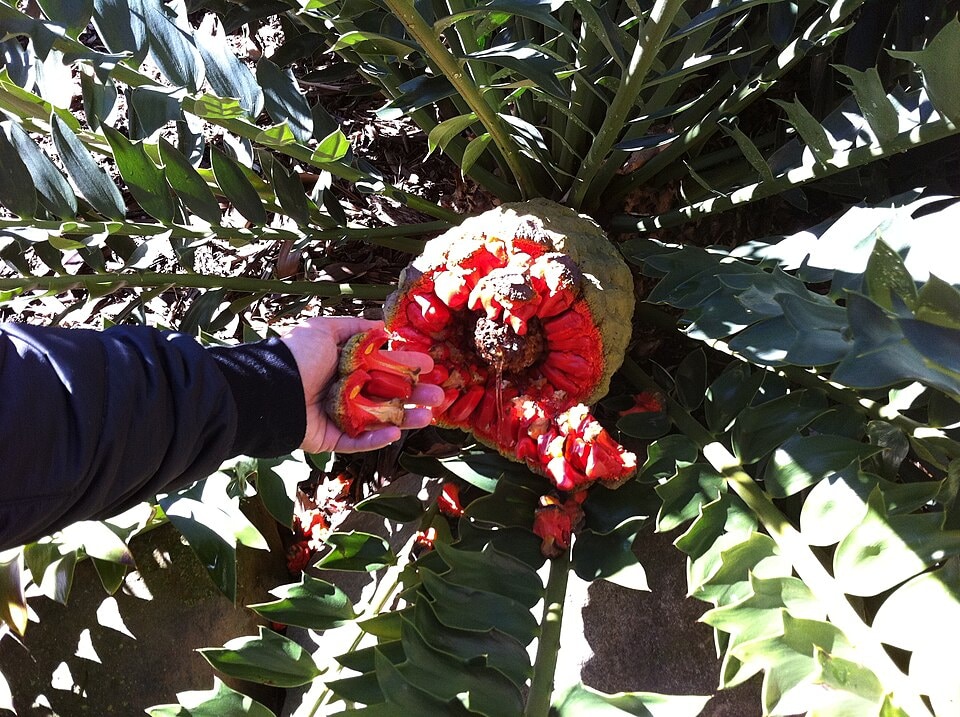
- ›Seeds have a red outer fleshy layer called a sarcotesta.
Ituri Forest Cycad
Democratic Republic of the Congo
Grows Up To 6 Metres Tall, Trunk Diameter Up To 50 cm
Glossy dark green leaves, Leaflets are curved and tapering, Leaflets have a spine at the top, Leaflets have several teeth along the margin
- Male Trees Have 1–4 Pollen Cones, Narrowly Ovoid.
- Female Trees Have 1 Or 2 Seed Cones, Ovoid and 18–20 cm Long.
Seeds Have A Red Sarcotesta.
About Encephalartos ituriensis
Encephalartos ituriensis, commonly referred to as the Ituri Forest cycad, is a striking member of the Zamiaceae family, recognized for its palm-like appearance. This species is indigenous to the Democratic Republic of the Congo, specifically found thriving in the grassland ecosystems situated on two significant granite monadnocks within the Ituri forest region.
Botanical Description
The Ituri Forest cycad is a robust plant, capable of reaching heights of up to 6 meters, with a substantial trunk diameter that can measure up to 50 cm. Its foliage consists of glossy, dark green leaves. The individual leaflets are distinctively curved and tapering, culminating in a sharp spine at their apex and featuring several serrated teeth along their margins. As is characteristic of many cycads, Encephalartos ituriensis exhibits dioecy, meaning that individual plants are either male or female.
Reproduction
Reproductive structures vary between the sexes. Male plants produce one to four narrowly ovoid pollen cones, while female plants bear one or two ovoid seed cones, which are typically between 18 and 20 cm in length. A notable feature of the seeds is their red sarcotesta, an outer fleshy covering.
Conservation Status
Currently, Encephalartos ituriensis is listed as 'Near Threatened' by the International Union for Conservation of Nature (IUCN). This classification indicates that the species faces a considerable risk of extinction in the wild in the medium-term future if conservation efforts are not maintained or enhanced.
Source: Wikipedia ↗
Frequently Asked Questions
Where is Encephalartos ituriensis found?
Encephalartos ituriensis is indigenous to the grassland areas found on two large granite monadnocks within the Ituri forest region of the Democratic Republic of the Congo.
What does Encephalartos ituriensis look like?
This cycad grows to a height of 6 meters with a trunk that can reach 50 cm in diameter. It has glossy, dark green leaves, and its leaflets are curved and tapering, ending in a spine with several teeth along the edges.
Does Encephalartos ituriensis have male and female plants?
Yes, like most cycads, Encephalartos ituriensis is dioecious, meaning individual plants are either male or female. Male trees produce pollen cones, while female trees produce seed cones.
What are the cones of Encephalartos ituriensis like?
Male trees typically bear one to four narrowly ovoid pollen cones. Female trees have one or two ovoid seed cones that measure between 18 and 20 cm in length. The seeds themselves are covered by a red sarcotesta.
What is the conservation status of Encephalartos ituriensis?
The IUCN Red List classifies Encephalartos ituriensis as 'Near Threatened'. This designation indicates that the species is close to qualifying for a more threatened category in the near future.
Related Cycad species

Cycas rumphii
Cycas rumphii, also known as the queen sago, is a dioecious gymnosperm native to Indonesia, New Guinea, and Christmas Island. This palm-like cycad can grow up to 10 meters tall, featuring glossy green fronds and distinctive fissured bark. Its reproductive structures are notable for the male strobilus's orange color and foetid odor, and the female's fleshy, hairy megasporophylls.

Encephalartos lanatus
Encephalartos lanatus, commonly known as the Olifants River cycad, is a slow-growing cycad species native to Mpumalanga and Gauteng in South Africa. Characterized by its bluish-green, woolly leaves and the unique arrangement of leaflets, this species thrives in rocky, prairie-covered slopes and exhibits remarkable resilience to fire and frost.

Encephalartos natalensis
Encephalartos natalensis, also known as the Natal cycad or giant cycad, is a species of cycad native to the Eastern Cape and Kwazulu-Natal provinces of South Africa. It is characterized by its large, pinnate leaves and can grow to impressive heights, often leaning or branching from the base. This dioecious species produces distinct male and female cones, with the female cones yielding bright red seeds.