
Encephalartos aemulans
Shortgrass savannah among sandstone cliffs at altitudes of 1,000-1,100 m.·Arborescent·Critically Endangered
Encephalartos aemulans, commonly known as the Ngotshe cycad, is a critically endangered cycad species found exclusively in South Africa's Kwazulu-Natal province. This species is characterized by its tall, unbranched stems and long, spiny-edged leaves arranged oppositely. It is dioecious, with distinct male and female plants producing large, yellow to yellow-green cones.
Key Facts
- ›Endemic to a single population in Kwazulu-Natal, South Africa.
- ›Listed as Critically Endangered by the IUCN.
- ›Possesses tall, unbranched stems reaching up to 3 meters.
- ›Leaves are long (up to 2 meters) with pointed leaflets featuring spiny edges.
- ›Dioecious, with separate male and female plants bearing large reproductive cones.
- ›Primary threat is the collection of wild specimens.

Ngotshe Cycad
South Africa
Tall, unbranched stem, Can grow up to 3 m tall, Up to 35 cm wide
Can Reach 2 m In Length, Possess Pointed Leaflets With Spiny Edges, Leaflets Are About 12–15 cm Long
- Male cones are oval and yellow, 29–38 cm long and 14–18 cm wide
- Female cones are yellow-green, 35–40 cm long, and 20–23 cm wide
- Female cones have macrosporophylls with a bumpy surface
Oblong, About 25–30 mm Long, Covered With Red Sarcotesta
Collecting of Wild Specimens
About Encephalartos aemulans
Encephalartos aemulans: The Ngotshe Cycad
Encephalartos aemulans, commonly referred to as the Ngotshe cycad, is a rare and critically endangered species of cycad indigenous to South Africa. Its existence is confined to a single known population within the KwaZulu-Natal province, where it grows in its specialized habitat.
Description and Characteristics
This striking cycad is characterized by its tall, unbranched stem, which can ascend to heights of up to 3 meters and reach a diameter of 35 centimeters. The plant's foliage consists of long leaves, potentially extending up to 2 meters in length. These leaves are adorned with leaflets that are pointed and possess sharply spiny edges, each measuring approximately 12–15 cm long. A notable botanical feature is the arrangement of these leaflets, which are positioned oppositely along the stem at a distinct angle of 135 degrees.
Encephalartos aemulans exhibits dioecy, meaning that individual plants are either male or female. The reproductive structures, or cones, differ significantly between the sexes. Male plants produce oval, yellow cones that range from 29–38 cm in length and 14–18 cm in width, featuring broad, rhombic microsporophylls. In contrast, the female cones are larger, typically yellow-green in color, measuring 35–40 cm in length and 20–23 cm in width, with macrosporophylls that have a characteristically bumpy surface. The seeds produced by the female cones are oblong, approximately 25–30 mm long, and are enveloped by a red sarcotesta.
Distribution and Habitat
The Ngotshe cycad is found exclusively in the KwaZulu-Natal province of South Africa, with only one documented population. It thrives in a specific ecological niche, occurring among sandstone cliffs within shortgrass savannah environments. These preferred habitats are situated at altitudes ranging from 1,000 to 1,100 meters, though individual specimens have been observed at lower elevations.
Conservation Status
Encephalartos aemulans faces severe threats to its survival. It is listed by the International Union for Conservation of Nature (IUCN) as Critically Endangered, with estimates suggesting only 100 to 250 individuals remain in the wild. The species' population trend is documented as decreasing. The primary driver of this decline is the collection of wild specimens, a practice that significantly impacts its already limited numbers. Furthermore, Encephalartos aemulans is included in Appendix I of CITES, highlighting the global concern for its conservation and the strict regulations on its trade and protection.
Source: Wikipedia ↗
Frequently Asked Questions
What is Encephalartos aemulans?
Encephalartos aemulans, also known as the Ngotshe cycad, is a species of cycad native to South Africa. It is recognized for its tall, unbranched trunk and distinctive spiny leaves.
Where is the Ngotshe cycad found?
The Ngotshe cycad is endemic to the KwaZulu-Natal province in South Africa. It has been found growing among sandstone cliffs in shortgrass savannah at altitudes between 1,000 and 1,100 meters.
What is the conservation status of Encephalartos aemulans?
Encephalartos aemulans is listed as Critically Endangered by the International Union for Conservation of Nature (IUCN). Its population is estimated to be between 100 and 250 individuals, with a declining trend.
What are the main threats to Encephalartos aemulans?
The primary threat to the survival of Encephalartos aemulans is the illegal collection of wild specimens. This practice significantly impacts its already small and vulnerable population.
How can you distinguish male and female Encephalartos aemulans plants?
Encephalartos aemulans is a dioecious species, meaning it has separate male and female plants. Male plants bear oval, yellow cones measuring 29–38 cm long, while female plants produce yellow-green cones that are 35–40 cm long.
Related Cycad species

Encephalartos sclavoi
Encephalartos sclavoi, also known as Sclavo's cycad, is a critically endangered cycad species native to the Uluguru Mountains of Tanzania. This "living fossil" is characterized by its relatively short, arborescent growth, long dark green leaves with concave and spined leaflets, and distinctive yellow seed cones. Its limited population and specific ecological needs make it a focus of conservation efforts.
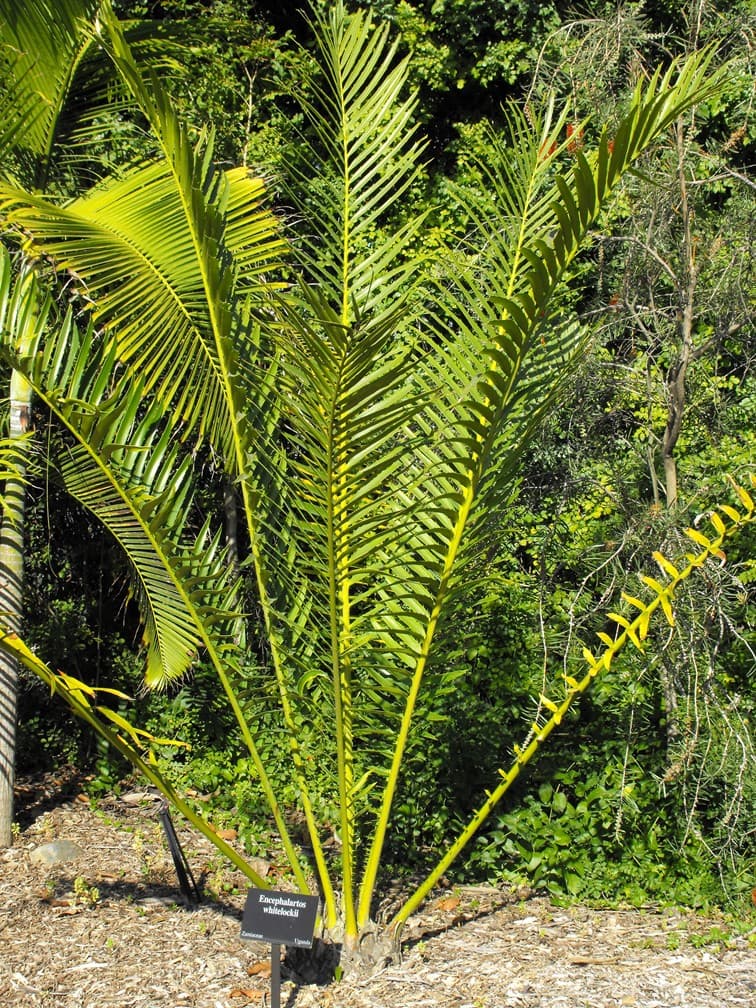
Encephalartos whitelockii
Encephalartos whitelockii is a critically endangered cycad species native to a single location in southwestern Uganda, forming one of Africa's most impressive cycad populations along the Mpanga River. This large, arborescent cycad is characterized by its tall stems topped with stiff, glossy dark green fronds and distinctive bluish-green cones, and it plays an important role in the local ecosystem, particularly for baboons.

Encephalartos hirsutus
Encephalartos hirsutus is a striking cycad species native to the Limpopo Province of South Africa, specifically found on quartzite cliffs in the Makuya Nature Reserve. This arborescent cycad is characterized by its erect, sometimes decumbent stem, and distinctive pinnate leaves with thorny leaflets. Its rarity in the wild is a significant concern, largely due to over-collection for ornamental purposes.