
Encephalartos hirsutus
South-east-facing quartzite cliffs·Arborescent·Critically Endangered
Encephalartos hirsutus is a striking cycad species native to the Limpopo Province of South Africa, specifically found on quartzite cliffs in the Makuya Nature Reserve. This arborescent cycad is characterized by its erect, sometimes decumbent stem, and distinctive pinnate leaves with thorny leaflets. Its rarity in the wild is a significant concern, largely due to over-collection for ornamental purposes.
Key Facts
- ›Native to Limpopo Province, South Africa.
- ›Found on south-east-facing quartzite cliffs.
- ›Can grow up to 4 meters tall with a trunk diameter of 35-40 cm.
- ›Leaves are pinnate, 1.1-1.4 meters long, with thorny leaflets.
- ›It is a dioecious species, meaning separate male and female plants exist.
- ›Critically Endangered due to over-collection for ornamental purposes.

Limpopo Province, South Africa
- Erect stem, becomes decumbent in older specimens
- Up to 4 m high
- Diameter of 35–40 cm
- Pinnate
- 1.1–1.4 m long
- Supported by a petiole about 13 cm long
- Composed of numerous pairs of elliptic leaflets
- Coriaceous texture
- Leaflets are 13–17 cm long
- Entire margin and thorny apex
- Leaflets fixed on the rachis at about a 40° angle
- Reduced to thorns towards the base of the petiole
- Male cones: 2 to 5, cylindrical-ovoid, erect, about 50 cm long and 9 cm broad
- Female cones: 1–3, ovoid, about 40 cm long and 35 cm broad
- Glaucous green color
- Glabrous
Coarsely Ovoid, 3–3.5 cm Long, Covered With An Orange-Red Sarcotesta
Ornamental
Over-Collecting For Ornamental Purposes
About Encephalartos hirsutus
Encephalartos hirsutus is a distinct species of cycad native to the Limpopo Province of South Africa. Its natural habitat is confined to south-east-facing quartzite cliffs, specifically noted within the Makuya Nature Reserve which borders the Kruger National Park. These cycads are found at elevations ranging from 800 to 1,000 meters above sea level.
Description and Characteristics
This species exhibits an arborescent growth form, with a stem that is typically erect but can become decumbent in older specimens. The stem can reach heights of up to 4 meters (13 feet) and possesses a diameter of 35–40 cm (14–16 inches). The leaves are pinnate, measuring 1.1–1.4 meters (3 ft 7 in – 4 ft 7 in) in length, and are arranged in a crown at the apex of the stem. Each leaf is supported by a petiole about 13 cm (5.1 inches) long. The leaflets are elliptic, coriaceous, and range from 13–17 cm (5.1–6.7 inches) long. They feature an entire margin and a thorny apex, and are attached to the rachis at an angle of approximately 40°. Towards the base of the petiole, these leaflets are reduced to thorns.
Encephalartos hirsutus is a dioecious species, meaning that male and female reproductive structures are found on separate plants. Male specimens typically bear 2 to 5 cylindrical-ovoid cones that are erect, measuring about 50 cm (20 inches) long and 9 cm (3.5 inches) broad. Female specimens usually have 1 to 3 ovoid cones, approximately 40 cm (16 inches) long and 35 cm (14 inches) broad, which are glaucous green and glabrous. The seeds are coarsely ovoid, measuring 3–3.5 cm (1.2–1.4 inches) in length, and are enveloped by an orange-red sarcotesta.
Conservation Status and Threats
Encephalartos hirsutus is classified as Critically Endangered. The primary threat to its survival in the wild is over-collection for ornamental purposes. As of recent assessments, it is estimated that there are fewer than 10 individuals remaining in their natural habitat, highlighting the severe impact of human activities on this species.
Source: Wikipedia ↗
Frequently Asked Questions
Where is Encephalartos hirsutus found in the wild?
Encephalartos hirsutus is native to the Limpopo Province of South Africa. It has been recorded on south-east-facing quartzite cliffs within the Makuya Nature Reserve, bordering the Kruger National Park.
What are the physical characteristics of Encephalartos hirsutus?
This species is an arborescent cycad with an erect stem that can reach up to 4 meters in height and 35-40 cm in diameter. Its leaves are pinnate, 1.1-1.4 meters long, featuring numerous pairs of coriaceous leaflets with entire margins and thorny apexes.
What are the reproductive characteristics of Encephalartos hirsutus?
Encephalartos hirsutus is dioecious, meaning it has separate male and female plants. Male specimens produce 2-5 cylindrical-ovoid cones up to 50 cm long, while female specimens bear 1-3 ovoid cones up to 40 cm long.
Why is Encephalartos hirsutus considered endangered?
The species is critically endangered primarily due to over-collection for ornamental purposes. As of 2020, it was estimated that only up to 10 individuals remained in the wild.
What do the seeds of Encephalartos hirsutus look like?
The seeds of Encephalartos hirsutus are coarsely ovoid, measuring 3-3.5 cm in length. They are characterized by being covered with an orange-red sarcotesta.
Related Cycad species

Encephalartos sclavoi
Encephalartos sclavoi, also known as Sclavo's cycad, is a critically endangered cycad species native to the Uluguru Mountains of Tanzania. This "living fossil" is characterized by its relatively short, arborescent growth, long dark green leaves with concave and spined leaflets, and distinctive yellow seed cones. Its limited population and specific ecological needs make it a focus of conservation efforts.
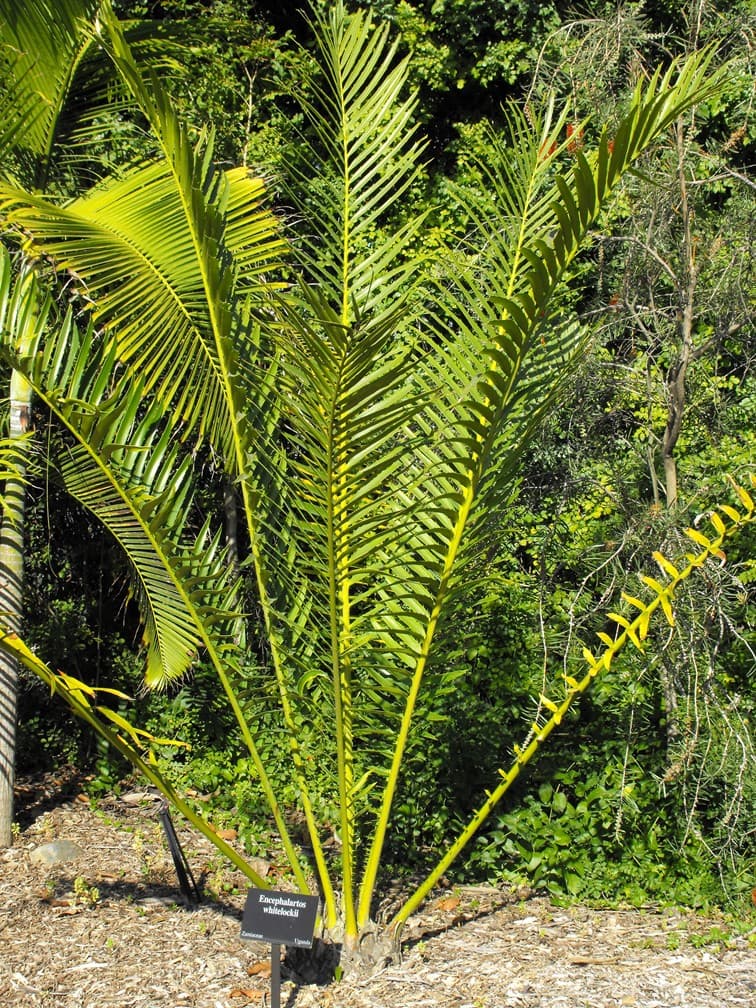
Encephalartos whitelockii
Encephalartos whitelockii is a critically endangered cycad species native to a single location in southwestern Uganda, forming one of Africa's most impressive cycad populations along the Mpanga River. This large, arborescent cycad is characterized by its tall stems topped with stiff, glossy dark green fronds and distinctive bluish-green cones, and it plays an important role in the local ecosystem, particularly for baboons.

Encephalartos aemulans
Encephalartos aemulans, commonly known as the Ngotshe cycad, is a critically endangered cycad species found exclusively in South Africa's Kwazulu-Natal province. This species is characterized by its tall, unbranched stems and long, spiny-edged leaves arranged oppositely. It is dioecious, with distinct male and female plants producing large, yellow to yellow-green cones.