
Encephalartos sclavoi
Uluguru Mountains·Arborescent·Dispersed by animals·Critically Endangered
Encephalartos sclavoi, also known as Sclavo's cycad, is a critically endangered cycad species native to the Uluguru Mountains of Tanzania. This "living fossil" is characterized by its relatively short, arborescent growth, long dark green leaves with concave and spined leaflets, and distinctive yellow seed cones. Its limited population and specific ecological needs make it a focus of conservation efforts.
Key Facts
- ›Endemic to the Uluguru Mountains of Tanzania.
- ›Population estimated at only ~50 mature plants.
- ›Leaves can reach lengths of 170-200 cm.
- ›Features concave, heavily spined leaflets.
- ›Seed cones are yellow, measuring 30-40 cm long.
- ›Considered a "living fossil" due to its ancient lineage.

Sclavo's Cycad
Tanzania
Grows to about 1 metre high.
- Leaves are 170 to 200 centimetres long.
- Leaves are dark green and semiglossy.
- Leaflets are concave and heavily spined.
- Two varieties exist: green emergent and reddish-brown emergent.
- Leaves mature to a green or greenish-yellow color.
- Seed cones are yellow.
- Male cones are generally cylindrical and greenish-yellow.
- Female cones are larger, more oval-shaped, and exhibit a greenish-brown color.
- Seed cones measure 30 to 40 centimetres long and 15 to 20 centimetres in diameter.
- Cones are dispersed by animals, some of which feed on them.
- Many seeds are damaged during dispersal, resulting in non-viable seeds.
- Gained popularity among peoples partly due to its endangered status.
Limited population size., Damage to seeds during dispersal by animals.
About Encephalartos sclavoi
Encephalartos sclavoi, commonly referred to as Sclavo's cycad, is a critically endangered species belonging to the Zamiaceae family. It is recognized as a "living fossil" due to its ancient lineage, with populations having existed for millions of years. This cycad is found exclusively in the Uluguru Mountains of Tanzania, where it faces significant threats to its survival.
Description and Characteristics
Sclavo's cycad typically reaches a height of approximately 1 meter (3.3 feet). Its leaves are notably long, spanning 170 to 200 centimeters, and possess a dark green, semiglossy appearance. A distinctive feature of this species is its leaflets, which are concave and heavily spined. Two growth varieties are noted: one with green emergent leaves that are less spiny and straighter, and another with reddish-brown emergent leaves that have thicker spines and are slightly more concave. As they mature, both varieties develop into green or greenish-yellow foliage.
The reproductive cones of Encephalartos sclavoi differ based on sex. Male cones are generally cylindrical and greenish-yellow, while female cones are larger, more oval-shaped, and exhibit a greenish-brown hue. These cones are dispersed by animals, many of which feed on them, but this process often results in damaged, non-viable seeds, further contributing to the species' precarious conservation status.
Conservation and Significance
With an estimated population of only around 50 mature plants, Encephalartos sclavoi is considered critically endangered. While its use in native Tanzanian society is limited, it has garnered popularity in other regions, partly due to its status as an endangered species. The species was formally described in 1990 by botanists Aldo Moretti, D.W. Stevenson, and Paolo Deluca, acknowledging the initial discovery by Jean Pierre Sclavo.
Source: Wikipedia ↗
Frequently Asked Questions
What is the common name for Encephalartos sclavoi?
Encephalartos sclavoi is commonly known as Sclavo's cycad. This name honors Jean Pierre Sclavo, the French collector who first discovered the species.
Where is Encephalartos sclavoi found naturally?
This cycad species is endemic to the Uluguru Mountains in Tanzania. Its natural habitat is restricted to this specific mountainous region.
How large can Encephalartos sclavoi grow?
Encephalartos sclavoi typically grows to a height of about 1 meter (approximately 3.3 feet). Its leaves are quite long, often reaching 170 to 200 centimeters.
What are the characteristics of Encephalartos sclavoi leaves and leaflets?
The leaves are dark green and semiglossy, with lengths ranging from 170 to 200 centimeters. Its leaflets are a distinctive feature, being concave and heavily spined.
What do the seed cones of Encephalartos sclavoi look like?
The seed cones of Encephalartos sclavoi are yellow. Male cones are generally cylindrical and greenish-yellow, while female cones are larger, more oval-shaped, and greenish-brown.
What is the conservation status of Encephalartos sclavoi?
Encephalartos sclavoi is classified as critically endangered. Its population is very small, with only approximately 50 mature plants recorded in its native habitat.
Related Cycad species
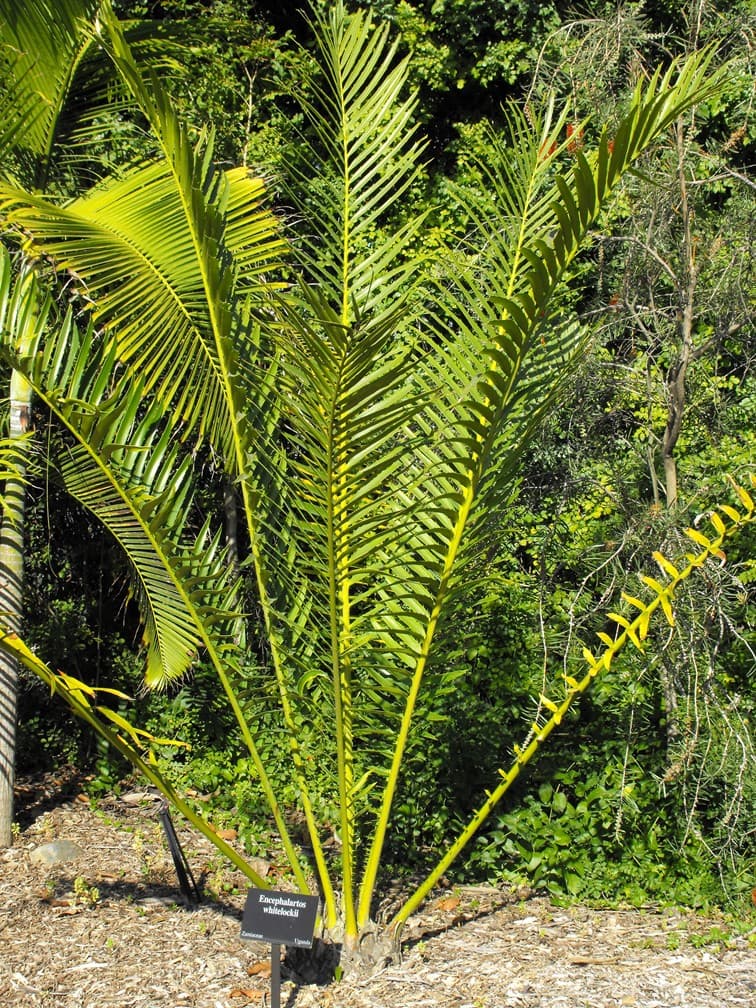
Encephalartos whitelockii
Encephalartos whitelockii is a critically endangered cycad species native to a single location in southwestern Uganda, forming one of Africa's most impressive cycad populations along the Mpanga River. This large, arborescent cycad is characterized by its tall stems topped with stiff, glossy dark green fronds and distinctive bluish-green cones, and it plays an important role in the local ecosystem, particularly for baboons.

Encephalartos aemulans
Encephalartos aemulans, commonly known as the Ngotshe cycad, is a critically endangered cycad species found exclusively in South Africa's Kwazulu-Natal province. This species is characterized by its tall, unbranched stems and long, spiny-edged leaves arranged oppositely. It is dioecious, with distinct male and female plants producing large, yellow to yellow-green cones.

Encephalartos hirsutus
Encephalartos hirsutus is a striking cycad species native to the Limpopo Province of South Africa, specifically found on quartzite cliffs in the Makuya Nature Reserve. This arborescent cycad is characterized by its erect, sometimes decumbent stem, and distinctive pinnate leaves with thorny leaflets. Its rarity in the wild is a significant concern, largely due to over-collection for ornamental purposes.