
Encephalartos whitelockii
Grows on almost sheer granite faces and rocky slopes amongst tall grass in savanna, and also occurs in dense evergreen montane forests. Found at altitudes between 1,000 and 1,300 meters.·Arborescent·Insects (weevils)·Critically Endangered
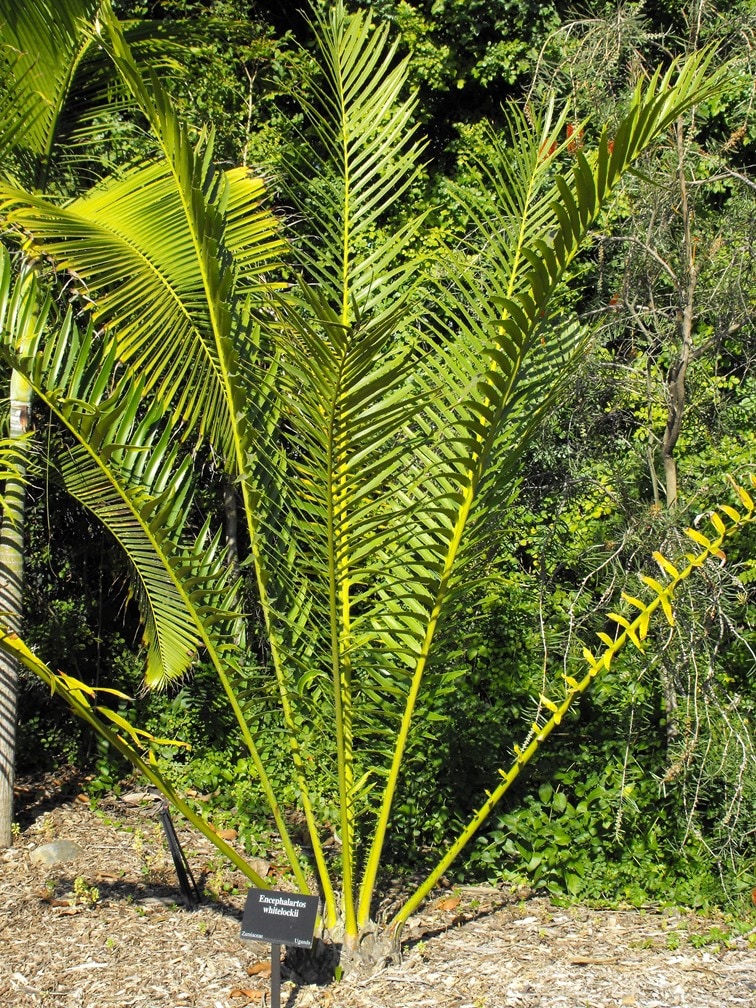
Encephalartos whitelockii is a critically endangered cycad species native to a single location in southwestern Uganda, forming one of Africa's most impressive cycad populations along the Mpanga River. This large, arborescent cycad is characterized by its tall stems topped with stiff, glossy dark green fronds and distinctive bluish-green cones, and it plays an important role in the local ecosystem, particularly for baboons.
Key Facts
- ›Native to a single location in southwestern Uganda, along the Mpanga River.
- ›Estimated population of 12,000 mature individuals.
- ›Recognized as Critically Endangered by the IUCN Red List.
- ›Features large, glossy dark green fronds and bluish-green reproductive cones.
- ›Pollinated by weevils attracted by strong odors from male and female cones.
- ›Seeds serve as a food source for baboons, which aid in seed dispersal.
Uganda
- Erect up to 4 m tall
- 35–40 cm in diameter
- Typically growing in large clumps
- Consists mostly of soft, pithy storage tissue protected by old leaf bases
- 310–410 cm long
- Dark green, highly glossy
- Slightly keeled
- Rachis green, gently curved, somewhat lax or straight with last third sharply recurved
- Petiole straight, with 6-12 prickles
- Leaflets lanceolate, strongly discolorous, not overlapping, not lobed
- Margins flat, heavily toothed
- Median leaflets 23–30 cm long, 20–28 mm wide
- Bluish-green cones with smooth scale apices
- Male cones: 1-5, narrowly ovoid, green or yellow, 50 cm long, 9 cm in diameter, long-stalked, often pendulous
- Female cones: 1-3, ovoid, green or yellow, 45 cm long, 35 cm in diameter, sessile
Ovoid, 30–35 mm Long, 25–30 mm Wide, Sarcotesta Red
- Seeds are an important food source for baboons
- Construction of hydroelectric power stations
- Construction of roads and camps
- Soil erosion and habitat reduction
- Reduction in population due to heavy machinery
- Collection of seed and seedlings for commercial trade
- Cultivation on slopes and clearing of cycads
- Harvesting of leaves for building materials
- Burning of occupied areas for grazing stimulation
About Encephalartos whitelockii
Encephalartos whitelockii is a striking species of cycad, distinguished by its arborescent growth form and impressive stature, with stems reaching up to 4 meters (13 feet) in height. Native to a remarkably restricted area in southwestern Uganda, this species forms one of the largest and most significant cycad populations found on the African continent. Its natural habitat is along the Mpanga River, where it thrives on granite faces and rocky slopes, often amidst tall savanna grasses or within dense montane forests.
Botanical Features
The species is characterized by a crown of long, stiff, dark green, and highly glossy fronds. These fronds are composed of falcate leaflets that curve towards the frond apex and possess distinctively toothed margins, with more than three teeth on each side. Encephalartos whitelockii produces separate male and female cones, which are notably bluish-green. Male cones are pendulous and long-stalked, while female cones are sessile and egg-shaped. The plant is slow-growing and long-lived, with individuals existing as either male or female plants, a characteristic that is only discernible once the plant begins to cone.
Ecology and Conservation
Encephalartos whitelockii plays a role in its local ecosystem, with its large seeds, featuring a fleshy red outer coat, serving as a food source for baboons, which in turn aid in seed dispersal. Pollination is facilitated by insects, specifically weevils, attracted by strong odors emitted by the cones. Despite its ecological importance and impressive population size of an estimated 12,000 mature individuals, the species faces severe threats. These include habitat destruction and degradation due to infrastructure development such as hydroelectric power stations, roads, and camps, as well as unsustainable harvesting practices and land clearing. Consequently, Encephalartos whitelockii is classified as Critically Endangered by the IUCN Red List, highlighting the urgent need for conservation efforts to protect its unique habitat and ensure its survival.
Source: Wikipedia ↗
Frequently Asked Questions
Where is Encephalartos whitelockii found?
Encephalartos whitelockii is endemic to a single location in the Kitagwenda District of southwestern Uganda. The known populations are specifically found along the Mpanga River, close to where it flows into Lake George.
What is the conservation status of Encephalartos whitelockii?
Encephalartos whitelockii is listed as Critically Endangered on the IUCN Red List. Its survival is seriously threatened by development projects and habitat degradation.
How does Encephalartos whitelockii reproduce?
This species is dioecious, meaning it has separate male and female plants. Reproduction involves cones, with pollination primarily carried out by weevils attracted by odors produced by the cones.
What are the main threats to Encephalartos whitelockii?
Major threats include the construction of hydroelectric power stations, roads, and camps, which cause habitat loss and soil erosion. Other threats include commercial collection of seeds and seedlings, harvesting of leaves, and burning of occupied areas for grazing.
What are the physical characteristics of Encephalartos whitelockii?
Encephalartos whitelockii is a large, arborescent cycad that can grow up to 4 meters tall. It has a stem topped with a crown of long, stiff, dark green, glossy fronds, and produces distinctive bluish-green cones.
Related Cycad species

Encephalartos lanatus
Encephalartos lanatus, commonly known as the Olifants River cycad, is a slow-growing cycad species native to Mpumalanga and Gauteng in South Africa. Characterized by its bluish-green, woolly leaves and the unique arrangement of leaflets, this species thrives in rocky, prairie-covered slopes and exhibits remarkable resilience to fire and frost.

Dioon edule
Dioon edule, commonly known as the chestnut dioon or palma de la virgen, is a cycad species native to the eastern coast of Mexico. It is characterized by pinnate leaves that can reach around 135 cm in length and a slow growth rate adapted to harsh, dry climates. This species plays a significant role in its ecosystem, particularly in nitrogen fixation, and is recognized for its mutualistic relationship with specific beetle species responsible for its pollination.

Encephalartos sclavoi
Encephalartos sclavoi, also known as Sclavo's cycad, is a critically endangered cycad species native to the Uluguru Mountains of Tanzania. This "living fossil" is characterized by its relatively short, arborescent growth, long dark green leaves with concave and spined leaflets, and distinctive yellow seed cones. Its limited population and specific ecological needs make it a focus of conservation efforts.