
Encephalartos gratus
Arborescent (trunk-forming)
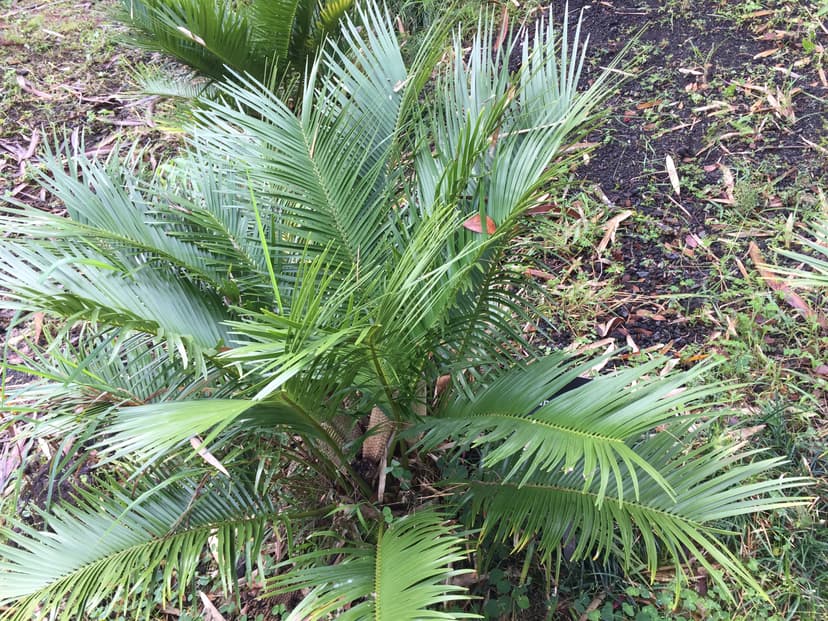
Encephalartos gratus is a species of cycad native to Malawi and Mozambique, characterized by its solitary, spherical to erect trunks that can reach up to 1.2 meters in height. It features numerous arched, lance-shaped leaves and produces striking, large cones. A unique variation found in Mozambique's Namuli Mountains exhibits a cluster of leaves emerging from the tip of each cone.
Key Facts
- ›Native to Malawi and Mozambique.
- ›Trunks are solitary, spherical, or erect, reaching up to 1.2 meters.
- ›Leaves are arched, lance-shaped, and can be 0.9 to 1.8 meters long.
- ›Female cones are large, cylindrical to conical, measuring up to 68 cm in length.
- ›Male cones are spindle-shaped, up to 40 cm long.
- ›A notable variation on Mount Namuli produces leaves from the cone tip.

Malawi, Mozambique
Solitary, Spherical, Or Erect Trunks, Up To 1.2 Meters In Height, Up To 60 cm In Width
- Numerous arched leaves
- Shaped like a lance or narrow oval
- 0.9 - 1.8 meters long
- 34 - 44 cm wide
- Flat surface, rounded tip, abruptly narrowing base
- Dull green, flexible leaflets
- Leaflets arranged in 30 to 70 pairs, do not overlap
- Basal leaflets reduced to thorns
- Middle leaflets lanceolate, 18 - 26 cm long, 23 - 35 mm wide
- Female cones: solitary or in clusters of up to ten, cylindrical or approximately conical, 55 - 68 cm long, 15 - 20 cm diameter, dark brown.
- Male cones: usually solitary, spindle-shaped, 30 - 40 cm long, 7.5 - 10 cm diameter, densely covered in reddish-brown hair.
- Sarcotesta is dull vermilion when mature
- Ovate in shape
- 30 - 37 mm in length
- 19 - 21 mm in diameter
- More or less smooth with 11 to 14 indistinct longitudinal furrows
About Encephalartos gratus
Encephalartos gratus is a species of cycad that is native to the African nations of Malawi and Mozambique. It is recognized for its distinctive physical characteristics, including its trunk and foliage, as well as its reproductive cones.
Description and Morphology
The trunks of Encephalartos gratus are typically solitary and can present as spherical or grow erect, reaching heights of up to 1.2 meters and widths of 60 cm. The plant bears numerous arched leaves that are characterized by their lance-like or narrow oval shape. These leaves can extend from 0.9 to 1.8 meters in length and 34 to 44 cm in width. The leaflets themselves are dull green, flexible, and arranged in 30 to 70 pairs along the leaf stem. The basal leaflets are notably reduced to thorns, while the middle leaflets are lanceolate, measuring between 18 and 26 cm long and 23 to 35 mm wide. The margins of these middle leaflets can bear spines.
Reproductive Structures
Encephalartos gratus produces distinct male and female cones. The female cones are substantial, either solitary or occurring in clusters of up to ten, and are cylindrical to conical in shape, measuring between 55 and 68 cm in length and 15 to 20 cm in diameter. They are dark brown in color, and their mature seeds have a dull vermilion sarcotesta.
The male cones are typically solitary and spindle-shaped, ranging from 30 to 40 cm in length and 7.5 to 10 cm in diameter. They are densely covered in reddish-brown hair.
Notable Variations
A particularly noteworthy variation of Encephalartos gratus has been observed in the Namuli Mountains of Mozambique. In this localized form, a cluster of leaves emerges directly from the tip of each cone, with these leaves capable of reaching lengths of up to a meter.
Geographic Distribution
The natural range of Encephalartos gratus extends across specific regions of Malawi and Mozambique. In Malawi, it is found in the Mulanje District, between the Tuchila and Ruo Rivers. In Mozambique, its presence is documented in the Zambezia Province, the Chiraba and Navene River areas, and on Mount Namuli, as well as near Derre, Mount Morrumbala, and Namarroi.
Source: Wikipedia ↗
Frequently Asked Questions
Where is Encephalartos gratus found naturally?
Encephalartos gratus is indigenous to the southern regions of Malawi, specifically in the Mulanje District between the Tuchila and Ruo Rivers. It is also found in various locations within Mozambique, including Zambezia Province, the Chiraba and Navene River areas, and Mount Namuli.
What are the dimensions of Encephalartos gratus trunks?
The trunks of Encephalartos gratus are typically solitary and can be spherical in shape or grow erect up to 1.2 meters in height and 60 cm in width.
Can you describe the leaves of Encephalartos gratus?
The leaves of Encephalartos gratus are numerous and arched, resembling a lance or narrow oval shape. They range from 0.9 to 1.8 meters in length and 34 to 44 cm in width, with a flat surface, rounded tip, and abruptly narrowing base. The leaflets are dull green, flexible, and arranged in 30 to 70 pairs.
What do the cones of Encephalartos gratus look like?
Female cones are either solitary or in clusters of up to ten, cylindrical to conical, measuring 55-68 cm long and 15-20 cm in diameter, and are dark brown. Male cones are usually solitary, spindle-shaped, 30-40 cm long and 7.5-10 cm in diameter, and covered in reddish-brown hair.
Is there anything unusual about the cones of Encephalartos gratus?
Yes, a local variation found in the Namuli Mountains of Mozambique exhibits a unique characteristic where a cluster of leaves emerges from the tip of each cone, with these leaves potentially reaching a meter in length.
Related Cycad species

Encephalartos horridus
Encephalartos horridus, commonly known as the Eastern Cape blue cycad, is a distinctive, low-growing cycad native to the Eastern Cape Province of South Africa. It is recognized for its striking blue-gray, spiny leaves and typically develops a subterranean stem. This species thrives in arid shrublands and rocky ridges, exhibiting a slow growth rate and requiring specific conditions for successful cultivation.
Zamia inermis
Zamia inermis is a critically endangered cycad species native to Actopan, Veracruz, Mexico. It is characterized by its shrub-like growth, with a trunk that can be branched and upright leaves composed of numerous linear-lanceolate leaflets. This species is dioecious and faces significant threats from habitat loss, wildfires, and over-harvesting.

Encephalartos dolomiticus
Encephalartos dolomiticus, commonly known as the Wolkberg cycad, is a critically endangered cycad species native to the Wolkberg region of South Africa. This tree-like cycad typically grows up to 2 meters tall and is characterized by its distinctive bluish leaves forming a crown, with lance-shaped leaflets arranged oppositely along the rachis. It is a dioecious species, producing separate male and female cones.