
Encephalartos inopinus
The specific habitat of Encephalartos inopinus is not detailed beyond its native geographical region.·Palm-like cycad
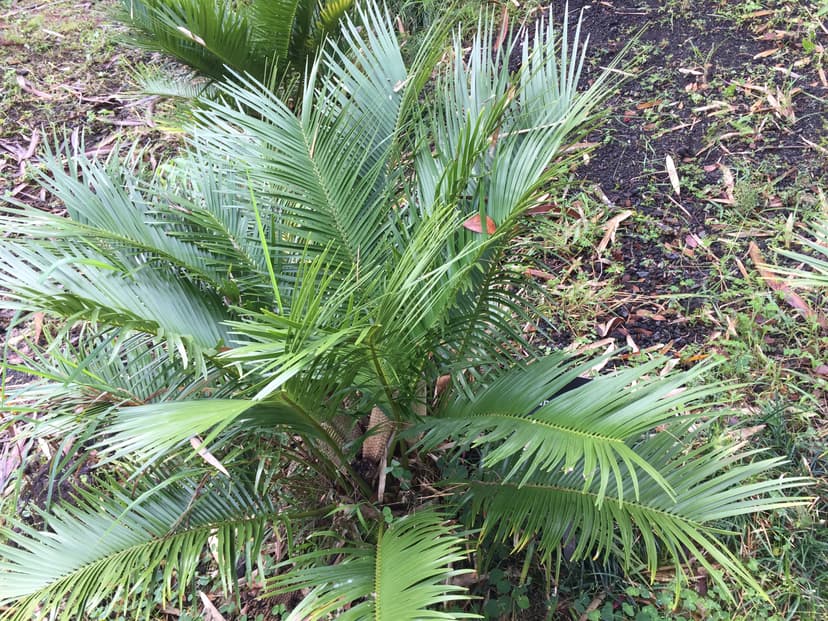
Encephalartos inopinus is a species of cycad native to Limpopo Province, South Africa. This palm-like plant can grow up to 3 meters tall and is characterized by its distinctive blue or silvery leaves. It is dioecious, with male and female plants producing cones that vary in size and shape.
Key Facts
- ›Native to Limpopo Province, South Africa.
- ›Can grow up to 3 meters tall with stems 15-25 cm in diameter.
- ›Leaves are 80-110 cm long, either blue or semi-glossy silver.
- ›Leaflets are lanceolate with entire or slightly toothed margins.
- ›Dioecious, with separate male and female plants producing cones.
- ›Seeds are covered with an orange sarcotesta.

Limpopo Province, South Africa
Up To 3 Metres Tall, 15–25 cm In Diameter
- 80–110 cm long
- Blue or semi-glossy silver color
- Leaflets are 14–21 cm long and 8–13 mm wide
- Leaflets are lanceolate
- Leaflets have an entire margin or sometimes with 1–2 very small teeth
- Leaflets grow in pairs at a 180° angle along the rachis
- Male cones: 1-3, green, ovoid, 18–25 cm long, 6–8 cm in diameter, green to silvery color.
- Female cones: 1-2, oval, same color as male cones, larger at 30–35 cm long and 12 cm in diameter.
- Both male and female cones are described as silvery.
- Cones appear in January.
20–25 mm Long, 15–20 mm Wide, Covered With An Orange Sarcotesta
About Encephalartos inopinus
Encephalartos inopinus is a species of cycad belonging to the Zamiaceae family, predominantly found in Limpopo Province, South Africa. This striking plant presents a palm-like growth form, capable of reaching heights of up to three meters with a stem diameter ranging from 15 to 25 centimeters.
Botanical Features
The foliage of Encephalartos inopinus is a notable characteristic, with leaves measuring between 80 and 110 centimeters in length. These leaves display a distinctive blue or semi-glossy silver hue. The individual leaflets are lanceolate, measuring 14 to 21 centimeters long and 8 to 13 millimeters wide. They possess an entire margin, though occasionally exhibit one or two very small teeth, and are arranged in pairs along the rachis at a 180° angle.
This species is dioecious, meaning that separate male and female plants exist. Both sexes produce reproductive cones, which typically appear in January, the midst of the Southern Hemisphere's summer. Male cones are ovoid, green to silvery, and measure 18 to 25 cm in length and 6 to 8 cm in diameter, with one to three cones per plant. Female cones are larger, oval in shape, and range from 30 to 35 cm in length and 12 cm in diameter, with one to two cones usually present. The seeds of Encephalartos inopinus are also distinctive, measuring 20 to 25 mm long and 15 to 20 mm wide, and are enveloped in a vibrant orange sarcotesta, a fleshy coating similar to an aril.
Source: Wikipedia ↗
Frequently Asked Questions
What are the key physical characteristics of Encephalartos inopinus?
Encephalartos inopinus is a palm-like cycad that can reach heights of up to 3 meters. Its stems are typically 15-25 cm in diameter, and its leaves are 80-110 cm long, exhibiting a blue or semi-glossy silver coloration. The leaflets are lanceolate and can have entire or slightly toothed margins.
How do the male and female cones of Encephalartos inopinus differ?
Male specimens of Encephalartos inopinus produce 1-3 green ovoid cones that measure 18-25 cm in length and 6-8 cm in diameter. Female specimens bear 1-2 oval cones of similar color, but these are larger, ranging from 30-35 cm long and up to 12 cm in diameter. Both cone types are described as silvery in color and appear in January.
What is the meaning behind the scientific name Encephalartos inopinus?
The genus name Encephalartos originates from Greek, meaning 'bear's head.' The species name, inopinus, is Latin and translates to 'unexpected,' suggesting a characteristic or discovery that was not anticipated.
Where is Encephalartos inopinus naturally found?
Encephalartos inopinus is indigenous to Limpopo Province in South Africa. Its natural habitat is within this specific region of the country.
What are the seeds of this cycad like?
The seeds of Encephalartos inopinus are quite distinctive. They measure 20-25 mm in length and 15-20 mm in width, and are notably covered with an orange sarcotesta, which is a fleshy outer layer akin to an aril.
Related Cycad species

Encephalartos horridus
Encephalartos horridus, commonly known as the Eastern Cape blue cycad, is a distinctive, low-growing cycad native to the Eastern Cape Province of South Africa. It is recognized for its striking blue-gray, spiny leaves and typically develops a subterranean stem. This species thrives in arid shrublands and rocky ridges, exhibiting a slow growth rate and requiring specific conditions for successful cultivation.
Zamia inermis
Zamia inermis is a critically endangered cycad species native to Actopan, Veracruz, Mexico. It is characterized by its shrub-like growth, with a trunk that can be branched and upright leaves composed of numerous linear-lanceolate leaflets. This species is dioecious and faces significant threats from habitat loss, wildfires, and over-harvesting.

Encephalartos dolomiticus
Encephalartos dolomiticus, commonly known as the Wolkberg cycad, is a critically endangered cycad species native to the Wolkberg region of South Africa. This tree-like cycad typically grows up to 2 meters tall and is characterized by its distinctive bluish leaves forming a crown, with lance-shaped leaflets arranged oppositely along the rachis. It is a dioecious species, producing separate male and female cones.