
Encephalartos latifrons
Rocky outcrops and hill slopes amongst scrub bush vegetation.·Tall, tree-like cycad·Critically Endangered
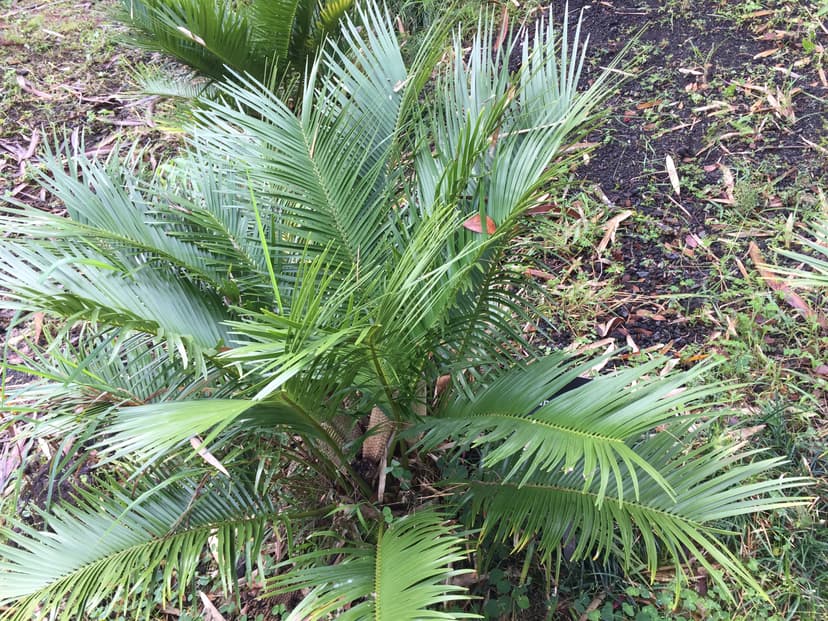
Encephalartos latifrons, commonly known as the Albany Cycad, is a critically endangered species of cycad native to the Eastern Cape province of South Africa. This tall, tree-like plant is characterized by its upright or prostrate stem and bright green, feather-like leaves. It is notable for its rarity and the challenges it faces in natural reproduction.
Key Facts
- ›Native to the Eastern Cape province of South Africa.
- ›Can grow up to 4.5 meters in height with a thick trunk.
- ›Possesses long, bright green, feather-like leaves with leathery leaflets.
- ›Is dioecious, meaning separate male and female plants exist.
- ›Male cones are cylindrical, 30-50 cm long; female cones are 50-60 cm long.
- ›Seeds are egg-shaped and covered with a dark red sarcotesta.

Albany Cycad
Eastern Cape, South Africa
Upright Or Lying Down, Up To 4.5 m In Height, 30–45 cm In Diameter
- Bright green
- Feather-like
- 1–1.5 m long
- Supported by a 10–20 cm long stalk that curves downward
- Composed of many pairs of large, leathery leaflets
- Leaflets up to 15 cm long
- Leaflets arranged at a sharp angle along the central leaf spine
- Leaflets partially overlapping
- Lower edges of leaflets have 3-4 triangular lobes
- Male Cones: 1-3, Short, Cylindrical, About 30–50 cm Long and 8–17 cm Wide, Olive-Green.
- Female Cones: 1-3, Upright, Cylindrical, About 50–60 cm Long and 23–25 cm Wide, Olive-Green.
- Macrosporophylls About 8 cm Long.
Roughly Egg-Shaped, 2.5–3.0 cm Long, Covered With Dark Red Sarcotesta
Ornamental Plant
Trade in cycads, Removal of mature plants, Habitat loss due to land use changes, Extinction of natural pollinators, Lack of recent seed production
About Encephalartos latifrons
Encephalartos latifrons: The Albany Cycad
The Albany Cycad, scientifically classified as Encephalartos latifrons, is an exceptionally rare species of cycad belonging to the Zamiaceae family. This striking plant is endemic to the Eastern Cape province of South Africa, where it is found at elevations ranging from 200 to 600 meters. Its natural habitat consists of rocky outcrops and hill slopes, often nestled within scrub bush vegetation.
Botanical Description
Encephalartos latifrons is a tall, arborescent cycad, distinguished by a trunk that can grow upright or lie prostrate along the ground, reaching impressive heights of up to 4.5 meters and a diameter of 30 to 45 cm. The plant's foliage is a vibrant green, forming a dense crown of feather-like leaves at the apex of the trunk. Each leaf is substantial, measuring between 1 and 1.5 meters in length, and is supported by a downward-curving stalk. The leaves are composed of numerous pairs of leathery leaflets, each up to 15 cm long. These leaflets are arranged at a distinct angle along the central rachis, often overlapping, with the lower edges featuring characteristic triangular lobes.
Reproduction and Conservation
This species is dioecious, meaning individual plants are either male or female. The male cones are cylindrical, typically measuring 30–50 cm in length and 8–17 cm in width, with an olive-green hue. Female plants produce larger, upright cones, which can be 50–60 cm long and 23–25 cm wide, also in an olive-green color. The seeds produced are roughly egg-shaped, about 2.5–3.0 cm long, and are encased in a dark red fleshy layer known as a sarcotesta.
The Albany Cycad faces severe threats, primarily due to illegal poaching for the lucrative cycad trade and habitat alteration resulting from agricultural expansion, such as pineapple and chicory farming, and livestock rearing. The loss of mature plants is particularly detrimental, as the species has struggled with natural reproduction in recent times, exacerbated by the decline of its natural pollinators and a scarcity of new seed production. Consequently, Encephalartos latifrons is listed as Critically Endangered, with conservation efforts focusing on protecting remaining wild populations and, where possible, facilitating reproduction.
Source: Wikipedia ↗
Frequently Asked Questions
What is the Albany Cycad?
The Albany Cycad, scientifically known as Encephalartos latifrons, is a very rare species of cycad found in the Eastern Cape province of South Africa. It is recognized for its tree-like growth form and distinctive foliage.
Where does Encephalartos latifrons grow naturally?
Encephalartos latifrons is indigenous to scattered areas within the Bathurst and Albany districts of the Eastern Cape province in South Africa. It typically grows on rocky outcrops and hill slopes, often amidst scrub vegetation.
What are the physical characteristics of Encephalartos latifrons?
This cycad species can reach up to 4.5 meters in height, with a stem that can be either upright or lying down. Its leaves are bright green, feather-like, and measure 1-1.5 meters in length, growing in a cluster at the top of the trunk.
How does Encephalartos latifrons reproduce?
Encephalartos latifrons is dioecious, meaning it has separate male and female plants. Male plants produce cylindrical cones, while female plants also produce upright, cylindrical cones. The seeds are egg-shaped and enveloped in a dark red fleshy layer.
What are the main threats to Encephalartos latifrons?
The primary threat to Encephalartos latifrons is the illegal trade driven by its rarity, leading to the removal of mature plants. Habitat changes due to farming and livestock rearing also pose a significant risk. The decline in natural pollinators and lack of recent seed production further challenge its survival.
What is the conservation status of Encephalartos latifrons?
Encephalartos latifrons is considered a critically endangered species. Its natural reproduction in the wild is severely hampered, making it highly vulnerable to extinction.
Related Cycad species
Zamia inermis
Zamia inermis is a critically endangered cycad species native to Actopan, Veracruz, Mexico. It is characterized by its shrub-like growth, with a trunk that can be branched and upright leaves composed of numerous linear-lanceolate leaflets. This species is dioecious and faces significant threats from habitat loss, wildfires, and over-harvesting.

Encephalartos dolomiticus
Encephalartos dolomiticus, commonly known as the Wolkberg cycad, is a critically endangered cycad species native to the Wolkberg region of South Africa. This tree-like cycad typically grows up to 2 meters tall and is characterized by its distinctive bluish leaves forming a crown, with lance-shaped leaflets arranged oppositely along the rachis. It is a dioecious species, producing separate male and female cones.

Encephalartos sclavoi
Encephalartos sclavoi, also known as Sclavo's cycad, is a critically endangered cycad species native to the Uluguru Mountains of Tanzania. This "living fossil" is characterized by its relatively short, arborescent growth, long dark green leaves with concave and spined leaflets, and distinctive yellow seed cones. Its limited population and specific ecological needs make it a focus of conservation efforts.