
Encephalartos laurentianus
Found along the Kwango River, suggesting riparian or seasonally moist environments within its native range.·Multiple stems, both upright and prostrate.
Encephalartos laurentianus, also known as the malele or Kwango giant cycad, is the largest known species of cycad. Native to the border region of northern Angola and southern Democratic Republic of Congo, it is characterized by its massive, multiple stems and enormous pinnate fronds. This species is notable for its rapid growth among cycads, producing multiple leaf flushes annually.
Key Facts
- ›It is the largest species of cycad, with stems reaching up to 15 meters in length.
- ›Native to northern Angola and southern Democratic Republic of Congo, along the Kwango River.
- ›Features massive once-pinnate fronds that can be 4–7 meters long.
- ›Pollen cones measure 17–35 cm long, and seed cones are 35–40 cm long.
- ›Considered the fastest-growing cycad, producing up to five leaf flushes per year.
- ›Discovered in 1902 by Louis Gentil.

Malele, Kwango Giant Cycad
Northern Angola, Southern Democratic Republic of Congo
Multiple Stems, Upright and Prostrate Growth, Up To 15 m In Length, Up To 100 cm Thick
Massive Once-Pinnate Fronds, 4–7 m In Length, 70–100 cm In Width, Leaflets 35–50 cm Long and 4–7 cm Wide, Petiole Up To 8 cm Thick
Pollen Cones: 17–35 cm Long, Seed Cones: 35–40 cm Long
About Encephalartos laurentianus
Encephalartos laurentianus, commonly referred to as the malele or the Kwango giant cycad, is a remarkable species recognized as the largest among all cycads. Its native range is confined to the border region between northern Angola and southern Democratic Republic of Congo, with a particular association with the Kwango River.
Botanical Characteristics
This species is distinguished by its impressive stature, featuring multiple stems that can grow both upright and prostrate, reaching lengths of up to 15 meters (49 feet). Each stem can attain a substantial thickness of up to 100 cm (39 inches). Encephalartos laurentianus bears a rosette of massive, once-pinnate fronds that are exceptionally large, measuring between 4 to 7 meters (13 to 23 feet) in length. The leaflets themselves are also substantial, ranging from 35 to 50 cm (14 to 20 inches) long and 4 to 7 cm (1.6 to 2.8 inches) wide. The stout petioles, or stalks, can be up to 8 cm (3.1 inches) thick where they join the stem.
Reproductively, the male (pollen) cones are considerable, measuring 17 to 35 cm (6.7 to 13.8 inches) in length, while the female (seed) cones are even larger, ranging from 35 to 40 cm (14 to 16 inches) long.
Growth and Discovery
A notable characteristic of Encephalartos laurentianus is its comparatively rapid growth rate for a cycad. It is reported to produce up to five "flushes" or clusters of leaves each year. The species was first formally identified and documented in 1902 by the botanist Louis Gentil. It was subsequently named in honor of Emile Laurent, a Belgian botanist from the 19th century.
Source: Wikipedia ↗
Frequently Asked Questions
What is Encephalartos laurentianus commonly called?
Encephalartos laurentianus is commonly known as the malele or the Kwango giant cycad. These names reflect its vernacular use and its geographic origin along the Kwango River.
Where is the Kwango giant cycad found naturally?
The natural habitat of Encephalartos laurentianus is located in northern Angola and southern Democratic Republic of Congo. It is found along their common border, specifically in the vicinity of the Kwango River.
What makes Encephalartos laurentianus unique botanically?
Encephalartos laurentianus holds the distinction of being the largest cycad species. It is also recognized as the fastest-growing cycad, capable of producing multiple clusters of leaves each year.
How large can Encephalartos laurentianus grow?
This species can achieve impressive sizes, with individual stems reaching up to 15 meters (49 feet) in length and up to 100 cm (39 inches) in thickness. Its fronds are also massive, extending 4–7 meters (13–23 feet) in length.
When and by whom was Encephalartos laurentianus discovered?
Encephalartos laurentianus was discovered in 1902. The botanist responsible for its discovery was Louis Gentil.
Related Cycad species

Encephalartos horridus
Encephalartos horridus, commonly known as the Eastern Cape blue cycad, is a distinctive, low-growing cycad native to the Eastern Cape Province of South Africa. It is recognized for its striking blue-gray, spiny leaves and typically develops a subterranean stem. This species thrives in arid shrublands and rocky ridges, exhibiting a slow growth rate and requiring specific conditions for successful cultivation.
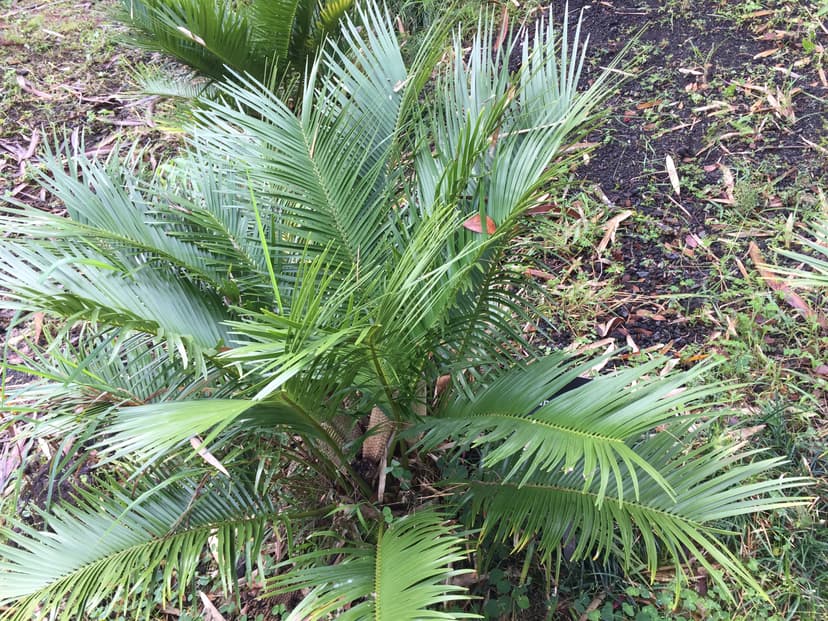
Zamia inermis
Zamia inermis is a critically endangered cycad species native to Actopan, Veracruz, Mexico. It is characterized by its shrub-like growth, with a trunk that can be branched and upright leaves composed of numerous linear-lanceolate leaflets. This species is dioecious and faces significant threats from habitat loss, wildfires, and over-harvesting.

Encephalartos dolomiticus
Encephalartos dolomiticus, commonly known as the Wolkberg cycad, is a critically endangered cycad species native to the Wolkberg region of South Africa. This tree-like cycad typically grows up to 2 meters tall and is characterized by its distinctive bluish leaves forming a crown, with lance-shaped leaflets arranged oppositely along the rachis. It is a dioecious species, producing separate male and female cones.