
Encephalartos longifolius
Coastal regions and mountain ridges.·Low-growing, palm-like cycad.·Near Threatened
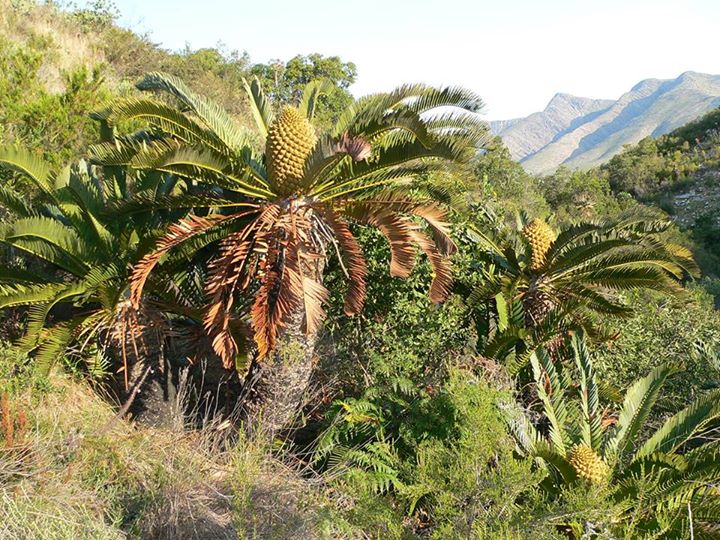
Encephalartos longifolius, commonly known as Thunberg's cycad, breadpalm, or broodboom, is a low-growing, palm-like cycad native to the coastal regions of South Africa. It is characterized by its thick trunk, which can reach up to three meters in height, and its dark green, arching leaves. This species is notable for producing some of the largest pollen cones within its genus.
Key Facts
- ›Endemic to the Eastern Cape Province of South Africa.
- ›Can grow up to three meters tall with a thick trunk.
- ›Features dark green, semi-glossy, arching leaves up to two meters long.
- ›Produces large ovoid male cones (40-60 cm long) and robust female cones.
- ›Seeds are red and can be up to five centimeters long.
- ›Listed as 'near Threatened' on the IUCN Red List.
Thunberg's Cycad, Breadpalm, Broodboom
South Africa
Develops a very thick trunk with age, Can grow up to three metres tall
- Dark Or Metallic Green
- Semi-Glossy
- Arching
- Up To Two Metres Long
- Moderately Keeled
- Leaflets Are Lanceolate and Overlapping Upwards
- Leaflets Have Smooth Margins
- Male cones are green, ovoid, 40 to 60 cm long and 15 to 20 cm in diameter.
- Male cones are the largest pollen cones in its genus.
- Female cones are green and more robust, with a diameter of up to 40 cm.
Red, Can Reach Five Centimetres Long
Population Decline
About Encephalartos longifolius
Encephalartos longifolius, commonly referred to as Thunberg's cycad, breadpalm, or broodboom, is a distinctive species of cycad that is endemic to the coastal regions of South Africa. Belonging to the Zamiaceae family, this low-growing, palm-like plant is recognized for its robust appearance and significant reproductive structures.
Botanical Description
The breadpalm typically grows to a height of up to three meters, developing a stout and thick trunk as it matures. Its foliage consists of dark to metallic green, semi-glossy leaves that arch gracefully, often reaching lengths of up to two meters. These leaves are characterized by a moderate keel and possess lanceolate leaflets with smooth margins, arranged in an overlapping fashion upwards. The species is notable for producing some of the largest pollen cones within its genus, which are green and ovoid, measuring between 40 to 60 centimeters in length and 15 to 20 centimeters in diameter. Female cones are similarly green and more substantial, with diameters that can reach up to forty centimeters. The seeds produced are red and can grow to approximately five centimeters in length.
Distribution and Habitat
Encephalartos longifolius is found exclusively in South Africa, inhabiting the coastal areas of the Eastern Cape Province. It thrives in a variety of habitats along mountain ridges, extending from west of Joubertina in the Kouga mountains eastward towards Grahamstown. These plants grow at elevations up to six hundred meters.
Conservation Status and Historical Significance
This species is currently listed as 'Near Threatened' on the IUCN Red List of Threatened Species. Despite being present in numerous locations, its populations are generally in decline. Historically, Encephalartos longifolius holds a place in South African colonial history. Early settlers encountered it as the "Thunberg's breadtree." Its seeds are infamously linked to an incident during the Anglo-Boer War, where General Smuts and his men were poisoned after consuming them, an event detailed in Colonel Deneys Reitz's memoir 'Commando,' though the specific cycad species involved was later clarified by botanists.
Source: Wikipedia ↗
Frequently Asked Questions
What are the common names for Encephalartos longifolius?
Encephalartos longifolius is widely known by several common names, including Thunberg's cycad, breadpalm, and broodboom. These names reflect its historical significance and appearance.
Where is Encephalartos longifolius found naturally?
This cycad is endemic to South Africa, specifically found in the coastal regions of the Eastern Cape Province. It grows on mountain ridges at elevations up to six hundred meters.
What are the characteristics of Encephalartos longifolius leaves?
The leaves of Encephalartos longifolius are dark or metallic green, semi-glossy, and arching, reaching lengths of up to two meters. They are moderately keeled, with lanceolate leaflets that overlap upwards and have smooth margins.
What are the reproductive cones like in Encephalartos longifolius?
The species produces green, ovoid male cones that are typically one to three in number, measuring 40 to 60 centimeters long and 15 to 20 centimeters in diameter. These are the largest pollen cones in its genus. Female cones are similar in number but more robust, with diameters up to forty centimeters.
What is the conservation status of Encephalartos longifolius?
Encephalartos longifolius is classified as 'Near Threatened' on the IUCN Red List of Threatened Species. While found in many locations, its overall populations are reported to be declining.
Is Encephalartos longifolius part of any historical events?
Yes, historical accounts suggest that the seeds of Encephalartos longifolius were mistakenly identified and consumed by General Smuts and a Boer commando during the Anglo-Boer War, leading to poisoning. This event was recorded in Colonel Deneys Reitz's book 'Commando'.
Related Cycad species

Encephalartos lanatus
Encephalartos lanatus, commonly known as the Olifants River cycad, is a slow-growing cycad species native to Mpumalanga and Gauteng in South Africa. Characterized by its bluish-green, woolly leaves and the unique arrangement of leaflets, this species thrives in rocky, prairie-covered slopes and exhibits remarkable resilience to fire and frost.

Encephalartos natalensis
Encephalartos natalensis, also known as the Natal cycad or giant cycad, is a species of cycad native to the Eastern Cape and Kwazulu-Natal provinces of South Africa. It is characterized by its large, pinnate leaves and can grow to impressive heights, often leaning or branching from the base. This dioecious species produces distinct male and female cones, with the female cones yielding bright red seeds.

Cycas rumphii
Cycas rumphii, also known as the queen sago, is a dioecious gymnosperm native to Indonesia, New Guinea, and Christmas Island. This palm-like cycad can grow up to 10 meters tall, featuring glossy green fronds and distinctive fissured bark. Its reproductive structures are notable for the male strobilus's orange color and foetid odor, and the female's fleshy, hairy megasporophylls.