
Encephalartos middelburgensis
Open grassland areas and sheltered valleys at elevations of 1,100–1,400 m.·Arborescent, with erect or decumbent stems.
Encephalartos middelburgensis is a striking cycad species native to the Gauteng and Mpumalanga provinces of South Africa, thriving at high elevations. It is characterized by its arborescent growth habit, with stems that can reach up to 10 meters tall, and distinctive pinnate leaves. This dioecious species produces prominent male and female cones, and its seeds are notable for their yellow to brown sarcotesta.
Key Facts
- ›Native to Gauteng and Mpumalanga provinces, South Africa.
- ›Can grow as an erect or decumbent stem up to 10 meters tall.
- ›Leaves are pinnate, 1.2–1.5 meters long, with leathery leaflets.
- ›Dioecious, with distinct male and female plants and cones.
- ›Male cones are cylindrical to ovoid, 30–55 cm long; female cones are cylindrical, 35–45 cm long.
- ›Seeds have a yellow to brown sarcotesta.

Middelburg Cycad
Gauteng, South Africa, Mpumalanga, South Africa
- Up to 10 m tall
- 35–45 cm in diameter
- Often with secondary stems originating from basal suckers
- Pinnate
- 1.2–1.5 m long
- Composed of numerous pairs of lanceolate, leathery leaflets
- Leaflets up to 20 cm long
- Entire margin or occasionally with a single spine on the inferior margin
- Sharp apex
- Male specimens: 1 to 8 cylindrical or strictly ovoid cones, erect, 30–55 cm long and 8–12 cm broad, green with brownish tomentum.
- Female specimens: 1-6 cylindrical cones, about 35–45 cm long and 17–20 cm wide, same color as male cones.
Coarsely ovoid, 3–3.5 cm long, Covered with a yellow to brown sarcotesta
Exploitation By Collectors, Habitat Loss Due To Agricultural Development, Increased Burning of Habitat, Grazing Practices, Disease Affecting Stems, Poaching of Suckers, Absence of Pollinators
About Encephalartos middelburgensis
Encephalartos middelburgensis, commonly known as the Middelburg Cycad, is a species of cycad native to the Gauteng and Mpumalanga provinces of South Africa. It thrives in open grassland areas and sheltered valleys at elevations between 1,100 and 1,400 meters.
Botanical Description
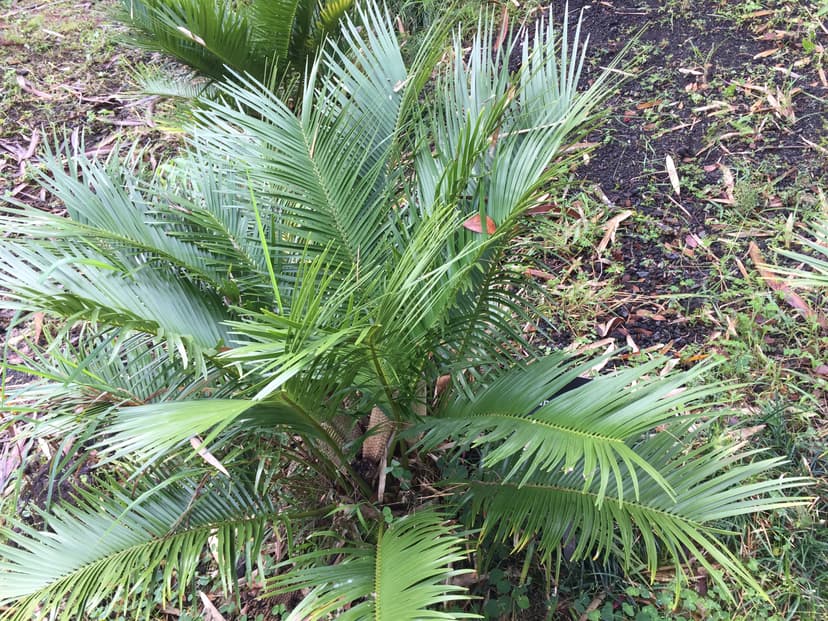
This cycad exhibits an arborescent growth habit, characterized by an erect or decumbent stem that can reach up to 10 meters in height and 35–45 cm in diameter. Secondary stems frequently emerge from basal suckers. The plant bears pinnate leaves, typically 1.2–1.5 meters in length, arranged in a crown at the stem's apex. These leaves are supported by a petiole and composed of numerous pairs of lanceolate, leathery leaflets, each up to 20 cm long, with margins that are either entire or occasionally bear a single spine on the inferior margin, culminating in a sharp apex.
Encephalartos middelburgensis is a dioecious species, meaning it has distinct male and female plants. Male specimens produce 1 to 8 cylindrical or ovoid cones, measuring 30–55 cm in length and 8–12 cm in breadth, which are green and covered with a brownish tomentum. Female specimens bear 1 to 6 cylindrical cones, approximately 35–45 cm long and 17–20 cm wide, in a similar green hue with brownish tomentum.
Reproduction and Seed Characteristics
The reproductive cones are a prominent feature of the species. Following pollination, seeds are produced that are coarsely ovoid, measuring 3–3.5 cm in length, and are notable for being covered by a distinctive yellow to brown sarcotesta.
Population and Conservation
Historically, Encephalartos middelburgensis was found in several locations near Middelburg, Bronkhorstspruit, and Loskop Dam, with an estimated population of several thousand mature individuals. However, in recent years, the species has experienced a significant decline, with current estimates suggesting only 184–200 mature individuals remain in the wild. This dramatic reduction is attributed to a combination of factors.
Threats and Challenges
The discovery of the Middelburg Cycad in the 1960s led to severe exploitation by collectors due to the accessibility of its habitats near urban centers. Although legislation now helps curb such activities, illegal exploitation continues. Furthermore, the development of semi-intensive agricultural areas has resulted in increased habitat burning and grazing practices, to which Encephalartos middelburgensis is particularly susceptible. More recently, evidence of disease affecting stems has been observed in Gauteng, and intensive poaching of suckers has been detected in Mpumalanga. A critical threat is the absence of pollinators in several subpopulations, which severely hinders the species' natural regeneration and long-term survival.
Source: Wikipedia ↗
Frequently Asked Questions
Where is Encephalartos middelburgensis found naturally?
Encephalartos middelburgensis is indigenous to the Gauteng and Mpumalanga provinces of South Africa. It is typically found at elevations ranging from 1,100 to 1,400 meters.
What is the growth habit of Encephalartos middelburgensis?
This species has an arborescent habit, meaning it grows like a tree. Its stem can be erect or decumbent, reaching up to 10 meters in height and 35–45 cm in diameter, and often produces secondary stems from basal suckers.
Describe the leaves of Encephalartos middelburgensis.
The leaves are pinnate and arranged in a crown at the apex of the stem. They are typically 1.2 to 1.5 meters long, supported by a petiole, and composed of numerous pairs of lanceolate, leathery leaflets that are up to 20 cm long.
Does Encephalartos middelburgensis have male and female plants?
Yes, Encephalartos middelburgensis is a dioecious species, meaning it has separate male and female individuals. Male plants produce cylindrical or ovoid cones, while female plants produce cylindrical cones.
What are the main threats to Encephalartos middelburgensis?
Major threats include exploitation by collectors, habitat destruction due to agricultural development and associated burning practices, disease affecting stems, poaching of suckers, and the absence of pollinators which hinders natural regeneration.
What is the conservation status of Encephalartos middelburgensis?
The article text does not explicitly state the IUCN conservation status, but it notes a substantial and concerning decline in population, with an estimated 184-200 mature individuals remaining in the wild, indicating a vulnerable or endangered status.
Related Cycad species

Encephalartos horridus
Encephalartos horridus, commonly known as the Eastern Cape blue cycad, is a distinctive, low-growing cycad native to the Eastern Cape Province of South Africa. It is recognized for its striking blue-gray, spiny leaves and typically develops a subterranean stem. This species thrives in arid shrublands and rocky ridges, exhibiting a slow growth rate and requiring specific conditions for successful cultivation.
Zamia inermis
Zamia inermis is a critically endangered cycad species native to Actopan, Veracruz, Mexico. It is characterized by its shrub-like growth, with a trunk that can be branched and upright leaves composed of numerous linear-lanceolate leaflets. This species is dioecious and faces significant threats from habitat loss, wildfires, and over-harvesting.

Encephalartos dolomiticus
Encephalartos dolomiticus, commonly known as the Wolkberg cycad, is a critically endangered cycad species native to the Wolkberg region of South Africa. This tree-like cycad typically grows up to 2 meters tall and is characterized by its distinctive bluish leaves forming a crown, with lance-shaped leaflets arranged oppositely along the rachis. It is a dioecious species, producing separate male and female cones.