
Encephalartos woodii
Steep south-facing slopes on the fringes of forests, with an annual rainfall of 750–1,000 mm, characterized by hot summers and mild winters.·Arborescent·Extinct in the Wild
Encephalartos woodii, commonly known as Wood's cycad, is an exceptionally rare species of cycad native to the ongoye Forest in Kwazulu-Natal, South Africa. It is now extinct in the wild, with all existing specimens being clonal offshoots of a single male plant discovered in 1895. Botanically, it is characterized by its palm-like appearance, a robust trunk, and a crown of glossy, dark green leaves, with male cones being a striking yellow-orange.
Key Facts
- ›Extinct in the wild, with all known specimens being clones of a single male plant.
- ›Discovered in 1895 in the ongoye Forest, Kwazulu-Natal, South Africa.
- ›Possesses a palm-like trunk that can reach up to 6 meters in height.
- ›Leaves are glossy, dark green, and can be 1.5 to 2.5 meters long, with numerous sickle-shaped leaflets.
- ›Dioecious, but no female plant has ever been found.
- ›Male cones are cylindrical, vibrant yellow-orange, and can grow up to 1.2 meters long.

Wood's Cycad
Ongoye Forest, Kwazulu-Natal, South Africa
Palm tree-like trunk, Height up to 6 metres, Diameter of 30–50 centimetres, Thickest at the bottom, Topped by a crown of 50–150 leaves
Glossy and Dark Green, 150–250 Centimetres In Length, Keeled, 70–150 Leaflets, Leaflets Are Falcate, Leaflets Are 13–15 Centimetres Long, Leaflets Are 20–30 Millimetres Broad
- Male strobili are cylindrical
- 20–40 centimetres long, exceptionally up to 120 centimetres
- 15–25 centimetres in diameter
- Vivid yellow-orange colour
- A single plant may bear from six to eight simultaneously
- Extinct In the Wild
- Absence of Female Plants Prevents Natural Reproduction
- Habitat Loss
About Encephalartos woodii
Encephalartos woodii: Wood's Cycad
Encephalartos woodii, commonly known as Wood's cycad, is a plant of almost mythical rarity, celebrated for its striking appearance and its critical conservation status. Discovered in 1895 by John Medley Wood in the dense oNgoye Forest of KwaZulu-Natal, South Africa, this species is now considered extinct in its natural habitat. All known living specimens are genetically identical clones, propagated from basal suckers of the single male plant initially found.
Botanical Characteristics
The Wood's cycad exhibits a palm-like growth form, with a stout trunk that can reach an impressive height of up to six meters and a diameter of 30 to 50 centimeters. This trunk is crowned by a lush arrangement of 50 to 150 leaves, each measuring between 1.5 and 2.5 meters in length. The leaves are a glossy, deep green, characterized by numerous sickle-shaped leaflets that are 13 to 15 centimeters long and 2 to 3 centimeters broad. The species is dioecious, meaning it has separate male and female plants, but crucially, no female specimen has ever been discovered, posing a significant barrier to natural reproduction.
The male reproductive structures, known as strobili or cones, are a spectacular feature. They are cylindrical, typically ranging from 20 to 40 centimeters in length but capable of reaching up to 1.2 meters, and possess a vivid yellow-orange hue. A single plant can produce between six to eight of these cones simultaneously.
Decline and Conservation
The story of Encephalartos woodii is one of profound loss and dedicated conservation efforts. The original wild population consisted of only a cluster of four stems. Over time, offsets were removed for cultivation and study, and the last remaining trunk in the wild eventually perished. Its extinction in the wild has led to stringent legal protections under both South African national legislation and international agreements like CITES.
Despite its wild extinction, Encephalartos woodii persists in botanical gardens and private collections worldwide, with an estimated 500 individuals existing as clones. While it is considered relatively fast-growing for a cycad in cultivation, its inability to reproduce sexually without a female plant makes its long-term survival entirely dependent on human intervention and propagation techniques.
Source: Wikipedia ↗
Frequently Asked Questions
What is Encephalartos woodii?
Encephalartos woodii, also known as Wood's cycad, is a critically endangered species of cycad. It is famed for its extreme rarity, being extinct in the wild and existing only as clones of a single male plant.
Where was Encephalartos woodii originally found?
The sole wild population of Encephalartos woodii was discovered in a small area of the oNgoye Forest in KwaZulu-Natal, South Africa. The original discovery was made in 1895 by John Medley Wood.
Is Encephalartos woodii a tree or a palm?
Encephalartos woodii is described as palm-tree-like, with a trunk that can grow up to 6 meters tall. While it resembles a palm, it is botanically classified as a cycad.
Why is Encephalartos woodii considered extinct in the wild?
Encephalartos woodii is considered extinct in the wild because all known specimens are clones of the original male plant discovered. No wild populations have been found since its initial discovery, and all cultivated plants are derived from that single source.
Does Encephalartos woodii have female plants?
Encephalartos woodii is dioecious, meaning it has separate male and female individuals. However, despite extensive searches, no female plant has ever been discovered in the wild or in cultivation.
What are the characteristics of Encephalartos woodii's leaves and cones?
The leaves of Encephalartos woodii are glossy and dark green, measuring 1.5 to 2.5 meters in length, and are adorned with many falcate leaflets. The male cones are cylindrical, a vivid yellow-orange color, and can reach impressive sizes, some exceptionally up to 1.2 meters long.
Can Encephalartos woodii reproduce naturally?
Natural reproduction of Encephalartos woodii is not possible unless a female plant is found. The species is known to form fertile hybrids with other Encephalartos species, but these hybrids do not result in pure E. woodii offspring due to genetic inheritance patterns.
Related Cycad species

Encephalartos lanatus
Encephalartos lanatus, commonly known as the Olifants River cycad, is a slow-growing cycad species native to Mpumalanga and Gauteng in South Africa. Characterized by its bluish-green, woolly leaves and the unique arrangement of leaflets, this species thrives in rocky, prairie-covered slopes and exhibits remarkable resilience to fire and frost.

Encephalartos sclavoi
Encephalartos sclavoi, also known as Sclavo's cycad, is a critically endangered cycad species native to the Uluguru Mountains of Tanzania. This "living fossil" is characterized by its relatively short, arborescent growth, long dark green leaves with concave and spined leaflets, and distinctive yellow seed cones. Its limited population and specific ecological needs make it a focus of conservation efforts.
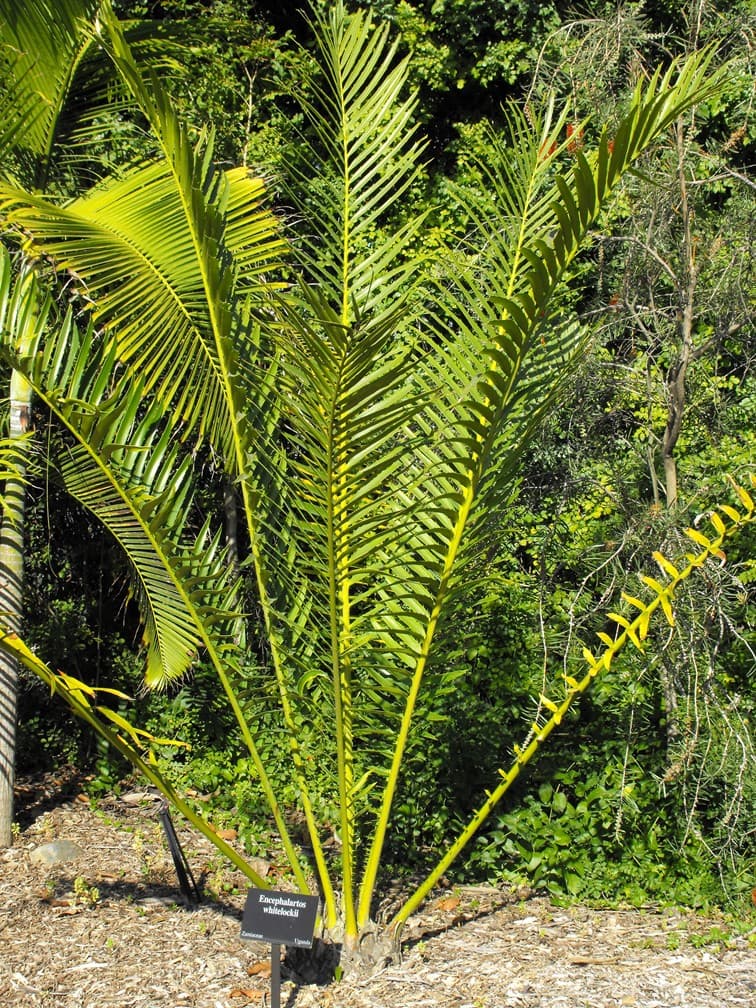
Encephalartos whitelockii
Encephalartos whitelockii is a critically endangered cycad species native to a single location in southwestern Uganda, forming one of Africa's most impressive cycad populations along the Mpanga River. This large, arborescent cycad is characterized by its tall stems topped with stiff, glossy dark green fronds and distinctive bluish-green cones, and it plays an important role in the local ecosystem, particularly for baboons.