
Lepidozamia hopei
Rainforest and neighbouring forests·Arborescent·Least Concern
Lepidozamia hopei, commonly known as Hope's cycad or zamia palm, is a cycad species endemic to a small region of Queensland, Australia. It is renowned for its impressive stature, reputed to be the tallest cycad species, growing as an understorey tree in rainforest environments. Botanically, it is characterized by its tall, single trunk, long fronds with numerous leaflets, and exceptionally large reproductive cones.
Key Facts
- ›Reputed to be the tallest known species of cycad.
- ›Endemic to a small part of northeast Queensland, Australia.
- ›Grows as an understorey tree in rainforests.
- ›Can reach heights of up to 20 meters.
- ›Produces very large male and female cones.
- ›Seeds are bright red when mature and eaten by native fauna.

Hope's Cycad, Zamia Palm
Queensland, Australia
Normally has a single trunk and crown, Can reach 50 cm in trunk diameter, Forked trunks occur on occasions
Fronds may reach up to 3 m long, Up to 200 leaflets per frond, Leaflets are dark green, Leaflets are fairly stiff, Leaflets up to 3 cm wide, Leaflets up to 40 cm long
- Male cones measure up to 40 cm tall and 14 cm diameter
- Female cones measure up to 60 cm tall and 30 cm diameter
- Cones are quite large
- Mature seeds measure about 5 cm long by 4 cm wide
- Sheathed in a bright red sarcotesta
About Lepidozamia hopei
Lepidozamia hopei, commonly known as Hope's cycad or zamia palm, is a remarkable species of cycad celebrated for its imposing stature. It is reputed to be the tallest cycad species globally, often found growing as an understorey tree within the rainforests of a small, specific region in Queensland, Australia. While it typically exhibits a single trunk and crown, occasional instances of forked trunks have been observed.
Description and Characteristics
This cycad can mature to impressive heights, reaching up to 20 meters (approximately 66 feet) with a trunk diameter of up to 50 centimeters (20 inches). Its fronds are exceptionally long, capable of extending up to 3 meters (9.8 feet), and each can bear as many as 200 leaflets. These leaflets are a deep, dark green, possess a rather stiff texture, and measure up to 3 centimeters (1.2 inches) in width and 40 centimeters (16 inches) in length. The reproductive cones of Lepidozamia hopei are notably substantial; male cones can grow up to 40 centimeters (16 inches) tall and 14 centimeters (5.5 inches) in diameter, while the female cones are even larger, reaching up to 60 centimeters (24 inches) tall and 30 centimeters (12 inches) in diameter. Upon maturity, the seeds are approximately 5 centimeters (2.0 inches) long by 4 centimeters (1.6 inches) wide and are distinguished by a vibrant red sarcotesta, or fleshy sheath.
Distribution and Habitat
Lepidozamia hopei is endemic to a confined area in northeast Queensland, Australia. Its natural range extends from the vicinity of the Bloomfield River in the north down to the lowlands situated just south of Tully. The species thrives within rainforest environments and adjacent forest types, typically found at altitudes ranging from near sea level to approximately 600 meters (2,000 feet).
Conservation Status and Ecology
The conservation status of Lepidozamia hopei is categorized as 'Least Concern' by the International Union for Conservation of Nature (IUCN). Furthermore, the Queensland Government designates it as 'Special Least Concern' (SL) under its Nature Conservation Act, a unique classification within Queensland that signifies a status between 'Least Concern' and 'Near Threatened'. Ecologically, the seeds of this cycad play a role in the local food web; they are consumed by cassowaries, and native rodents feed on the fleshy sarcotesta surrounding the seeds.
Source: Wikipedia ↗
Frequently Asked Questions
What is Lepidozamia hopei?
Lepidozamia hopei is a species of cycad, commonly called Hope's cycad or zamia palm. It is known for being the tallest known cycad species and is native to a limited area in Queensland, Australia. It typically grows as an understory tree within rainforests.
Where is Lepidozamia hopei found?
This cycad species is endemic to a small section of northeast Queensland, Australia. Its natural distribution ranges from the Bloomfield River area in the north down to the lowlands just south of Tully. It inhabits rainforests and adjacent forests at elevations from near sea level up to approximately 600 meters.
What are the distinguishing features of Lepidozamia hopei?
Lepidozamia hopei is recognized for its impressive size, with trunks that can reach up to 20 meters in height and 50 cm in diameter, though it rarely reaches the forest canopy. Its fronds can be up to 3 meters long and bear as many as 200 dark green leaflets. The plant also produces notably large male and female cones, and its mature seeds are enclosed in a bright red covering.
What is the conservation status of Lepidozamia hopei?
Lepidozamia hopei is assessed by the IUCN as 'Least Concern'. The Queensland Government also classifies it as 'Special Least Concern' (SL) under its Nature Conservation Act, a status unique to Queensland that indicates a position between 'Least Concern' and 'Near Threatened'.
What eats the seeds of Lepidozamia hopei?
The seeds of Lepidozamia hopei are a food source for native fauna. Cassowaries consume the seeds, and the fleshy outer layer, known as the sarcotesta, is eaten by native rodents.
Related Cycad species
Cycas thouarsii
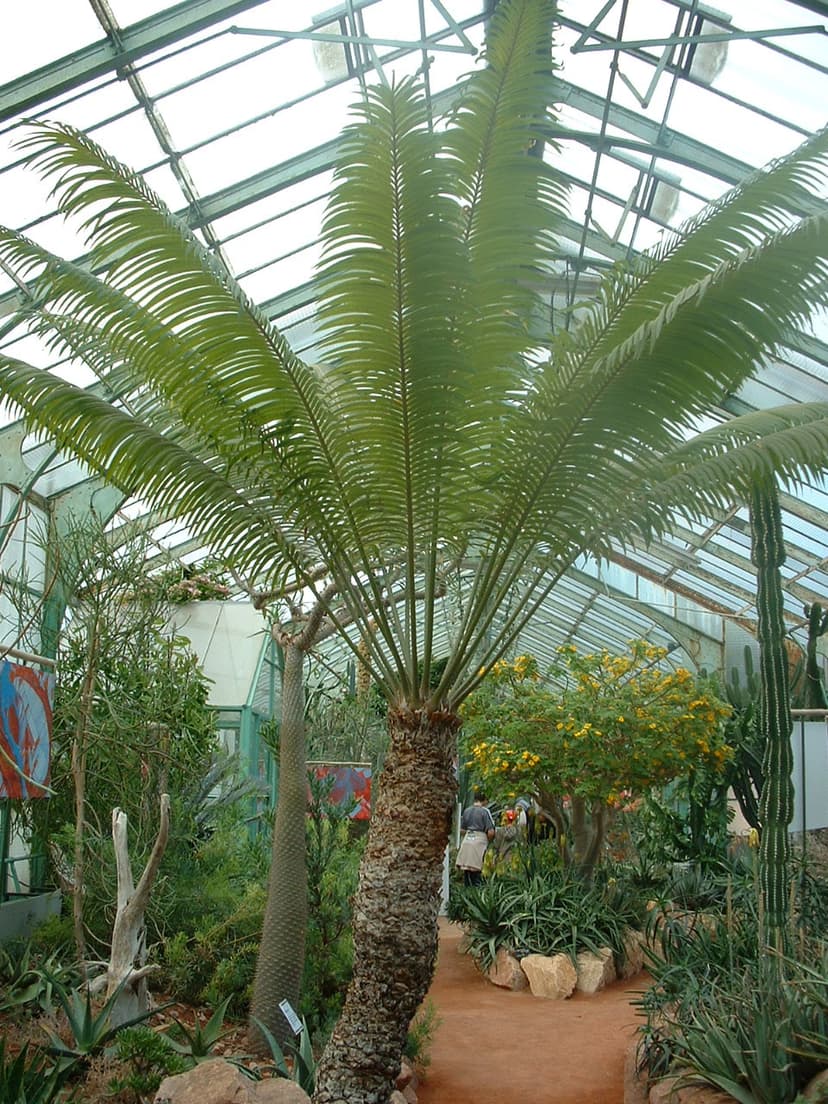
Cycas thouarsii, also known as the Madagascar cycad, is a large, evergreen, arborescent cycad native to Madagascar and surrounding islands, as well as coastal East Africa. It is characterized by its palm-like stem, long, pinnate, dark-green leaves, and distinctive pollen cones. The species thrives in coastal areas and light forests, and while its seeds contain toxins, they can be rendered edible through processing.
Macrozamia miquelii
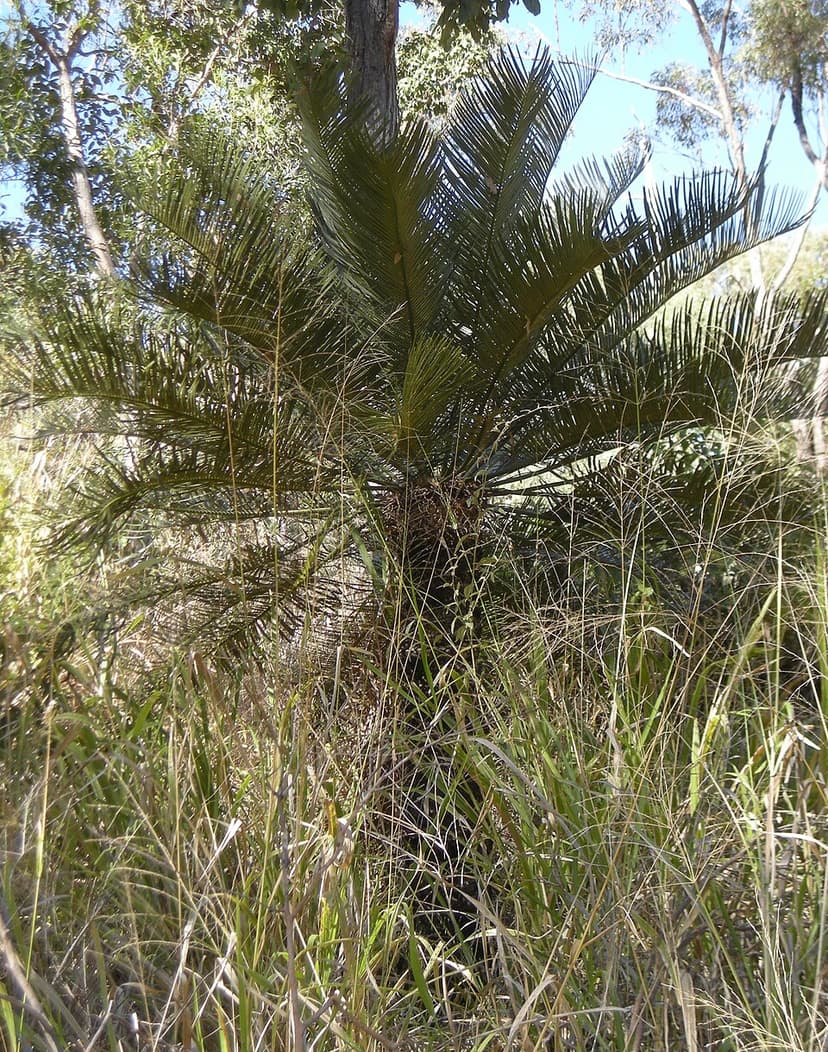
Macrozamia miquelii is a species of cycad native to eastern Australia, specifically Queensland and New South Wales. It is characterized by its medium height, intermediate cone sizes, and lighter green leaves compared to other Zamiaceae members. The plant's seeds, with an attractive orange-red sarcotesta, play a role in mutualistic seed dispersal with fauna, and are edible for humans when properly prepared to remove toxins.

Cycas apoa
Cycas apoa is a species of cycad native to northern New Guinea and Halmahera Island, thriving in wet lowland forests, particularly in seasonally flooded areas along the Sepik River basin. This species is characterized by erect stems, long, glossy green leaves with spiny petioles, and distinctive orange cones. Its scientific name originates from the vernacular name used by the Kaka tribe of the Sepik River estuary.