
Macrozamia miquelii
Sclerophyll forests dominated by eucalyptus trees, on ridges and slopes with low-nutrient stony or sandy soils.·Acaulescent (stem subterranean)·Thrips·Least Concern
Macrozamia miquelii is a species of cycad native to eastern Australia, specifically Queensland and New South Wales. It is characterized by its medium height, intermediate cone sizes, and lighter green leaves compared to other Zamiaceae members. The plant's seeds, with an attractive orange-red sarcotesta, play a role in mutualistic seed dispersal with fauna, and are edible for humans when properly prepared to remove toxins.
Key Facts
- ›Endemic to Queensland and New South Wales, Australia.
- ›Grows in sclerophyll forests on nutrient-poor soils.
- ›Features medium height (around 1m) and lighter green leaves.
- ›Seeds have an orange-red sarcotesta that attracts fauna for dispersal.
- ›Seeds are edible for humans after toxin removal.
- ›Rated as 'Least Concern' by the IUCN, though with a decreasing population trend.
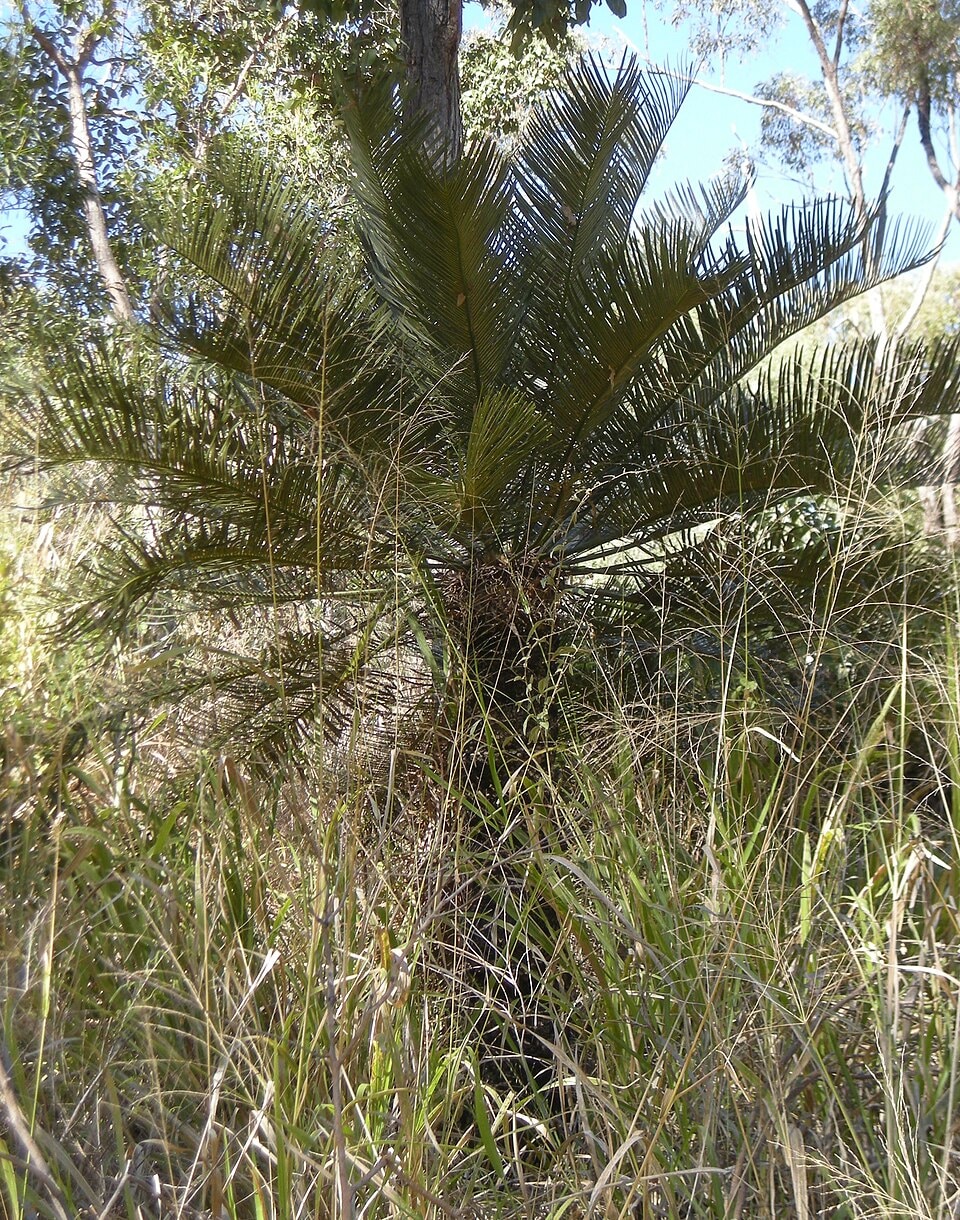
Queensland, New South Wales
- Caudex up to 45 cm in diameter and 50 cm in height.
- Usually subterranean with little of it visible above ground.
- Between 20 and 80 slightly glossy dark green leaves in the crown.
- Each leaf grows to a length of 2.3 m.
- Leaves consist of 80 to 160 leaflets.
- Leaflets are 15 cm to 50 cm long and 8 mm to 20 mm wide.
- Leaflets are covered in grey-brown hairs.
- Leaflets are discolorous: dark green and slightly glossy upper surface, paler green lower surface.
- Distal leaflets are spaced closely, proximal leaflets are more spread out.
- Rachis is straight with a pale green color.
- Leaflets are inserted at 40-degree angles to the rachis.
- Male cones: 1 to 5 per plant, 12 cm to 28 cm long, 4 cm to 7 cm diameter, fusiform but curve with age, remain green.
- Female cones: 1 to 3 per plant, 25 cm to 40 cm long, 10 cm to 15 cm diameter, cylindrical, remain green.
- Oblong shape.
- Length of 2 cm to 3 cm.
- Diameter of 1.5 cm to 2 cm.
- Sarcotesta has an orange-yellow color, turning reddish-orange when ripe.
- Edible seeds.
- Pith can be processed to remove toxins and used as an edible starch, also used in laundries.
Declining Quality of Habitat.
About Macrozamia miquelii
Macrozamia miquelii is a distinctive species of cycad found in the sclerophyll forests of eastern Australia, specifically within Queensland and New South Wales. This species is recognized for its relatively medium stature, typically reaching about 1 meter in height, and its lighter green foliage when compared to other members of the Zamiaceae family. Its reproductive cones are also of intermediate size, with both male and female cones exhibiting unique characteristics.
Description and Ecology
The plant is largely acaulescent, with its stem, or caudex, usually growing underground to a diameter of up to 45 cm and a height of 50 cm. Above ground, it presents a crown of 20 to 80 dark green leaves, each up to 2.3 meters long. These leaves are composed of numerous leaflets, which are glossy on the upper surface and paler on the lower. Macrozamia miquelii is dioecious, meaning individual plants are either male or female. Pollination is facilitated by thrips, attracted by a strong scent emitted from the male cones. The seeds, protected by a bright orange-red sarcotesta, are appealing to fauna. While smaller animals consume the sarcotesta, larger ones like emus and cassowaries play a crucial role in seed dispersal by ingesting and defecating the seeds intact, aiding the plant's propagation.
Uses and Toxicity
Traditionally, Aboriginal Australians utilized the seeds of Macrozamia miquelii after employing various preparation methods, such as leaching in water and aging, to neutralize their inherent toxins. The pith of the cycad also contains a toxic starch that, once processed, becomes edible and has historically been used in laundries. It is important to note that most parts of the Macrozamia miquelii are toxic, with seeds carrying a higher concentration of toxins like cycasin and macrozamin, as well as the neurotoxin BMAA. Ingestion of raw seeds can be fatal to animals and cause severe illness in humans.
Conservation
In 2009, Macrozamia miquelii was classified as 'Least Concern' by the IUCN, indicating a relatively stable population. However, the species is noted to have a decreasing population trend, primarily due to the declining quality of its natural habitat. Conservation efforts are in place in protected areas such as Byfield National Park and Mount Archer National Park.
Taxonomy
The species was first described as Encephalartos miquelii in 1862 by Ferdinand von Mueller. The specific epithet honors Dutch botanist Friedrich Anton Wilhelm Miquel, recognized for his significant contributions to the study of cycads. The current scientific name, Macrozamia miquelii, was established through subsequent taxonomic work.
Source: Wikipedia ↗
Frequently Asked Questions
What is the scientific name for this cycad species?
The scientific name for this cycad species is Macrozamia miquelii. It was first named Encephalartos miquelii in 1862 by Ferdinand von Mueller.
Where is Macrozamia miquelii found naturally?
Macrozamia miquelii is endemic to southern Queensland and northern New South Wales in Eastern Australia. Its natural range extends from the Port Curtis District to the upper Richmond River.
What kind of habitat does Macrozamia miquelii prefer?
This cycad thrives in sclerophyll forests, typically found on ridges and slopes where eucalyptus trees dominate. It grows on low-nutrient stony or sandy soils at altitudes ranging from 10 to 540 meters.
Are the seeds of Macrozamia miquelii safe to eat?
The seeds of Macrozamia miquelii contain toxins, including azoxyglycosides like cycasin and macrozamin, and the neurotoxin BMAA. However, they are edible for human consumption if prepared correctly to remove these toxins, a practice historically used by Aboriginal Australians.
What is the conservation status of Macrozamia miquelii?
As of 2009, Macrozamia miquelii was rated as 'Least Concern' by the IUCN. However, the species is noted to have a decreasing population trend due to declining habitat quality.
How does Macrozamia miquelii reproduce and disperse its seeds?
Macrozamia miquelii is dioecious, relying on thrips for pollination, which are attracted by a pungent scent from the male cones. Seed dispersal is facilitated by fauna, with larger animals like emus and cassowaries ingesting seeds and defecating them intact, aiding in propagation.
Related Cycad species
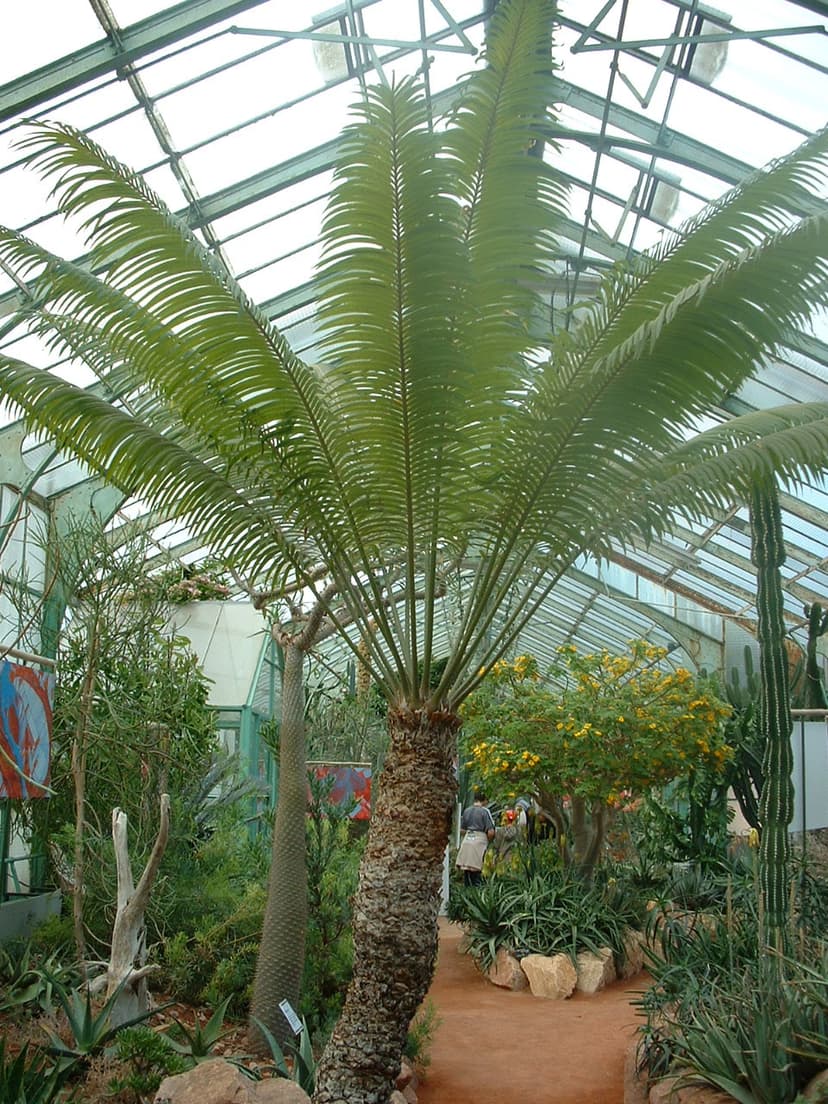
Cycas thouarsii
Cycas thouarsii, also known as the Madagascar cycad, is a large, evergreen, arborescent cycad native to Madagascar and surrounding islands, as well as coastal East Africa. It is characterized by its palm-like stem, long, pinnate, dark-green leaves, and distinctive pollen cones. The species thrives in coastal areas and light forests, and while its seeds contain toxins, they can be rendered edible through processing.

Cycas apoa
Cycas apoa is a species of cycad native to northern New Guinea and Halmahera Island, thriving in wet lowland forests, particularly in seasonally flooded areas along the Sepik River basin. This species is characterized by erect stems, long, glossy green leaves with spiny petioles, and distinctive orange cones. Its scientific name originates from the vernacular name used by the Kaka tribe of the Sepik River estuary.

Lepidozamia hopei
Lepidozamia hopei, commonly known as Hope's cycad or zamia palm, is a cycad species endemic to a small region of Queensland, Australia. It is renowned for its impressive stature, reputed to be the tallest cycad species, growing as an understorey tree in rainforest environments. Botanically, it is characterized by its tall, single trunk, long fronds with numerous leaflets, and exceptionally large reproductive cones.