
Lepidozamia peroffskyana
Wet sclerophyll forests or rainforest margins, usually on steep slopes.·Arborescent·Insect (Tranes group weevils)
Lepidozamia peroffskyana is a palm-like cycad native to eastern Australia, specifically in Queensland and New South Wales. It is characterized by its slow growth, long lifespan, and impressive reproductive cones, which are among the largest in the cycad world. The species is named in honor of Count Peroffsky, a benefactor of the St. Petersburg Botanical Garden.
Key Facts
- ›Endemic to eastern Australia, found in Queensland and New South Wales.
- ›Possesses some of the largest reproductive cones among all cycads.
- ›All parts of the plant, particularly the seeds, are toxic.
- ›Pollination is facilitated by a host-specific insect, the Tranes group weevils.
- ›Grows in wet sclerophyll forests or on rainforest margins, typically on steep slopes.
- ›Can reach heights of up to seven meters, with trunks up to eighty centimeters in diameter.
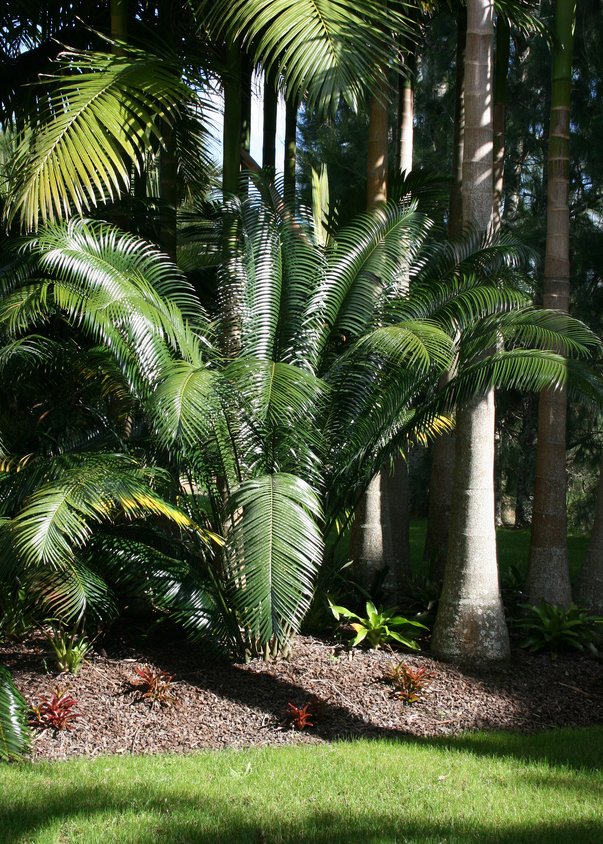
Queensland, Australia, New South Wales, Australia
Up to eighty centimeters in diameter, Covered by persistent remains of leaf bases, Forms an interesting texture
- Up to three meters long
- Each leaf bears about two hundred narrow, glossy, dark green leaflets
- Leaflets are somewhat lax and spreading
- Leaflets are softly coriaceous
- Each leaflet has seven to thirteen parallel veins
- Cylindrical cones
- Some of the largest of all cycad cones
- Male cones can reach seventy-five centimeters long
- Female cones can reach ninety centimeters long
- Female cones can weigh up to forty-five kilograms
Large and Numerous, Have Red Sarcotesta
Feature Plant
About Lepidozamia peroffskyana
Lepidozamia peroffskyana is a striking palm-like cycad belonging to the Zamiaceae family, endemic to the eastern coastal regions of Australia, specifically in Queensland and New South Wales. This species is renowned for its slow growth, longevity, and low maintenance requirements, making it a popular choice as a feature plant in semi-shaded gardens or as a container specimen. The plant's name honors Count Peroffsky, a noted benefactor of the St. Petersburg Botanical Garden.
Description and Characteristics
Mature Lepidozamia peroffskyana plants can reach an impressive height of up to seven meters, though they more typically grow to around four meters. The trunk, which can be up to eighty centimeters in diameter, is characteristically covered by the persistent bases of old leaf stalks, creating a textured and visually interesting surface. The crown is adorned with numerous fronds, each extending up to three meters in length. These fronds are composed of approximately two hundred narrow, glossy, dark green leaflets. Each leaflet is distinguished by seven to thirteen parallel veins, a key feature for identifying the species. The plant develops a rosette of fronds annually, with about six rosettes present at any given time, stacked sequentially as older ones recede.
Reproductive Biology and Cones
Lepidozamia peroffskyana produces some of the largest cones found within the cycad family. Male cones can grow up to seventy-five centimeters long, while the female cones are even more substantial, reaching ninety centimeters and weighing as much as forty-five kilograms. Pollination is a specialized process, not relying on wind but on a host-specific insect, the Tranes group weevils. The plant emits a scent to attract these weevils to its reproductive cones. Weevils play a crucial role in pollination by carrying pollen from male to female cones. Their life cycle is closely tied to the male cones, which provide them with food and a site for oviposition, though their activity eventually leads to the destruction of the cones.
Distribution and Habitat
This cycad species is naturally distributed in southeastern Queensland and northeastern New South Wales, Australia. Its range spans from Gympie, located north of Brisbane, to the Manning River area near Forster. Lepidozamia peroffskyana typically grows in scattered, small communities within wet sclerophyll forests or along the edges of rainforests. It favors habitats on steep slopes, at elevations ranging from sea level up to approximately 1,000 meters.
Toxicity
It is important to note that all parts of Lepidozamia peroffskyana, particularly its seeds, are toxic to both humans and livestock. Ingestion can result in severe gastrointestinal distress, including irritation, abdominal cramps, vomiting, nausea, and diarrhea. In more severe cases, it can lead to liver damage and muscular paralysis.
Source: Wikipedia ↗
Frequently Asked Questions
Where is Lepidozamia peroffskyana found naturally?
Lepidozamia peroffskyana is naturally found in southeastern Queensland and northeastern New South Wales, Australia. Its range extends from Gympie, north of Brisbane, down to the Manning River near Forster.
What are the distinctive features of Lepidozamia peroffskyana's leaves and cones?
Each leaf of Lepidozamia peroffskyana can be up to three meters long and bears approximately two hundred narrow, glossy, dark green leaflets, each with seven to thirteen parallel veins. The plant produces some of the largest cones in the cycad family, with male cones reaching up to seventy-five centimeters and female cones up to ninety centimeters in length.
How does Lepidozamia peroffskyana reproduce?
Reproduction involves host-specific Tranes group weevils. The plant attracts these weevils with a scent, and they transport pollen from male to female cones. The weevils' life cycle is associated with the male cones, where they feed and lay eggs, contributing to pollen dispersal.
Is Lepidozamia peroffskyana safe to handle or consume?
No, all parts of Lepidozamia peroffskyana, especially the seeds, are toxic to both livestock and humans. Ingestion can lead to severe gastrointestinal issues, including irritation, cramps, vomiting, nausea, diarrhea, and potentially liver damage or muscular paralysis.
What kind of environment does Lepidozamia peroffskyana prefer?
Lepidozamia peroffskyana thrives in wet sclerophyll forests or on the margins of rainforests. It is typically found on steep slopes, from sea level up to about 1,000 meters in elevation.
What is the typical size of Lepidozamia peroffskyana?
Lepidozamia peroffskyana is a slow-growing cycad that can reach up to seven meters in height, though it more commonly grows to about four meters. Its trunk can be up to eighty centimeters in diameter.
Related Cycad species

Encephalartos lanatus
Encephalartos lanatus, commonly known as the Olifants River cycad, is a slow-growing cycad species native to Mpumalanga and Gauteng in South Africa. Characterized by its bluish-green, woolly leaves and the unique arrangement of leaflets, this species thrives in rocky, prairie-covered slopes and exhibits remarkable resilience to fire and frost.
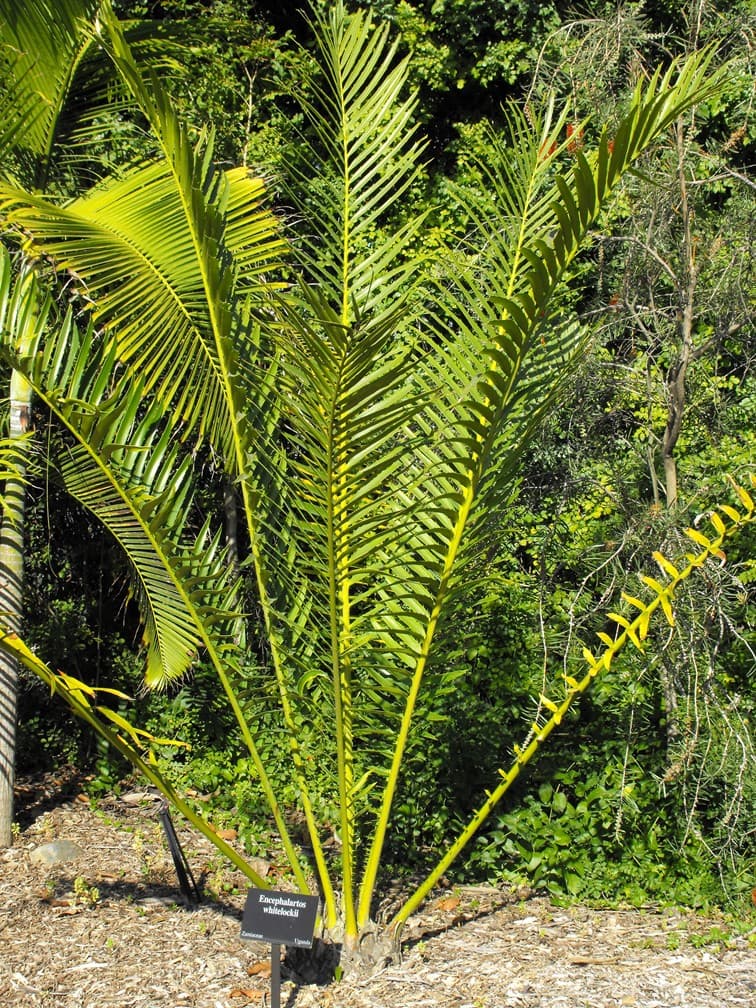
Encephalartos whitelockii
Encephalartos whitelockii is a critically endangered cycad species native to a single location in southwestern Uganda, forming one of Africa's most impressive cycad populations along the Mpanga River. This large, arborescent cycad is characterized by its tall stems topped with stiff, glossy dark green fronds and distinctive bluish-green cones, and it plays an important role in the local ecosystem, particularly for baboons.

Dioon edule
Dioon edule, commonly known as the chestnut dioon or palma de la virgen, is a cycad species native to the eastern coast of Mexico. It is characterized by pinnate leaves that can reach around 135 cm in length and a slow growth rate adapted to harsh, dry climates. This species plays a significant role in its ecosystem, particularly in nitrogen fixation, and is recognized for its mutualistic relationship with specific beetle species responsible for its pollination.