
Macrozamia concinna
Dry eucalyptus forests with medium to dense understory, often at high altitudes (800-1200m).·Dwarf cycad·Insect pollination by thrips (Cycadothrips chadwiki)·Threatened (based on IUCN Red List mention)
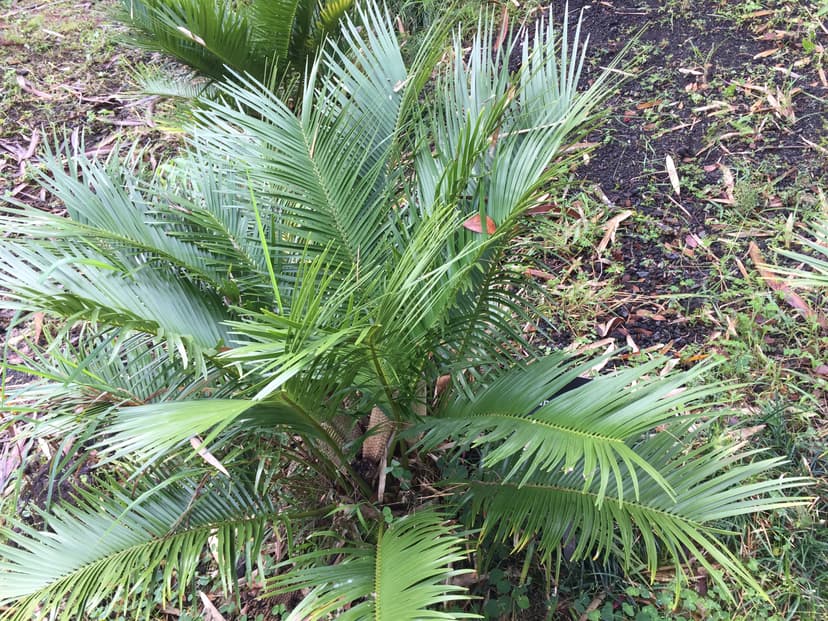
Macrozamia concinna is a distinctive cycad species belonging to the Zamiaceae family, native to New South Wales, Australia. It is characterized by its unique leaf structure with multiple twists and reddish seeds, and employs a specialized insect pollination method involving thrips. This species is considered a living fossil, predating dinosaurs, and plays a crucial role in understanding plant evolution.
Key Facts
- ›Native to New South Wales, Australia, thriving in dry eucalyptus forests.
- ›Possesses distinctive leaves with multiple twists and reddish seeds.
- ›Reproduces via a mutualistic relationship with thrips, not wind pollination.
- ›Considered a 'living fossil', with a lineage dating back to the Permian period.
- ›Under threat from habitat loss, urbanization, and fire.

New South Wales, Australia
Vicariously Covered In Leaf Bases, Spirally Twisted
- Pinnate leaves with possibility of pinnae dividing down the middle
- Darker green fronds
- Fronds twist multiple times at the base
- 1-5 fronds per plant
- Fronds 50–90 cm long
- Pinnae are 14–21 cm long by 4–6 cm wide
- Pinnae grow in a spiral 360-degree motion laterally from the stem
- Pinnae may twist several times or not at all
- Male cones: 1-2, 14–22 cm long, 4-4.5 cm diameter, with spines 0–1.3 cm long
- Female cones: 1, 13–15 cm long, 7–8 cm diameter
Reddish Complexion, 2.1-2.6 cm Long and 1.8-2.4 cm Wide
Habitat Loss Associated With Urbanisation, Potential Reproduction Failure, Loss To Fire, Close Extinction of Pollinator Thrips
About Macrozamia concinna
Macrozamia concinna is a remarkable species of cycad belonging to the Zamiaceae family, recognized for its distinct botanical features and ancient lineage. Native to the New South Wales region of Australia, this plant is easily distinguishable from other cycads by its unique leaf structure and reproductive strategies.
Botanical Characteristics
The species is often described as a dwarf cycad, with both male and female varieties present. Its leaves, or fronds, are pinnate and can be quite long, often twisting multiple times at the base. A notable feature is the possibility for the leaflets (pinnae) to divide down the center, and they tend to grow in a spiral arrangement around the stem. The seeds produced by Macrozamia concinna are visually striking due to their reddish complexion. Male plants typically bear one to two cones, while female plants usually have a single cone.
Reproduction and Evolutionary Significance
Macrozamia concinna employs a unique method of reproduction, diverging from the common wind pollination seen in many plants. It engages in a mutualistic relationship with specific insects called thrips. These thrips are attracted to the cycad cones through a sophisticated 'push-pull' pollination mechanism, involving thermogenesis and scent emission from the cones. This ancient lineage, dating back to the Permian period, makes Macrozamia concinna a significant subject for understanding plant evolution and the distinction between gymnosperms and angiosperms, often referred to as a 'living fossil'.
Habitat and Conservation
This cycad is endemic to New South Wales, typically found in dry eucalyptus forests at higher altitudes. It prefers slopes in areas with dry sclerophyll woodlands. Unfortunately, Macrozamia concinna is considered a threatened species. Its populations face considerable pressure from habitat loss due to urbanization, the risk of reproductive failure, and the impact of fires. The declining population of its essential pollinator, thrips, also poses a significant threat to the species' long-term survival.
Source: Wikipedia ↗
Frequently Asked Questions
What is Macrozamia concinna?
Macrozamia concinna is a species of cycad belonging to the Zamiaceae family. It is native to New South Wales, Australia, and is known for its unique appearance and reproductive mechanisms. It is considered a 'living fossil' due to its ancient lineage.
Where is Macrozamia concinna found?
This cycad is endemic to New South Wales, Australia. It typically grows in dry eucalyptus forests with a medium to dense understory, often found in higher altitudes between 800 and 1200 meters, particularly in regions like the Upper Hunter Valley and Liverpool Plains.
How does Macrozamia concinna reproduce?
Unlike many plants that rely on wind pollination, Macrozamia concinna engages in a specialized method involving thrips. These insects are attracted to the cones by a scent produced during a thermogenic phase, facilitating pollination in a process described as a 'push-pull' mechanism.
What are the threats to Macrozamia concinna?
The population of Macrozamia concinna is facing significant threats. These include habitat loss due to urbanization, potential reproductive failures, and damage from fires. The decline of its specific pollinator, thrips, also poses a risk to the species' survival.
What is unique about the leaves of Macrozamia concinna?
The leaves, or fronds, of Macrozamia concinna are characterized by their pinnate structure, where the leaflets (pinnae) can divide in the middle. The fronds often have a darker green color and twist multiple times at the base. The pinnae themselves tend to grow in a spiral motion around the stem and may twist several times.
Why is Macrozamia concinna considered a 'living fossil'?
Macrozamia concinna is referred to as a 'living fossil' because its lineage dates back approximately 280 million years to the Permian period, predating the age of dinosaurs. It represents an ancient group of seed-bearing plants that has survived into the present day, offering insights into early plant evolution.
Related Cycad species

Encephalartos horridus
Encephalartos horridus, commonly known as the Eastern Cape blue cycad, is a distinctive, low-growing cycad native to the Eastern Cape Province of South Africa. It is recognized for its striking blue-gray, spiny leaves and typically develops a subterranean stem. This species thrives in arid shrublands and rocky ridges, exhibiting a slow growth rate and requiring specific conditions for successful cultivation.
Zamia inermis
Zamia inermis is a critically endangered cycad species native to Actopan, Veracruz, Mexico. It is characterized by its shrub-like growth, with a trunk that can be branched and upright leaves composed of numerous linear-lanceolate leaflets. This species is dioecious and faces significant threats from habitat loss, wildfires, and over-harvesting.

Encephalartos dolomiticus
Encephalartos dolomiticus, commonly known as the Wolkberg cycad, is a critically endangered cycad species native to the Wolkberg region of South Africa. This tree-like cycad typically grows up to 2 meters tall and is characterized by its distinctive bluish leaves forming a crown, with lance-shaped leaflets arranged oppositely along the rachis. It is a dioecious species, producing separate male and female cones.