
Macrozamia glaucophylla
Dry sclerophyll woodlands, particularly in deep sandy soils, often under sparse tree canopies.·Acaulescent (short stem concealed on the ground), with a subterranean unbranched caudex.·Passive pollination via specialized mutualism with insect pollinators.
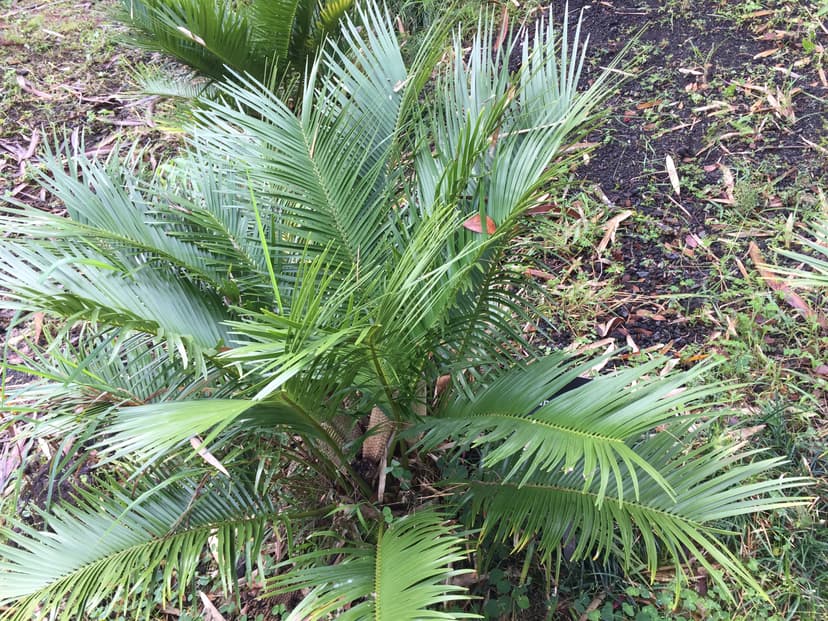
Macrozamia glaucophylla is a striking cycad species native to New South Wales, Australia, characterized by its glaucous blue, divided fronds and a subterranean trunk. While resembling a palm, it belongs to the Zamiaceae family. This species is known for its drought tolerance and ornamental appeal, though its seeds and young leaves contain toxins.
Key Facts
- ›Endemic to New South Wales, Australia.
- ›Possesses glaucous blue fronds with dichotomously branched pinnae.
- ›Features a normally subterranean, unbranched caudex.
- ›Seeds and young leaves contain toxins, primarily Methylazoxymethanol (MAM).
- ›Known for its ornamental value and drought tolerance.
- ›Pollination is a passive process involving specialized insect mutualism.

Zamia, Zamia 'Palm', Wild Pineapple, Burrawang
New South Wales, Australia
Normally Subterranean, Unbranched Caudex, Diameter of 20-40 cm
- Glaucous blue fronds
- Fronds 60-120 cm long
- Divided pinnae, often dichotomously branched
- Median pinnae dichotomously branched
- Basal pinnae not reducing to spines
- Pinnae 16-25 cm long and 4-7 mm wide
- Concolorous to weakly discolorous
- Flat margins
- Strongly to moderately keeled
- 90-10 pinnae per leaf
- Grey, green to blue color with dull appearance
- Petiole 12-25 cm long
- Rachis not to moderately spirally twisted
- Apex entire and not spinescent
- Average frond height from ground: 50-70 cm
- Red-coloured ovoid seed cones
- Fusiform pollen cones
- Megasporophyll with an expanded peltate apex
- Male cones mostly green, narrow, and often curved when mature
- Female cones green, broad, and erect with two seeds on each sporophyll
- Seed cones ovoid, 18-23 cm in length and 9-11 cm in diameter
- Megasporophyll apical spine 2-10 mm long
- Female plants typically have two cones after coning
- Male plants can have up to four cones after coning
- Ovoid
- Range from red, orange to yellow in color
- Size ranges from 30-34 mm in length and 24-26 mm in width
- Seeds may show teeth marks from animal consumption
Ornamental Plant
- Consumption by animals impacting seed dispersal and survival.
About Macrozamia glaucophylla
Macrozamia glaucophylla is a distinctive species of cycad belonging to the genus Macrozamia and the family Zamiaceae. Endemic to New South Wales, Australia, it is often mistaken for a palm due to its appearance but is botanically quite different. The species is characterized by its subterranean trunk and striking glaucous blue fronds, which are typically 60 to 120 cm in length and feature divided pinnae.
Botanical Characteristics
The plant typically has an unbranched, subterranean caudex, with a stem diameter ranging from 20 to 40 cm. Its fronds are notably glaucous, appearing blue when young and maturing to a bluish-green. The pinnae are usually dichotomously branched, giving the fronds a feathery appearance. Macrozamia glaucophylla produces both male (fusiform) and female (ovoid) cones. The male cones are generally green and narrow, while the female cones are broader, erect, and bear red, orange, or yellow seeds.
Distribution and Habitat
This cycad is primarily found in the northern part of the Pilliga State Forest, south of Narrabri, and in areas around Gunnedah in New South Wales. It thrives in dry sclerophyll woodlands, favoring deep sandy soils. The populations are sporadic, though locally abundant within its range. The species grows under a relatively open canopy of trees such as Acacia spp., Callitris spp., and Eucalyptus spp.
Toxicity and Ecology
Macrozamia glaucophylla is classified as a poisonous vascular plant. The toxic components, primarily Methylazoxymethanol (MAM) and an unidentified neurotoxin, are concentrated in the leaves, especially young ones, and the seeds. Consumption can lead to severe health issues in mammals, including neurological damage known as 'zamia staggers.' Ecologically, it engages in a specialized mutualism with insect pollinators, a process of passive pollination. Animals like kangaroos, feral pigs, and possums play a role in seed dispersal by consuming the seed flesh.
Source: Wikipedia ↗
Frequently Asked Questions
What are the common names for Macrozamia glaucophylla?
Macrozamia glaucophylla is also known by several common names, including zamia, zamia 'palm', wild pineapple, and burrawang (specifically in New South Wales).
Where is Macrozamia glaucophylla found naturally?
This cycad species is endemic to New South Wales, Australia, and is typically found in the northern areas of the Pilliga State Forest, south of Narrabri, and around Gunnedah.
What is the typical habitat of Macrozamia glaucophylla?
Macrozamia glaucophylla thrives in dry sclerophyll woodlands, often found in deep sandy soils. It grows beneath a sparse canopy of trees such as Acacia, Callitris, and Eucalyptus species.
Are the seeds or leaves of Macrozamia glaucophylla poisonous?
Yes, Macrozamia glaucophylla is considered a poisonous plant, with toxins present in its leaves, particularly the young ones, and its seeds. The primary toxin identified is Methylazoxymethanol (MAM).
What health effects can arise from consuming parts of Macrozamia glaucophylla?
Consumption of toxic parts can lead to 'zamia staggers,' a disease affecting the nervous system, causing posterior ataxia and spinal cord degeneration. In humans and animals, it can cause severe gastro-intestinal irritation, headaches, and in rare, severe cases, liver damage, coma, or death.
How does Macrozamia glaucophylla reproduce?
Reproduction involves a specialized mutualism with insect pollinators, a process described as passive pollination. The species has an irregular coning cycle, with male plants producing pollen cones and female plants producing seed cones.
What are the characteristics of Macrozamia glaucophylla's leaves?
The leaves, or fronds, are typically glaucous blue to bluish-green, ranging from 60 to 120 cm in length. They are characterized by divided pinnae, which are often dichotomously branched, and the leaves are moderately to strongly keeled.
Related Cycad species

Encephalartos horridus
Encephalartos horridus, commonly known as the Eastern Cape blue cycad, is a distinctive, low-growing cycad native to the Eastern Cape Province of South Africa. It is recognized for its striking blue-gray, spiny leaves and typically develops a subterranean stem. This species thrives in arid shrublands and rocky ridges, exhibiting a slow growth rate and requiring specific conditions for successful cultivation.
Zamia inermis
Zamia inermis is a critically endangered cycad species native to Actopan, Veracruz, Mexico. It is characterized by its shrub-like growth, with a trunk that can be branched and upright leaves composed of numerous linear-lanceolate leaflets. This species is dioecious and faces significant threats from habitat loss, wildfires, and over-harvesting.

Encephalartos dolomiticus
Encephalartos dolomiticus, commonly known as the Wolkberg cycad, is a critically endangered cycad species native to the Wolkberg region of South Africa. This tree-like cycad typically grows up to 2 meters tall and is characterized by its distinctive bluish leaves forming a crown, with lance-shaped leaflets arranged oppositely along the rachis. It is a dioecious species, producing separate male and female cones.