
Zamia chigua
Subtropical or tropical moist lowland forests·Shrub-like or small tree
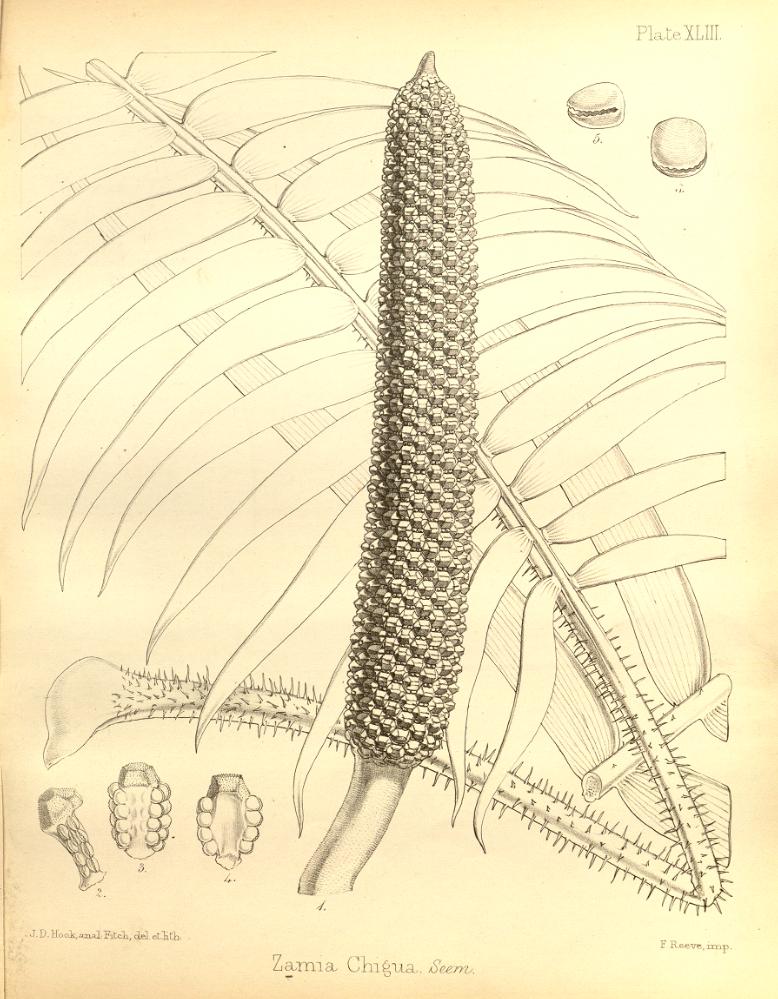
Zamia chigua is a species of cycad native to the Choco Department of Colombia and Chiriquí Province of Panama. It thrives in moist lowland tropical and subtropical forests, characterized by its shrub-like to small tree growth form with a wrinkled stem topped by compound leaves. This dioecious species produces distinct male and female cones, and its seeds are notable for their red sarcotesta.
Key Facts
- ›Native to Colombia (Choco Department) and Panama (Chiriquí Province).
- ›Found in subtropical or tropical moist lowland forests.
- ›Has a wrinkled stem that can reach up to 2 meters in height.
- ›Possesses compound leaves with 30 to 80 smooth-edged leaflets.
- ›Is dioecious, with separate male and female plants.
- ›Female cones are larger than male cones and tan to light brown in color.
Chigua
Colombia, Panama
Wrinkled Stem, Up To 2 Meters Tall, Up To 15 Centimeters In Diameter
- 3 to 15 compound leaves at the apex of the stem
- Leaves are 0.5 to 3 meters long
- Petiole up to 1 meter long
- Petiole is densely covered with prickles
- 30 to 80 leaflets per leaf
- Leaflets are long lanceolate
- Leaflets are smooth along the edges
- Leaflets in the middle of the leaf are 10 to 30 centimeters long and 1 to 1.5 centimeters wide
- Male strobili are cylindrical, 10 to 20 centimeters long and 2 to 3 centimeters in diameter, and cream to light-yellow in color.
- Female cones are narrow-ovoid to cylindrical, 20 to 30 centimeters long and 8 to 12 centimeters in diameter, and tan to light brown in color.
Ovoid Seeds, Red Sarcotesta
Habitat Destruction
About Zamia chigua
Zamia chigua is a species of cycad belonging to the Zamiaceae family. It is distinguished by its growth habit as a shrub or small tree, typically featuring a wrinkled stem that can ascend to approximately 2 meters in height. The plant is adorned with a crown of compound leaves at the stem's apex, each leaf comprising numerous long, lanceolate leaflets with smooth margins. The common name 'chigua' originates from the indigenous peoples of Choco Province, Colombia, where the species is found.
Botanical Description
The stem of Zamia chigua is notable for its wrinkled texture and can reach up to 2 meters (6 ft 7 in) in height and 15 centimeters (5.9 in) in diameter. The compound leaves range from 0.5 to 3 meters (1 ft 8 in to 9 ft 10 in) in length, supported by a petiole or stalk that can extend up to 1 meter (3 ft 3 in) and is densely covered with prickles. Each leaf contains between 30 and 80 leaflets, with those in the central part of the leaf measuring 10 to 30 centimeters (3.9 to 11.8 in) long and 1 to 1.5 centimeters (0.39 to 0.59 in) wide. As with all members of the Zamia genus, Zamia chigua is dioecious, meaning that individual plants are either male or female.
Reproduction
Reproductive structures in Zamia chigua are cones. Male cones, known as strobili, are cylindrical, measuring 10 to 20 centimeters (3.9 to 7.9 in) in length and 2 to 3 centimeters (0.79 to 1.18 in) in diameter, and present in a cream to light-yellow hue. The female cones are larger, described as narrow-ovoid to cylindrical, with lengths of 20 to 30 centimeters (7.9 to 11.8 in) and diameters of 8 to 12 centimeters (3.1 to 4.7 in), exhibiting a tan to light brown coloration. The seeds are ovoid and possess a distinct red sarcotesta, which is the fleshy outer layer.
Distribution and Habitat
Zamia chigua is found in the Choco Department of Colombia and the Chiriquí Province of Panama. It thrives in subtropical or tropical moist lowland forest environments. While it is common in Chiriquí Province at elevations between 600 to 1,200 meters (2,000 to 3,900 ft), it is also present in the lowland rainforests of Choco Department. There is an indication that it may also grow on mountain slopes in Darien Province, Panama, and adjacent Colombian regions, though it had not been documented there as of 2004.
Conservation
The primary threat to the survival of Zamia chigua is habitat destruction. This loss of its natural environment poses the most significant challenge to the species' continued existence in its native range.
Source: Wikipedia ↗
Frequently Asked Questions
What is Zamia chigua?
Zamia chigua is a species of plant belonging to the Zamiaceae family, commonly known as a cycad. It is characterized by its shrub-like or small tree form and is found in specific lowland forest regions of Colombia and Panama.
Where is Zamia chigua found naturally?
This species is indigenous to the Choco Department of Colombia and the Chiriquí Province of Panama. Its natural habitat consists of subtropical or tropical moist lowland forests.
What are the physical characteristics of Zamia chigua?
Zamia chigua typically grows as a shrub or small tree with a wrinkled stem that can reach up to 2 meters tall. It has compound leaves at the stem's apex, each bearing 30 to 80 long, lanceolate leaflets with smooth edges.
How does Zamia chigua reproduce?
Like other Zamia species, Zamia chigua is dioecious, meaning individual plants are either male or female. Male plants produce cylindrical cream to light-yellow cones, while female plants bear larger, tan to light brown, narrow-ovoid to cylindrical cones.
What are the seeds of Zamia chigua like?
The seeds of Zamia chigua are ovoid in shape and are distinguished by a red sarcotesta, which is the outer fleshy coat surrounding the seed.
What are the main threats to Zamia chigua?
The primary threat identified for Zamia chigua is habitat destruction. This loss of its natural environment poses the most significant risk to the species' survival.
Related Cycad species
Zamia obliqua
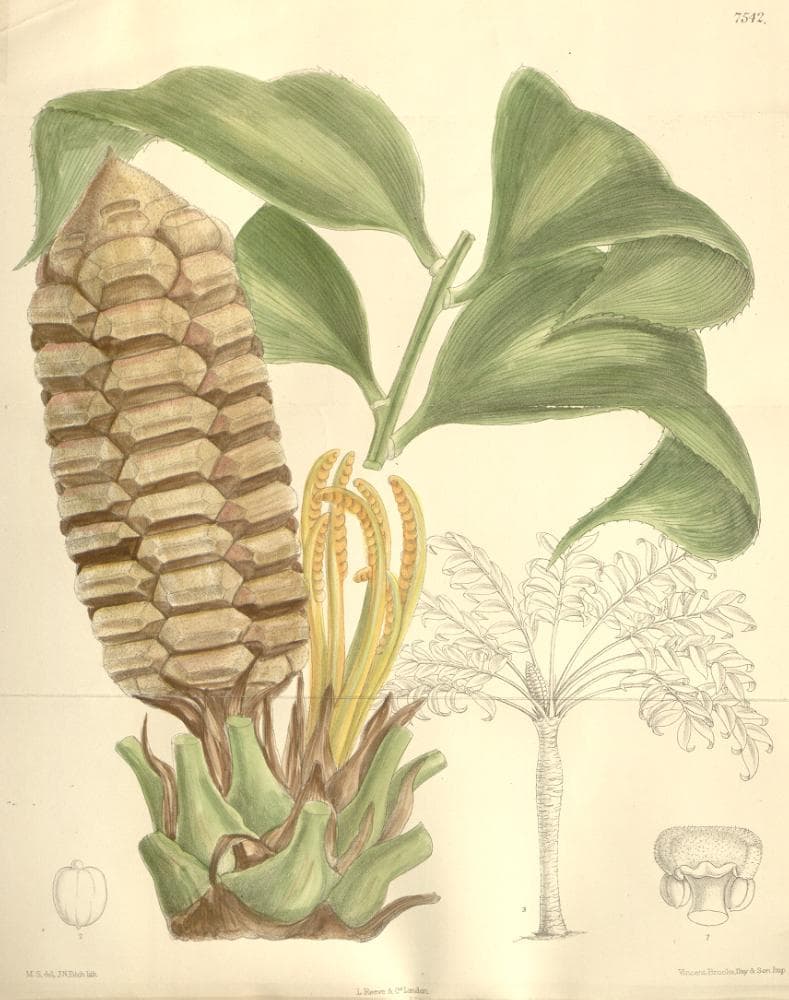
Zamia obliqua is a species of cycad native to the lowland moist forests of Colombia and Panama. Commonly known as "chigua", this plant is a member of the Zamiaceae family. Its survival is threatened by ongoing habitat loss in its natural range.

Zamia pseudoparasitica
Zamia pseudoparasitica is a unique cycad species endemic to Panama, notable for being the only known obligate epiphytic gymnosperm. It grows on the branches of forest trees, developing very long leaves and orange seeds. Its existence is closely tied to primary forests, where it faces threats from habitat loss.

Zamia tuerckheimii
Zamia tuerckheimii is a cycad species native to the Alta Verapaz region of Guatemala. Found in subtropical or tropical moist lowland forests, this plant is characterized by its unique botanical features and is currently facing threats due to habitat loss. The species was named in honor of the German plant collector Hans von Türckheim.