
Zamia cunaria
Secondary vegetation on clay soils in hilly country·Subterranean stem with aerial leaves
Zamia cunaria is a species of cycad belonging to the Zamiaceae family, endemic to the Comarca Guna Yala in Panama. It is characterized by its subterranean stem and compound leaves with toothed leaflets. The plant is dioecious, producing distinct male and female cones, and its seeds are used by the indigenous Guna people for making necklaces.
Key Facts
- ›Endemic to Comarca Guna Yala, Panama.
- ›Has a subterranean, sub-globose stem up to 10 cm in diameter.
- ›Leaves are compound, 0.5 to 1.5 meters long, with prickly petioles.
- ›Dioecious, with separate male and female plants.
- ›Male cones are cream to tan; female cones are wine-red to dark red-brown.
- ›Seeds are pink to light-red and used by the Guna people for necklaces.
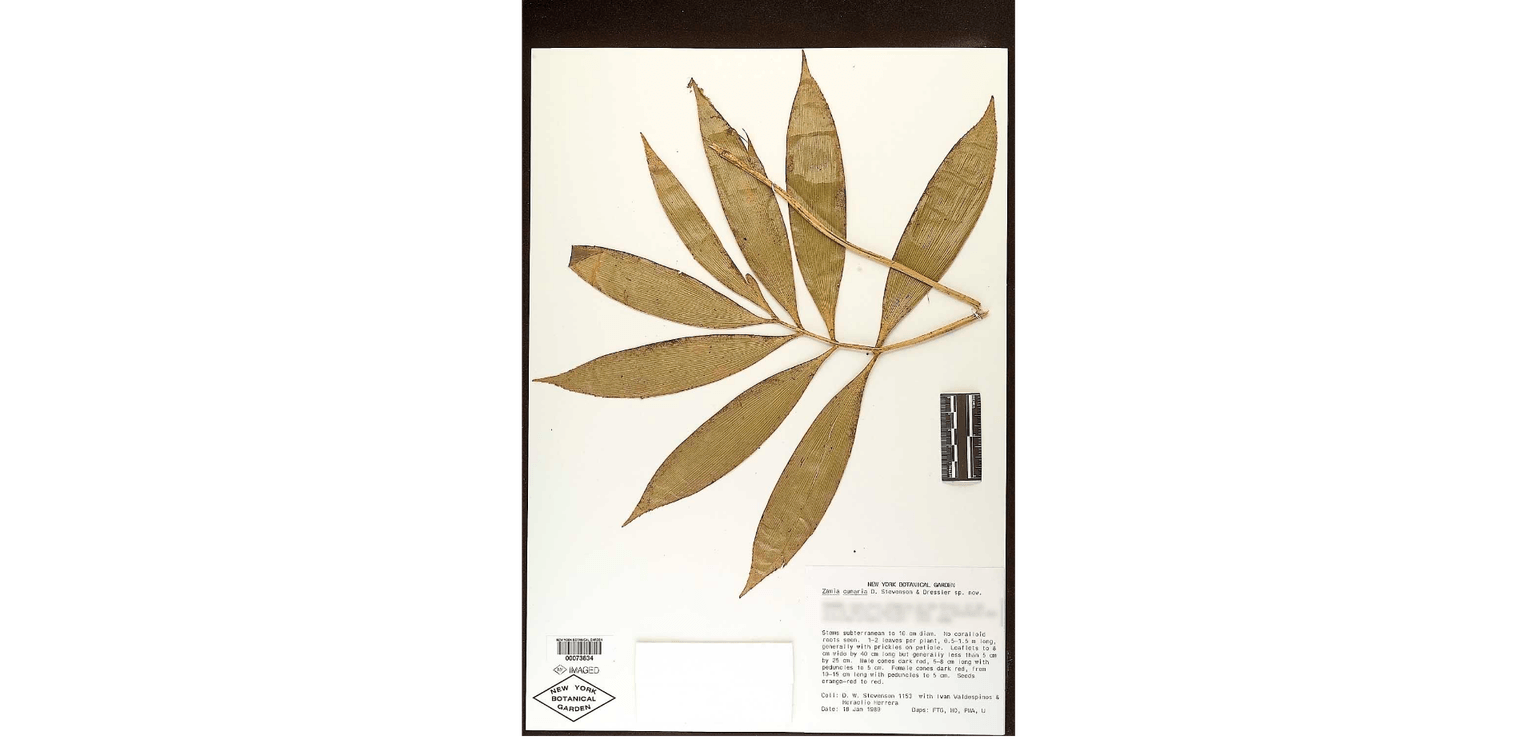
Obset
Comarca Guna Yala, Panama
Subterranean, Sub-Globose, Up To 10 Centimetres In Diameter
- Compound leaves
- 0.5 to 1.5 metres long
- 15 to 50 centimetres long petiole
- Petiole sparsely to densely covered by prickles
- Three to twelve pairs of leaflets on the rachis
- Leaflets are lanceolate or oblanceolate
- Leaflets wedge-shaped at the base and tapering to a point
- Edges are toothed on the outer third of the leaflets
- Larger leaflets 20 to 40 centimetres long and 5 to 8 centimetres wide
- Male strobili are cream to tan in color, cylindrical to ovoid-cylindrical, 4 to 6 centimetres long and 1 to 1.5 centimetres in diameter, standing on a peduncle 2 to 4 centimetres tall.
- Female strobili are wine-red to dark red-brown in color, ovoid to ovoid-cylindrical, 15 to 20 centimetres long and 5 to 7 centimetres in diameter.
Pink To Light-Red, 1.5 To 2 Centimetres Long, 0.5 To 0.8 Centimetres In Diameter
Necklaces made from seeds by the Guna people
About Zamia cunaria
Zamia cunaria is a species of cycad native to the Comarca Guna Yala region of Panama. This species is a member of the Zamiaceae family, a group of ancient plants known for their distinctive palm-like appearance, though they are not true palms.
Botanical Characteristics
The stem of Zamia cunaria is typically subterranean and sub-globose, reaching up to 10 centimeters in diameter. The plant usually bears one, but sometimes up to three, compound leaves at the apex of its stem. These leaves can grow between 0.5 to 1.5 meters in length, featuring a petiole (leaf stalk) that is 15 to 50 centimeters long and may be sparsely to densely covered with prickles. The rachis (shaft) of the leaf supports three to twelve pairs of leaflets. These leaflets are lanceolate or oblanceolate, meaning they are wedge-shaped at the base and taper to a point. Their edges are toothed, particularly on the outer third. Larger leaflets can measure 20 to 40 centimeters in length and 5 to 8 centimeters in width.
Reproduction and Distribution
Zamia cunaria, like all cycads, is dioecious, with individual plants being either male or female. Male cones, called strobili, are cream to tan in color, cylindrical to ovoid-cylindrical, and measure 4 to 6 centimeters long. Female cones are larger, ranging from wine-red to dark red-brown, and are ovoid to ovoid-cylindrical, growing 15 to 20 centimeters long. The seeds of Zamia cunaria are pink to light-red and are approximately 1.5 to 2 centimeters in length. The indigenous Guna people, to whom the species' epithet 'cunaria' refers, traditionally use these seeds to create necklaces.
Habitat and Ecology
This species is usually found growing on clay soils within secondary vegetation in hilly terrain. Its natural habitat is situated at elevations between 400 and 800 meters above sea level.
Karyology and Phylogeny
Studies on the chromosomes of Zamia cunaria reveal chromosome numbers of either 2n=23 or 2n=24. These numbers suggest that the chromosomes may be more fragile compared to species with a 2n=18 chromosome count. Phylogenetic analyses have placed Zamia cunaria in different clades depending on the study, with some suggesting a 'Cunaria clade' that includes other Panamanian and South American species, distinct from clades primarily found in Mesoamerica.
Source: Wikipedia ↗
Frequently Asked Questions
What is Zamia cunaria?
Zamia cunaria is a species of plant in the cycad family Zamiaceae. It is native to a specific region in Panama and is recognized for its unique botanical characteristics.
Where is Zamia cunaria found naturally?
This cycad species is endemic to the Comarca Guna Yala in Panama. It typically grows in secondary vegetation on clay soils in hilly areas at elevations between 400 and 800 meters.
What are the distinct features of Zamia cunaria's leaves?
The leaves of Zamia cunaria are compound and can range from 0.5 to 1.5 meters in length. The petiole, or leaf stalk, is 15 to 50 centimeters long and may be covered in prickles. The leaflets are lance-shaped, wedge-shaped at the base, and have toothed edges on their outer third.
How do Zamia cunaria reproduce?
Like all cycads, Zamia cunaria is dioecious, meaning individual plants are either male or female. Male plants produce cream to tan colored cones (strobili), while female plants produce wine-red to dark red-brown cones. Seeds are pink to light-red.
What does the name 'cunaria' refer to?
The epithet 'cunaria' refers to the Guna people, formerly known as 'Kuna' or 'Cuna'. They traditionally make necklaces from the seeds of this plant, in whose territory the species is found.
Related Cycad species

Encephalartos horridus
Encephalartos horridus, commonly known as the Eastern Cape blue cycad, is a distinctive, low-growing cycad native to the Eastern Cape Province of South Africa. It is recognized for its striking blue-gray, spiny leaves and typically develops a subterranean stem. This species thrives in arid shrublands and rocky ridges, exhibiting a slow growth rate and requiring specific conditions for successful cultivation.
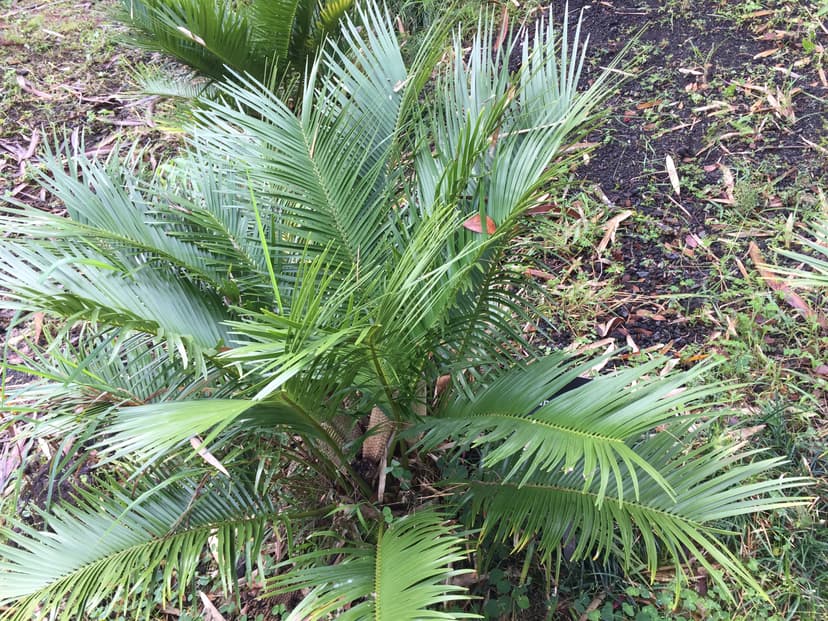
Zamia inermis
Zamia inermis is a critically endangered cycad species native to Actopan, Veracruz, Mexico. It is characterized by its shrub-like growth, with a trunk that can be branched and upright leaves composed of numerous linear-lanceolate leaflets. This species is dioecious and faces significant threats from habitat loss, wildfires, and over-harvesting.

Encephalartos dolomiticus
Encephalartos dolomiticus, commonly known as the Wolkberg cycad, is a critically endangered cycad species native to the Wolkberg region of South Africa. This tree-like cycad typically grows up to 2 meters tall and is characterized by its distinctive bluish leaves forming a crown, with lance-shaped leaflets arranged oppositely along the rachis. It is a dioecious species, producing separate male and female cones.