
Zamia dressleri
Zamia dressleri is a species of cycad native to Eastern Panama, thriving in rainforest environments. This species is distinguished by its subterranean stem and large, compound leaves, each bearing numerous toothed leaflets. Its reproductive structures include cylindrical male cones and ovoid, wine-red female cones, with the seeds also being red.
Key Facts
- ›Endemic to Eastern Panama, found in Colón Province and Guna Yala.
- ›Possesses a subterranean stem that is typically 3 to 5 cm in diameter.
- ›Leaves can reach lengths of 0.5 to 1.5 meters, with petioles covered in prickles.
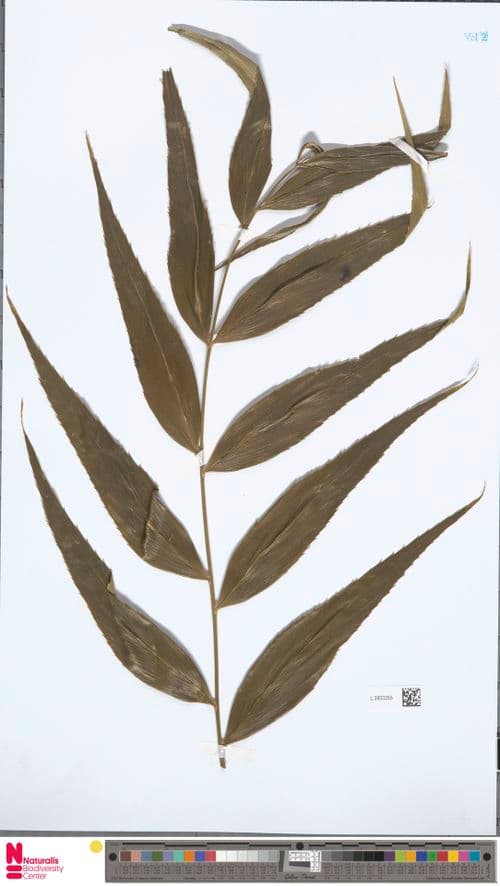
- ›Leaflets are elliptical, toothed on the outer edges, and can be up to 50 cm long.
- ›Dioecious, with distinct male and female plants bearing differently colored cones.
- ›Female cones are ovoid-cylindrical and wine-red to dark red-brown.

Eastern Panama
- Subterranean
- 3 to 5 centimetres in diameter
- Stem apex usually has one compound-leaf, though up to three may occur
- Leaves are 0.5 to 1.5 metres long
- Petiole is 0.3 to 1 metre long
- Petiole is sparsely to densely covered with prickles
- Two to five pairs of leaflets on the rachis
- Leaflets are elliptical, cuneate at the base and pointed at the apex
- Outer third of the leaflet edges are toothed
- Leaflets on the middle of the leaf are 30 to 50 centimetres long and 12 to 15 centimetres wide
- Male strobili are cylindrical to elongate-cylindrical, 5 to 8 centimetres long, 1 to 2 centimetres in diameter, and cream to tan in color.
- Female strobili are ovoid-cylindrical, 10 to 15 centimetres long, 3 to 4 centimetres in diameter, and wine-red to dark red-brown in color.
- Female strobili stand on short peduncles.
Ovoid, 1 To 1.5 Centimetres In Diameter, Red In Color
About Zamia dressleri
Zamia dressleri is a species of cycad indigenous to Eastern Panama, where it is found in rainforest habitats. Its distribution is restricted to two small populations located in Colón Province and the comarca indígena of Guna Yala, making it an endemic species to this region.
Botanical Description
The most striking characteristic of Zamia dressleri is its subterranean stem, which typically measures between 3 to 5 centimeters in diameter. Emerging from this stem is usually a single, compound leaf, although up to three can sometimes be present. These leaves are substantial, ranging from 0.5 to 1.5 meters in length, supported by a petiole that can be anywhere from 0.3 to 1 meter long. The petiole is often adorned with prickles, as may be the lower third of the leaf's central axis (rachis). The leaves bear two to five pairs of leaflets, which are elliptical in shape, tapering to a wedge at the base and pointed at the apex. A notable feature of the leaflets is that their outer edges are toothed. The central leaflets can be quite large, measuring 30 to 50 centimeters long and 12 to 15 centimeters wide.
Reproduction
As with all cycads, Zamia dressleri is dioecious, meaning individual plants are either male or female. The reproductive structures, known as strobili or cones, differ significantly between the sexes. Male strobili are cylindrical to elongated-cylindrical, measuring 5 to 8 centimeters in length and 1 to 2 centimeters in diameter, and are typically cream to tan in color. Female strobili are ovoid-cylindrical and larger, ranging from 10 to 15 centimeters in length and 3 to 4 centimeters in diameter. These female cones are distinctively colored wine-red to dark red-brown and are borne on short stalks. The seeds of Zamia dressleri are also ovoid, approximately 1 to 1.5 centimeters in diameter, and are red in color.
Source: Wikipedia ↗
Frequently Asked Questions
What are the defining physical characteristics of Zamia dressleri?
Zamia dressleri is characterized by its subterranean stem, typically measuring 3 to 5 cm in diameter. Its compound leaves are substantial, ranging from 0.5 to 1.5 meters in length, featuring a petiole that may be sparsely to densely covered in prickles. The leaflets are elliptical, toothed along their outer edges, and can grow to be quite large.
Where is Zamia dressleri found naturally?
This species is endemic to Eastern Panama, specifically occurring in two small, distinct populations. These populations are located in Colón Province and within the comarca indígena of Guna Yala.
What do the reproductive cones of Zamia dressleri look like?
Zamia dressleri is dioecious, meaning it has separate male and female plants. The male cones are cylindrical to elongate-cylindrical, cream to tan in color, and relatively small. Female cones are ovoid-cylindrical, larger than the male cones, and distinctively colored wine-red to dark red-brown.
What is the origin of the name Zamia dressleri?
The specific epithet 'dressleri' honors Robert Louis Dressler. Dressler was a botanist who conducted significant work in Panama and was the first to identify this plant as a species distinct from other Zamias.
How large can the leaves and leaflets of Zamia dressleri grow?
The leaves of Zamia dressleri can grow to be between 0.5 to 1.5 meters in length, with petioles ranging from 0.3 to 1 meter long. The leaflets, particularly those in the middle of the leaf, are substantial, measuring 30 to 50 centimeters in length and 12 to 15 centimeters in width.
Related Cycad species

Cycas bifida
Cycas bifida is a distinctive cycad species native to southern China and northern Vietnam, found in mixed deciduous forests and bamboo woodlands, often near limestone outcroppings. It is characterized by its bipinnate leaves, where each leaflet is further dichotomously divided, a feature reflected in its scientific name. Due to its habitat in remote and sometimes hazardous border regions, and the establishment of nature reserves, populations are protected, though the species is rarely encountered in cultivation.
Zamia restrepoi
Zamia restrepoi is a species of cycad native to Panama and Colombia, found in rainforests and disturbed habitats. It is characterized by its subterranean stem, large compound leaves with toothed leaflets, and a critically endangered conservation status due to severe habitat loss. The species was originally described as Chigua restrepoi before being reclassified into the genus Zamia.

Cycas angulata
Cycas angulata is the largest Australian species of cycad, distinguished by its tall, often branched stems and numerous grey-green to glaucous leaves reaching up to 1.7 meters in length. Native to the Northern Territory and northwest Queensland, it is occasionally cultivated as an ornamental plant and its seeds were historically used as a food source by Aboriginal Australians after careful detoxification.